Pokémon Vending Machine Placement Agreement: Complete 2026 Guide
Meta Description: Learn what a Pokémon vending machine placement agreement should include, from revenue share and machine ownership to insurance, access, termination, and legal terms.
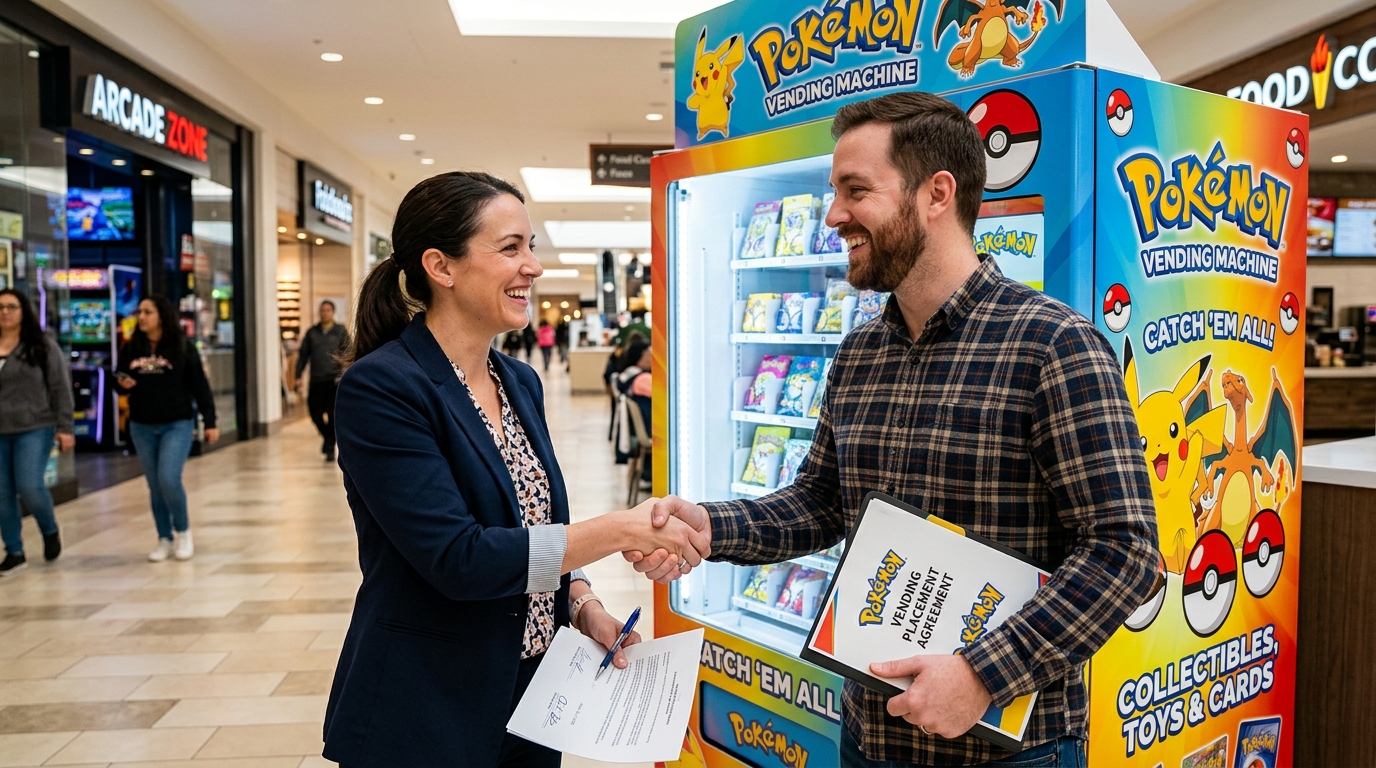
A Pokémon vending machine placement agreement is a written contract between the vending machine operator and the property or business owner that authorizes the machine’s installation and defines the rights and responsibilities of both parties. A strong agreement should address machine ownership, placement location, term, revenue sharing, access, electricity, maintenance, insurance, liability, exclusivity, termination, and machine removal.
The first distinction matters: an independent operator using a third-party TCG vending machine is not the same as operating an official Pokémon Automated Retail vending machine. The Pokémon Company International states that its official machines are currently owned and operated by the company and are not available for purchase. (Pokémon Center Support)
This guide focuses on independent Pokémon/TCG vending machine placements, where an operator owns or leases a machine and obtains permission to install it at a third-party location.
Read the complete 2026 Pokémon card vending machine operator guide
What Is a Pokémon Vending Machine Placement Agreement?
A Pokémon vending machine placement agreement is a contract that gives an operator permission to install and operate a vending machine at a specific property while establishing the commercial terms between the operator and location owner.
The agreement is more than permission to put a machine in a corner. It determines who owns the machine, who receives sales commissions, who supplies electricity, who handles repairs, who carries insurance, when the operator can access the machine, and what happens when either party wants to end the relationship.
For an independent operator, the agreement should be signed before installation, not after the machine is already generating sales.
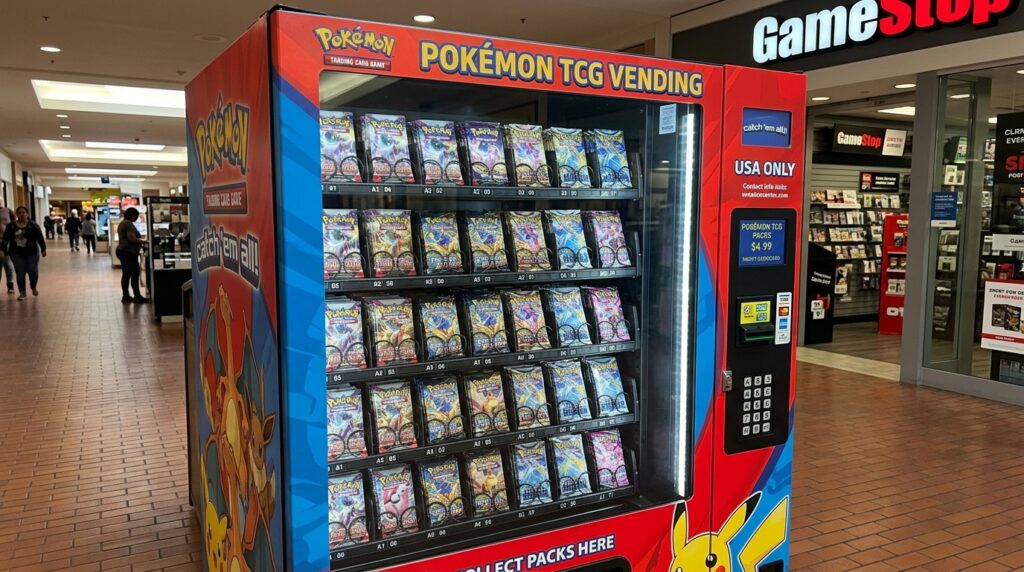
Official Pokémon Machines vs. Independent TCG Machines
The distinction between an official Pokémon machine and an independent Pokémon-themed or TCG vending machine is critical.
| Factor | Official Pokémon Automated Retail Machine | Independent TCG/Pokémon Product Machine |
|---|---|---|
| Machine ownership | The Pokémon Company International | Operator or financing company |
| Available for individual purchase? | No, according to Pokémon Center | Yes, depending on manufacturer |
| Placement relationship | Established by Pokémon’s automated retail program | Negotiated directly with property/location |
| Product sourcing | Pokémon’s automated retail supply chain | Operator’s lawful inventory source |
| Placement agreement | Between relevant program/location parties | Operator and host location |
| Branding | Official Pokémon branding | Must be handled carefully under trademark rules |
| Maintenance | Official program/operator | Usually independent operator |
Pokémon Center states that its official automated retail machines are owned and operated by The Pokémon Company International and that there are currently no plans to sell them. (Pokémon Center Support)
The official Pokémon vending machine locator is therefore useful for identifying official machines, but it should not be confused with a marketplace for privately operated machines. (Pokémon Vending Machine Locator)
Learn how Pokémon vending machines work
What Should a Pokémon Vending Machine Placement Agreement Include?
A well-written agreement should remove ambiguity before the machine enters the property. The most important provisions are machine ownership, location, compensation, access, maintenance, insurance, liability, term, termination, and removal.
1. Parties and Property Information
Identify both parties using their complete legal names and include the exact property where the machine will operate.
The agreement should specify:
- Operator’s legal business name
- Property owner’s or host company’s legal name
- Property address
- Specific machine location within the property
- Contact information for operational notices
- Names and titles of authorized representatives
If the property has multiple locations, avoid vague language such as “the host’s premises.” Identify the exact site covered by the agreement.
2. Machine Ownership
The contract should explicitly establish who owns the machine.
For an independent vending operation, a useful provision states that the machine remains the property of the operator, even though it is physically located inside another business.
This becomes particularly important if the host business changes ownership, experiences financial problems, relocates, or terminates the agreement.
The contract should also address whether the host may:
- Move the machine
- Modify the machine
- Attach signage
- Disconnect power
- Allow another party to service it
- Use the machine as collateral
- Prevent the operator from removing it after termination
A clear ownership clause prevents disagreements when the business relationship ends.
3. Exact Placement Area
The agreement should identify where the machine will physically sit.
Ideally, document the location using a floor plan, photograph, or specific description such as:
Main entrance lobby, approximately six feet from the customer entrance and adjacent to the designated retail display area.
The location matters because visibility, customer flow, security, and accessibility directly affect vending performance.
A machine hidden behind merchandise may technically have a placement but still be commercially worthless.
4. Term and Renewal
Specify exactly how long the placement agreement lasts.
Common structures include:
| Agreement Structure | Best Use |
|---|---|
| 30–90 day trial | Testing an unproven location |
| 6 months | Short-term commercial placement |
| 12 months | Standard ongoing relationship |
| 12 months + renewal | Long-term route building |
| Month-to-month after initial term | Flexible continuation |
A trial period can reduce resistance from a location owner because the host does not have to make a long-term commitment before seeing how the machine performs.
The agreement should state whether renewal happens automatically or requires written consent.
5. Revenue Share or Fixed Rent
The compensation model is one of the most important parts of a vending machine placement agreement.
The host may receive:
- A percentage of gross sales
- A percentage of net sales
- A fixed monthly placement fee
- A hybrid of fixed rent and revenue share
Industry placement guides commonly discuss revenue-sharing arrangements, but there is no universal legally required percentage. The appropriate commercial rate depends on location quality, traffic, machine economics, competition, and negotiating leverage. (Digital Media Vending International)
Define exactly what the percentage applies to.
For example:
Host shall receive 10% of Gross Machine Sales generated during each calendar month.
Then define Gross Machine Sales rather than leaving the phrase open to interpretation.
The agreement should also explain:
- Payment frequency
- Payment method
- Sales reporting method
- Treatment of refunds
- Treatment of sales tax
- Chargebacks
- Discounts
- Failed transactions
- Payment processing fees
Revenue Share vs. Fixed Rent
| Model | Operator Advantage | Host Advantage | Best Situation |
|---|---|---|---|
| Revenue share | Lower downside when sales are weak | Income increases with sales | New/unproven location |
| Fixed monthly fee | Predictable operating cost | Predictable income | Proven high-volume site |
| Hybrid | Balances both models | Minimum income + upside | Premium commercial site |
The most important calculation is not the percentage itself. It is whether the placement remains profitable after product cost, payment processing, host compensation, insurance, maintenance, travel, taxes, and other operating expenses.
6. Electricity and Utilities
A Pokémon or TCG vending machine requires electricity, so the agreement should specify who provides it.
State:
- Outlet location
- Required electrical service
- Whether electricity is included
- Whether the operator pays a utility contribution
- Who pays for electrical modifications
- What happens during an extended power outage
Do not assume the host will provide electricity indefinitely simply because they agreed to the placement.
7. Restocking and Maintenance
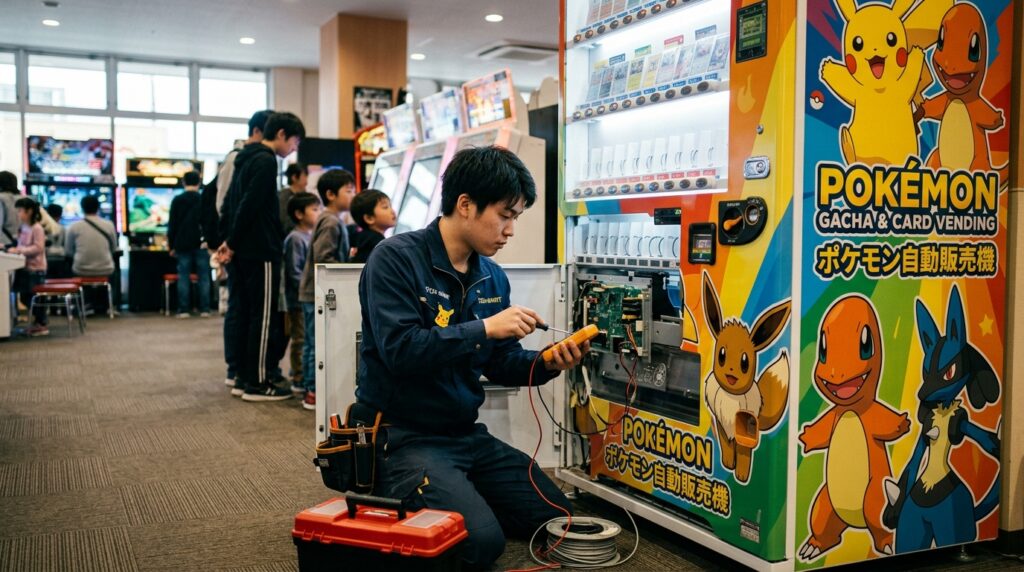
The operator should normally be responsible for keeping the machine operational and stocked unless the agreement says otherwise.
The contract should cover:
- Product restocking
- Machine cleaning
- Preventive maintenance
- Repairs
- Payment terminal problems
- Software issues
- Product jams
- Emergency service
- Replacement parts
- Response procedures
A location owner should not become responsible for fixing an unattended retail machine they do not own.
See the Pokémon vending machine maintenance guide
8. Operator Access
The operator needs reasonable access to the machine for inventory management and service.
Specify:
- Normal service hours
- Advance notice requirements
- Emergency access
- Holiday access
- Who receives access credentials
- Whether the operator may access the machine without host supervision
A contract that provides no practical access rights can create operational problems even when the placement itself is profitable.
9. Insurance and Liability
Insurance requirements should be agreed before installation.
A commercial host may request a Certificate of Insurance (COI) and may require the host to be listed as an additional insured under the operator’s policy.
The agreement should identify:
- General liability insurance
- Product liability coverage where applicable
- Property damage responsibility
- Damage caused by vandalism
- Customer injury claims
- Machine damage
- Insurance certificate requirements
- Indemnification obligations
Insurance requirements are contractual and location-specific, so the agreement should not simply insert an arbitrary coverage amount without confirming what the property owner and insurer actually require.
10. Damage, Theft and Vandalism
TCG products can have significant resale value, making physical security particularly relevant.
The agreement should establish who bears responsibility when:
- The machine is vandalized
- The machine is stolen
- Product is stolen
- The property suffers damage
- A customer damages the machine
- The machine causes damage to the property
Do not leave “damage” as a single undefined term. Separate operator-caused damage, host-caused damage, customer damage, ordinary wear, theft, and force majeure events where appropriate.
11. Exclusivity
An exclusivity clause can prevent the host from installing another competing machine during the agreement.
For example, the agreement might restrict the host from permitting another vending machine selling substantially similar TCG products in the same premises.
However, exclusivity should be carefully drafted. A clause covering “all vending” could unintentionally prevent the host from operating unrelated snack, beverage, or other vending equipment.
Define the protected category narrowly.
12. Product and Branding Rules
The agreement should identify what products the machine may sell and who is responsible for sourcing them.
This is especially important with Pokémon products because Pokémon is a protected brand and trademark rights are separate from the right to resell genuine products.
The USPTO explains that trademarks identify the source of goods or services and provide legal protection for brands. (USPTO)
Do not assume that purchasing genuine Pokémon cards automatically gives you permission to manufacture a machine covered in Pokémon logos or represent your business as an official Pokémon-operated vending program.
For independent operators, branding should be reviewed separately from product resale.
Read more about Pokémon logo use on TCG vending machines
Read about legally selling Pokémon products through vending machines
Pokémon Vending Machine Placement Agreement: Key Terms at a Glance
A strong contract should answer every practical question before the machine is installed.
| Contract Term | What It Should Establish |
|---|---|
| Parties | Legal identity of operator and host |
| Premises | Exact property and machine location |
| Machine ownership | Who legally owns the equipment |
| Products | What may be sold |
| Term | Start and end dates |
| Renewal | How continuation occurs |
| Compensation | Revenue share or fixed rent |
| Sales definition | Gross/net calculation |
| Payment | Timing and method |
| Electricity | Who supplies and pays for power |
| Access | When operator may service machine |
| Maintenance | Responsible party |
| Restocking | Inventory responsibility |
| Insurance | Required coverage and documentation |
| Liability | Responsibility for injury/damage |
| Security | Theft and vandalism responsibilities |
| Exclusivity | Whether competing machines are restricted |
| Termination | How either party can end agreement |
| Removal | Deadline and process for removing machine |
| Disputes | Governing law and dispute process |
How to Negotiate a Pokémon Vending Machine Placement Agreement
Negotiation should begin with the location’s economics rather than an arbitrary commission percentage.
Start With the Value to the Location
A strong pitch explains what the host receives:
- Additional customer amenity
- Potential recurring income
- No need for employees to operate the machine
- Operator-managed inventory
- Automated payments
- Regular maintenance
- A collectible retail attraction
For example, a hobby store may value the machine because it expands product availability without requiring additional counter space or employee checkout time.
A mall or entertainment center may instead care about customer engagement, appearance, security, and incremental revenue.
Use a Trial Period for Unproven Locations
If neither party knows how the machine will perform, a 60–90 day trial can reduce risk.
During the trial, track:
- Gross sales
- Transactions
- Average transaction value
- Product sell-through
- Stockouts
- Peak sales periods
- Customer complaints
- Maintenance events
At the end of the trial, both parties have actual data rather than assumptions.
Never Negotiate From Gross Sales Alone
Suppose a machine generates $5,000 in monthly sales.
That does not mean the operator earns $5,000.
The operator may still pay for:
Product inventory + host commission + payment processing + insurance + maintenance + travel + taxes + machine financing + shrinkage.
The placement agreement should therefore be evaluated using the machine’s actual contribution margin.
Frequently Asked Questions
What is a Pokemon vending machine placement agreement?
It is a written contract between an operator and a property owner that defines the exact placement spot, the revenue share or flat fee structure, the term length, access rights, liability responsibilities, and how the arrangement can be terminated.
What commission rate is standard for vending machine placement?
Standard commission rates generally range from 5% to 25% of monthly revenue, with the exact figure depending on foot traffic, venue type, and how much the location itself contributes to sales.
Should a placement agreement use revenue share or a flat fee?
Revenue share aligns incentives and lowers risk if the location underperforms, while a flat fee is simpler and more predictable for both sides. The right choice depends on how confident both parties are in expected sales volume.
How long is a typical vending machine placement term?
A typical initial term runs one to three years with automatic renewal unless either party gives written notice, commonly 60 to 90 days ahead of the renewal date.
Do I need an exclusivity clause for a card vending machine?
It is strongly recommended. Language preventing a competing card vending machine within a defined distance protects the investment in a niche category where a second machine could meaningfully split demand.
Who owns the machine and inventory in a placement agreement?
In nearly every arrangement the operator owns the equipment and inventory outright, but the agreement should state this explicitly to avoid confusion if the relationship ends and the machine needs to be removed.
Who is liable if a customer is injured using the machine?
Liability responsibilities almost always default to the operator, but the agreement should state this clearly rather than leaving it implied, since ambiguity here is what turns an incident into a drawn-out dispute.
What happens to the machine if the agreement is terminated?
The equipment belongs to the operator regardless of who terminates the agreement, and the contract should define a specific notice period and removal window so neither party is left in an open-ended standoff.
Should the agreement be signed by an individual or a business entity?
A business entity, not an individual. Signing as a sole proprietor exposes personal assets to any liability the placement creates, which is why most operators form an LLC before entering location agreements.
Is a verbal agreement enough to place a vending machine at a location?
No. A verbal understanding is not a substitute for a written agreement, because disputes over commission percentages, repair responsibility, or removal notice are far harder to resolve once the machine is already generating revenue.