Soda Vending Machine Legal Requirements: A Complete Compliance Guide
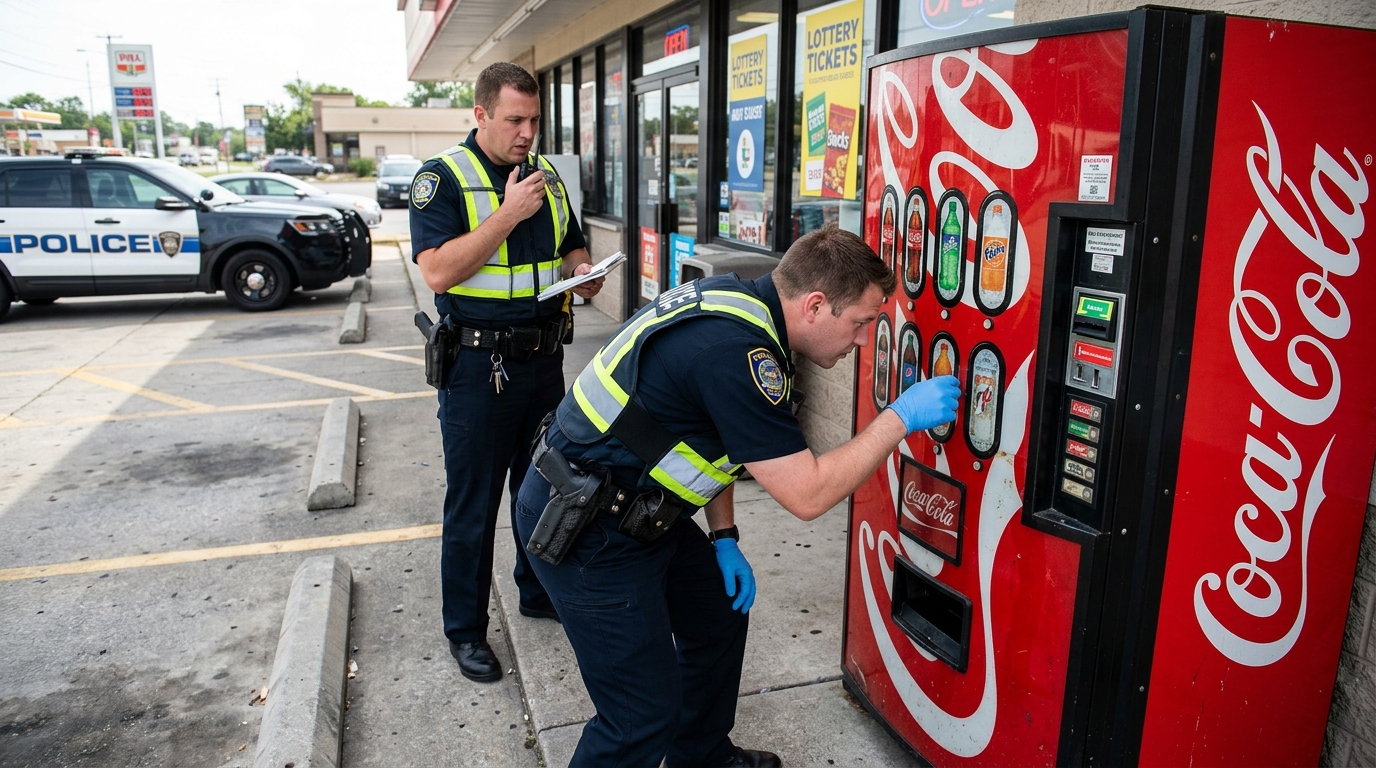
Soda vending machine legal requirements span at least five separate layers of government, including a state seller’s permit, possible per-machine registration, standard sales tax, a sugar-sweetened beverage tax in a growing number of cities, and federal calorie labeling once an operator crosses 20 machines. Missing any one of these does not just risk a fine; several states treat an unregistered vending machine as grounds for confiscation. This guide walks through every requirement that actually applies to a soda machine specifically, where the rules vary most by state, and how to structure the business so one compliance gap doesn’t expose personal assets.
Quick takeaways
Every state requires some form of seller’s permit or sales tax registration before a soda machine can legally operate.
Seven U.S. localities currently tax sugar-sweetened beverages, and machines inside those city limits must collect and remit it.
Ten states plus Guam require a bottle deposit on beverage containers, which changes the vend price and the operator’s reporting duties.
Calorie labeling is a federal requirement only once an operator owns or operates 20 or more machines.
What Legal Requirements Apply to a Soda Vending Machine
A soda vending machine is legally treated as a retail point of sale, which means it triggers the same category of obligations a storefront would, plus several rules written specifically for unattended equipment. At minimum, an operator needs a state seller’s permit or sales tax registration, compliance with any applicable sugar-sweetened beverage tax where the machine sits, adherence to bottle deposit law if the state has one, and a business structure that separates personal liability from the equipment itself. Federal requirements layer on top of state and local ones once an operator’s fleet crosses specific size thresholds, most notably the FDA’s calorie labeling rule at 20 machines.
Business Licensing and Registration
There is no single federal vending machine license. Instead, operators assemble compliance from state, county, and city layers, and the combination looks different in nearly every jurisdiction, according to Wendor’s 2026 state-by-state vending license guide.
State Seller’s Permits and Sales Tax Registration
A state seller’s permit, sometimes called a resale certificate or sales tax license, is the baseline requirement almost every state imposes before a machine can legally dispense a paid product. Illinois requires operators to register as retailers with the Illinois Department of Revenue and remit Retailers’ Occupation Tax, a process handled through Form REG-1 on the state’s MyTax Illinois portal, per VendSoft’s Illinois vending law summary. Colorado takes a similar approach, requiring a Colorado Sales Tax License from the Department of Revenue before any machine goes live.
Per-Machine Decals and Registration
Several states require a physical identification decal on every individual machine, not just a business-level permit. Texas mandates annual machine registration with visible decals in addition to a sales tax permit, and Illinois issues machine-specific decals through Form STS-80. Massachusetts goes further, requiring a distinct, non-transferable license for each individual vending machine rather than a single business-wide permit, according to DFY Vending’s state-by-state permit and licensing guide. California sits at the opposite end: a single seller’s permit covers every machine an operator runs statewide, regardless of count.
Local and Municipal Business Licenses
A state-level permit rarely covers every jurisdiction an operator’s machines sit in. Home rule states, including Colorado and Texas, allow individual cities to layer on additional licensing and tax requirements beyond the state baseline, which means a state sales tax license alone does not guarantee compliance inside Denver, Austin, or any other home rule municipality with its own rules. Confirming city-level requirements before installation avoids the more common compliance gap operators run into: assuming a state permit is sufficient everywhere the business operates.
Sales Tax on Vended Soda
How Vending Sales Tax Differs From Retail
Sales tax on a vended soda works differently from a storefront in one important respect: there’s no cash register itemizing the tax separately at checkout, so most states require the tax to be baked into the posted vend price rather than added on top. Texas requires operators to collect 6.25% state sales tax plus up to 2% in local sales tax depending on the machine’s location, with a separate sales tax permit required for each distinct location an operator runs machines in, per VendSoft’s Texas vending law breakdown.
State-by-State Rate Variation
Sales tax rates on vended beverages vary not just by state but sometimes by product category within the same state, since some jurisdictions tax vended food differently than vended beverages, or apply a reduced rate to items under a certain price point. There is no substitute for confirming the current rate and category treatment directly with the state department of revenue before setting a machine’s price points, since guessing wrong compounds into back-tax liability the longer a machine runs unregistered.
Sugar-Sweetened Beverage Taxes
Which Jurisdictions Currently Tax Soda
Seven U.S. localities currently levy a tax specifically on sugar-sweetened beverages: Berkeley, San Francisco, Oakland, and Albany in California, plus Boulder, Colorado, Seattle, Washington, and Philadelphia, Pennsylvania, according to the Tax Policy Center’s overview of state and local soda taxes. Philadelphia’s version is broader than the others, since it taxes all sweetened drinks including diet soda, not just those with added sugar. No state currently levies a statewide soda tax, though the Tax Foundation notes that Connecticut, Hawaii, New York, and Washington have each considered statewide versions in recent legislative sessions, per the Tax Foundation’s tracking of state sugar tax proposals. Boulder currently applies the highest rate in the country at 2 cents per ounce.
How Soda Taxes Apply to Vending Machines Specifically
Where a soda tax exists, it typically applies at the distributor level first and gets passed through into the shelf or vend price, which means an operator placing machines inside a taxed city needs the tax reflected in the posted price rather than collected separately at the point of sale. San Francisco’s ordinance defines a sugar-sweetened beverage as any nonalcoholic drink with more than 25 calories per 12 fluid ounces of added caloric sweetener, and explicitly extends the tax to syrups and powders used in beverage-dispensing equipment, according to the San Francisco Treasurer and Tax Collector’s sugary drinks tax page, which closes the loophole some fountain-style vending formats might otherwise rely on.
State Preemption Laws
Four states, Arizona, California, Michigan, and Washington, have passed laws preempting any new local government from creating its own soda tax, according to research published in a peer-reviewed analysis in the National Library of Medicine’s PMC archive. Existing taxes in the four California cities and Seattle were allowed to remain in effect under those preemption laws, so operators in those specific cities still owe the tax even though no new California locality can introduce one. This distinction matters for an operator scouting new locations: a preemption law blocks future taxes, but it does not retroactively remove ones already on the books.
Bottle Deposit and Container Redemption Laws
States With Deposit Requirements
Ten states plus Guam currently operate a beverage container deposit system, commonly called a bottle bill, according to the National Conference of State Legislatures’ survey of state beverage container deposit laws. California’s version charges consumers a 5-cent deposit on containers under 24 ounces and 10 cents on containers 24 ounces or larger, refundable when the empty container is returned to a certified redemption center.
Operator Obligations Under Bottle Bills
In a deposit state, the deposit is built into the price the distributor charges for each container, which the vending operator then passes through to the consumer in the vend price. The operator generally isn’t responsible for accepting returned containers back through the machine itself, since that obligation typically falls on retailers and dedicated redemption centers rather than vending equipment, but the deposit still has to appear in the posted price and in the operator’s own tax and revenue records. Operating machines in a deposit state without reflecting the deposit in pricing risks both a consumer-facing pricing violation and a mismatch in the operator’s own sales tax filings, since the deposit itself is typically treated differently from taxable sale revenue.
FDA Calorie Labeling Requirements
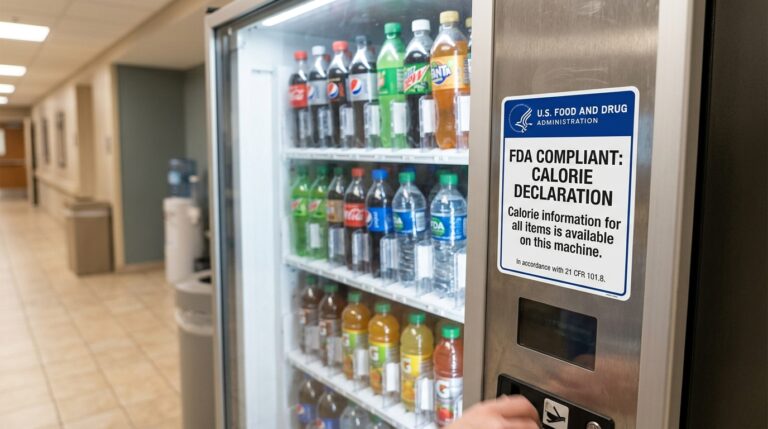
Calorie labeling on vended soda becomes a federal requirement once an operator owns or operates 20 or more vending machines, under the FDA’s vending machine labeling final rule issued pursuant to Section 4205 of the Affordable Care Act, per the FDA’s official vending machine labeling requirements page. Covered operators must disclose calorie information at the point of purchase, either through a sign next to the selection button or front-of-package labeling visible through a glass-front cabinet, with a compliance date of December 1, 2016 for most provisions. Operators below the 20-machine threshold aren’t required to comply but can voluntarily register using FDA Form 3757 if they choose to disclose calories anyway.
Health Department and Food Safety Permits
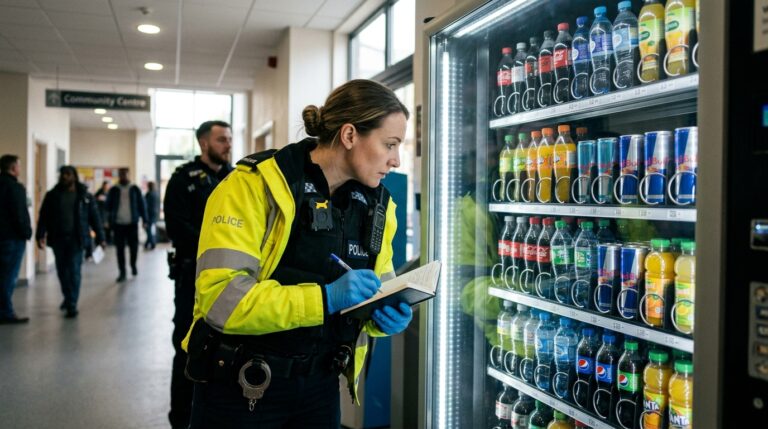
Refrigerated beverage machines fall under state and local food codes even though they’re unattended, because the products inside are still classified as food for regulatory purposes. Most states have adopted some version of the FDA Food Code as their baseline standard, with Texas explicitly requiring compliance with the 2017 FDA Food Code for food vending operations and Illinois having adopted the 2022 FDA Food Code for uniformity across its jurisdictions. In practice, this means a county or municipal health department, not just the state revenue agency, has independent authority to inspect vending locations and cite an operator for sanitation or temperature-control violations regardless of whether the sales tax and licensing paperwork is otherwise in order.
ADA and Electrical Code Compliance
ADA Reach Range and Clear Floor Space
Any soda machine bolted or secured to a building counts as a fixed element subject to ADA accessibility rules. Under the 2010 ADA Standards, every operable part, including selection buttons, the card reader, and the product delivery bin, must sit no higher than 48 inches and no lower than 15 inches above the floor, per the U.S. Access Board’s guide to operable parts, with a minimum 30-by-48-inch clear floor space maintained in front of the machine.
Electrical and GFCI Requirements
Every vending machine, regardless of how it connects to power, requires ground-fault circuit interrupter protection under NEC Section 422.5 and the corresponding branch-circuit rule at 210.8(D), a requirement extended to hardwired units by the 2014 National Electrical Code. This is a code compliance issue distinct from the licensing and tax obligations above, and it’s typically enforced by a building or electrical inspector rather than a revenue agency, but a machine installed without proper GFCI protection can still trigger a citation independent of whether every other requirement has been met.
Location Agreements and Contracts
A written location agreement is not always legally mandatory, but operating without one leaves both the operator and the property owner exposed on questions a verbal handshake never answers clearly: who pays for machine removal if the relationship ends, whether the property owner receives a commission, who’s liable if the machine causes property damage, and what happens if the location changes ownership. A solid agreement covers term length, commission structure if any, insurance and liability allocation, and a clear removal or renewal process, ideally reviewed against the specific vending, sales tax, and food-safety obligations already covered above so the contract doesn’t promise something the operator can’t legally deliver.
Property owners who would rather not deal with any of the compliance layers above have an alternative: hosting a machine supplied and operated by a managed vending provider that assumes these obligations directly, rather than owning the equipment themselves.
Own the Space, Not the Compliance Burden?
List your location and get matched with a qualified operator who supplies, stocks, and stays compliant on the machine itself.
List Your Location for Free PlacementChoosing a Business Structure for Liability Protection
None of the licensing and tax compliance above protects an operator’s personal assets from a lawsuit, which is a separate question answered entirely by business structure. A sole proprietorship leaves the owner personally liable for anything tied to the machines, from a product-related injury claim to an unpaid vendor invoice, since the business and the individual are legally the same entity. An LLC, by contrast, creates a legal separation between the business’s liabilities and the owner’s personal assets, which is why it’s the default structure most vending operators choose once they’re running more than a single machine on a handshake basis.
Beyond the entity itself, an EIN and, in most states, active sales tax registration are the two pieces of paperwork operators most often let lapse, since vending sales are taxable retail transactions in the large majority of jurisdictions even though no cashier is present to collect the tax manually. Getting the entity, EIN, and tax registration in place before the first machine goes live avoids retrofitting compliance after a state notice arrives asking why months of vending revenue were never reported.
Ready to formalize your vending operation?
Set up the right entity and liability protection before your first location agreement is signed.
Form an LLC for a Vending Machine BusinessMulti-State Compliance
An operator running machines across state lines is effectively running several separate compliance programs at once, since a permit, decal, or tax registration valid in one state carries no weight in another. Texas requires a registered agent and office within the state for any business entity operating there, and foreign entities, meaning businesses formed in another state, must register before conducting business at all. This registered-agent requirement isn’t unique to Texas; most states impose some version of it on out-of-state entities, which means an operator expanding into a second or third state typically needs a registered agent in each new jurisdiction before the first machine can legally go live there.
Single-Permit States: Pros
Lower administrative overhead for operators with many machines.
One registration to track and renew instead of dozens.
Simpler expansion within the state’s borders.
Per-Machine States: Cons
Every new machine adds a discrete compliance step, not just a delivery.
Decals must be tracked, renewed, and physically applied per unit.
Higher risk of an individual machine falling out of compliance unnoticed.
Compliance Checklist Before Placing Your First Machine
Confirm the state seller’s permit or sales tax registration is active before signing any location agreement, then check whether that state also requires per-machine decals or registration on top of the business-level permit. Verify whether the installation city or county levies a sugar-sweetened beverage tax or a bottle deposit, since both change the vend price calculation before the machine ever ships. Confirm the entity is formed, the EIN is issued, and liability coverage is in place, and only then move to the physical requirements: ADA reach range, GFCI-protected electrical circuit, and any local health department registration for refrigerated food equipment. Once the location is confirmed and sized correctly, our drink vending machine capacity guide and dimensions guide help match the right unit to the space, and our pricing guide covers what to budget once compliance costs are factored in.
For office-specific installations, our guides on drink vending machines for offices and where to place one inside an office cover the placement side once the legal groundwork above is settled, and our broader placement guide across facility types is worth a look before approaching any new location. Once the machine is running, our walkthroughs on how to use a drink vending machine and freeing a stuck drink handle the operational side, while our guide to finding drink vending machines near you is useful reference for the consumer side of the same market.
Compliant and Ready to Equip a Location?
Browse ready-to-ship drink vending machines or configure a custom unit for your route.
Frequently Asked Questions