Drink Vending Machine FDA Regulations: What Operators Need to Know
The primary FDA regulation affecting drink vending machines is the vending machine calorie labeling rule, which requires operators who own or operate 20 or more vending machines to disclose calorie information for beverages and food sold from those machines, unless the machine already displays visible nutrition information at the point of purchase. This rule, implemented under the Affordable Care Act, applies to beverages the same way it applies to snacks, since both fall under the FD&C Act’s definition of food requiring nutrition disclosure. This guide breaks down exactly who the rule applies to, how compliance works in practice, and what falls under FDA authority versus state and local food safety oversight.
Not legal advice. This article explains general FDA regulatory requirements as of this writing. Federal rules can be updated, and specific compliance obligations should be confirmed directly through FDA guidance or with a food regulatory attorney before making business decisions.
Quick Answer: Does the FDA Regulate Drink Vending Machines?
Yes, but narrowly: FDA’s specific vending machine rule addresses calorie disclosure rather than general licensing or operational requirements, which remain governed by state and local authorities. An operator running fewer than 20 machines generally falls outside the mandatory federal requirement entirely, though smaller operators can voluntarily register with FDA to be covered by the same standardized rule if they choose.
The FDA Vending Machine Calorie Labeling Rule
The Food Labeling: Calorie Labeling of Articles of Food in Vending Machines final rule, published in the Federal Register in December 2014, implements a provision of the Affordable Care Act requiring calorie disclosure at the point of purchase for vended food and beverages.
Who the Rule Applies To
The rule applies to any person or company that owns or operates 20 or more vending machines, a threshold set at the business level rather than per location, meaning an operator’s total machine count across every site combined determines coverage.
Exemptions and Voluntary Registration
Machines that already display visible nutrition information at the point of purchase, such as a Nutrition Facts panel clearly readable before purchase, are generally exempt from the additional calorie disclosure requirement, since the rule’s purpose is ensuring buyers have calorie information available, not duplicating information already visible. Operators running fewer than 20 machines can voluntarily register with FDA using the designated registration form to opt into the same standardized requirements, an option some smaller operators choose for consistency across a growing operation.
How Calorie Information Must Be Displayed
Vending Machines Without Visible Nutrition Info
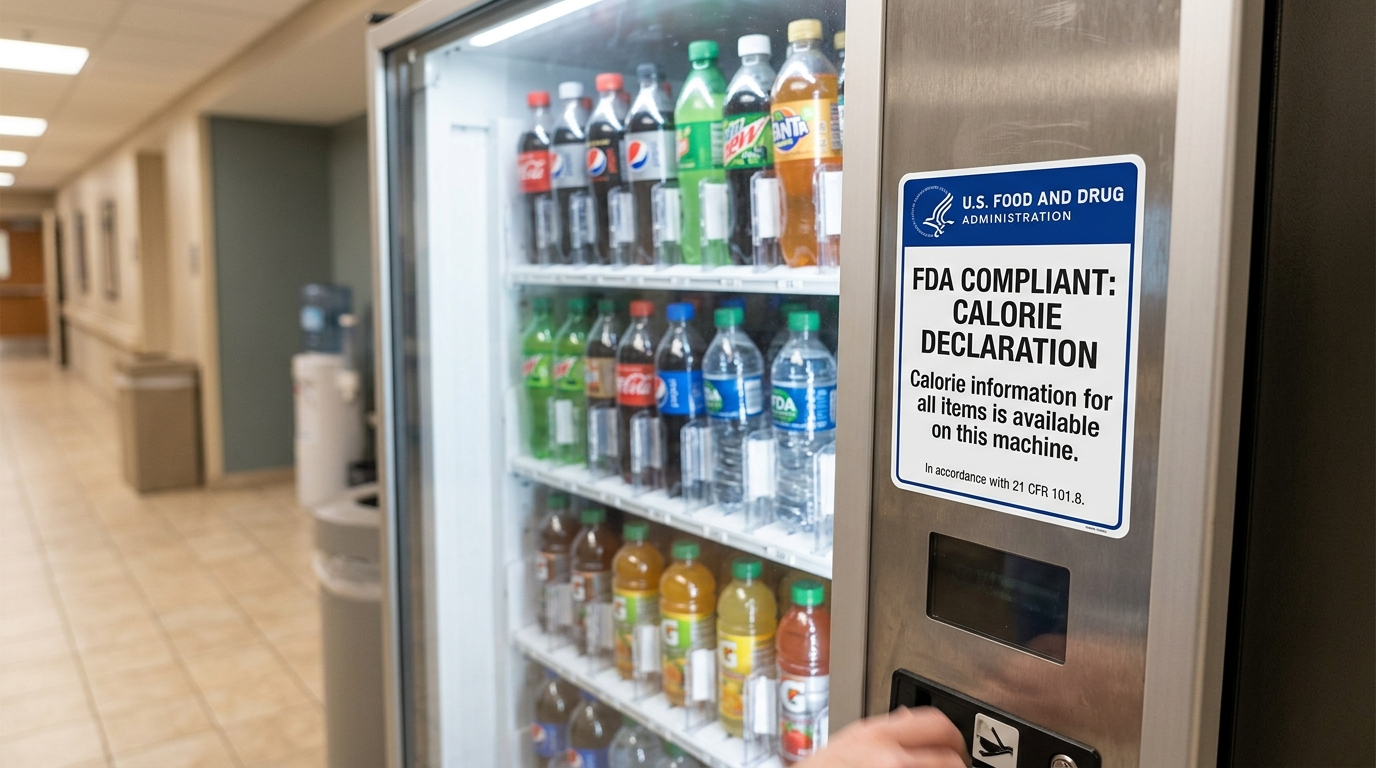
For machines where a buyer can’t see the Nutrition Facts panel before purchasing, typically machines with opaque product displays, the operator must declare calorie content in another format visible at the point of purchase, such as a sign, label, or electronic display near the selection button.
Glass-Front Machines and Front-of-Package Labeling
Glass-front machines, where buyers can see the actual product packaging before purchasing, can rely on front-of-package calorie labeling already printed on the product itself. A 2019 final rule updated the required type size for this front-of-package declaration, setting it at a minimum of 150 percent the size of the product’s net weight declaration, a change from the original 2014 standard tied to the largest printed text on the label.
Compliance Timeline and Current Requirements
| Milestone | Detail |
|---|---|
| Final rule published | December 2014, implementing ACA vending machine labeling provisions |
| General compliance date | December 1, 2016 for most provisions |
| Front-of-package type size update | 2019 final rule, calorie declaration at least 150% of net weight text size |
| Coverage threshold | 20 or more vending machines owned or operated by a single business |
FDA Authority vs State and Local Food Safety Rules
FDA’s direct regulatory reach over vending machines centers specifically on the calorie labeling requirement and the broader adulteration and misbranding provisions of the Food, Drug, and Cosmetic Act, which apply to any food or beverage sold anywhere in the country. Day-to-day operational requirements, business licensing, vending permits, and health inspections covering sanitation and refrigeration temperature, fall under state and local health department authority rather than direct FDA enforcement, even though many of those state and local rules are modeled on the FDA Food Code as a reference standard.
Does This Apply to Drinks Specifically?
Yes, beverages qualify as food under the FD&C Act’s legal definition, so the calorie labeling rule applies to drink vending machines the same way it applies to snack machines, with no separate or reduced standard for beverages specifically. A machine dispensing exclusively drinks and falling under an operator’s 20-machine threshold faces identical disclosure obligations as a mixed snack-and-drink combo unit.
Penalties for Non-Compliance
Non-compliance with FDA labeling requirements can result in the food being considered misbranded under the FD&C Act, which carries potential enforcement action ranging from warning letters to more serious regulatory consequences depending on the nature and persistence of the violation. In practice, most enforcement in this specific area has focused on compliance guidance and warning correspondence rather than aggressive penalty action, though operators shouldn’t treat that pattern as a guarantee against stricter enforcement going forward.
Compliance Checklist for Operators
Confirm your total machine count across all locations to determine whether the 20-machine threshold applies, then audit whether each machine already displays visible nutrition information or needs a supplemental calorie disclosure added. For glass-front machines, verify current product packaging meets the 2019 front-of-package type size standard, and for opaque-display machines, confirm a compliant calorie label or sign is posted at each selection point.
- Count Your Machines
- Check Visibility
- Verify Label Size
Pros and Cons of the Calorie Labeling Requirement
Advantages
Gives buyers informed purchasing decisions at the point of sale. Standardizes disclosure across large operators. Voluntary registration option lets smaller operators opt in consistently.
Trade-offs
Adds compliance overhead for operators crossing the 20-machine threshold. Glass-front packaging may need review for type size compliance. Ongoing responsibility to verify labeling as product lines change.
Legal and Business Setup Considerations
Compliance responsibility ultimately falls on the business entity operating the machines, which is one more reason proper business formation matters as an operation scales toward or past the 20-machine threshold. Many operators form an LLC for their vending machine business partly for this reason, since a properly structured entity clarifies exactly who bears compliance responsibility as the business grows, and confirming a registered agent for a vending machine business is in place ensures any regulatory correspondence reaches the business reliably.
Where to Learn More
FDA calorie labeling is one compliance layer among several that scale with business growth, alongside standard business licensing and sales tax obligations covered elsewhere. Operators building toward a larger machine count should review how to start a vending machine business for how compliance planning fits into overall growth strategy, while a look at healthy food options for vending machines pairs naturally with calorie-conscious product selection now that calorie visibility is a standard buyer expectation at scale.
Snack Vending Machines
Explore configurations built with visible-nutrition, compliance-friendly product displays.
Snack Vending MachinesExplore Machines by Type
From compact countertop units to high-capacity elevator configurations.
Does the FDA regulate drink vending machines?
Yes, narrowly, through a calorie labeling rule requiring operators with 20 or more vending machines to disclose calorie information, while general licensing and health inspections remain governed by state and local authorities. This is not legal advice — confirm current requirements directly with FDA guidance.
How many vending machines trigger FDA calorie labeling requirements?
An operator owning or operating 20 or more vending machines across their entire business, not per individual location, falls under the mandatory federal calorie disclosure requirement.
Can operators with fewer than 20 machines opt into the FDA rule?
Yes, smaller operators can voluntarily register with FDA using the designated registration form to be covered by the same standardized calorie labeling requirements.
Does the calorie labeling rule apply to drinks the same as snacks?
Yes, beverages qualify as food under the FD&C Act’s legal definition, so the rule applies to drink vending machines identically to snack machines, with no separate standard for beverages.
What counts as a machine already displaying visible nutrition information?
A machine where a buyer can clearly see the Nutrition Facts panel before purchasing, such as many glass-front units, generally satisfies the visibility requirement without needing a separate calorie sign.
What is the front-of-package type size requirement for glass-front machines?
Since a 2019 final rule, the calorie declaration on front-of-package labeling must be at least 150 percent the size of the product’s net weight declaration.
What happens if a covered operator doesn’t comply with calorie labeling rules?
Non-compliant food can be considered misbranded under the FD&C Act, which carries potential enforcement action ranging from warning letters to more serious regulatory consequences.
Does FDA handle vending machine health inspections?
No, food safety inspections covering sanitation and refrigeration temperature are handled by state and local health departments, even though many of those rules are modeled on the FDA Food Code.
When did the FDA vending machine calorie labeling rule take effect?
The final rule was published in December 2014, with a general compliance date of December 1, 2016 for most provisions.
Who is responsible for FDA compliance in a vending machine business?
Compliance responsibility falls on the business entity operating the machines, which is one reason proper business formation matters as an operation scales toward the 20-machine threshold.