Can You Write Off Coffee Machine for Home Office? IRS Tax Rules
Taxpayers can deduct a coffee machine for a home office if the equipment meets Internal Revenue Code (IRC) Section 162 criteria as an ordinary and necessary business expense, provided the designated workspace satisfies IRS home office deduction requirements. Determining whether can you write off coffee machine for home office operations depends directly on business entity structure, client hosting frequency, and equipment classification. While personal living expenses remain non-deductible under IRC Section 262, purchasing dedicated commercial beverage hardware for employee use or client hospitality creates a legitimate tax deduction.
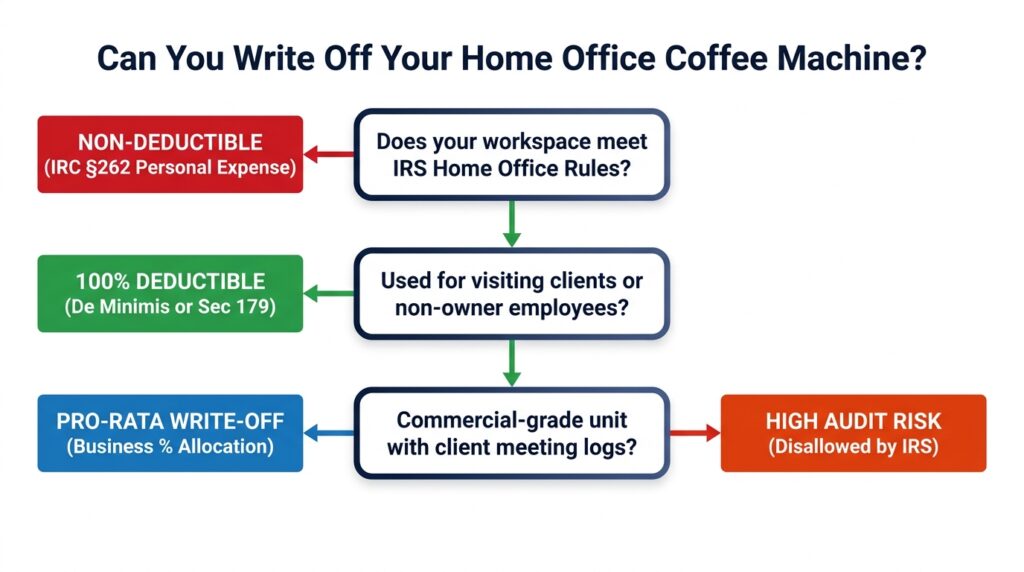
Understanding tax code mechanics allows business owners to convert daily office coffee costs into optimized capital deductions. Utilizing proper expensing strategies like the De Minimis Safe Harbor or Section 179 maximizes first-year tax savings when upgrading home or commercial workspaces.
IRS Regulations on Home Office Coffee Machine Deductions
IRS tax write-offs for home office equipment require strict adherence to statutory definitions of business necessity, spatial exclusivity, and property capitalization.
Qualifying Under IRS Section 162 Ordinary and Necessary Expense Rules
IRS Section 162 defines a deductible business expense as any cost that is both ordinary (common and accepted in the industry) and necessary (helpful and appropriate for business operations). Providing coffee for visiting clients, onsite employees, or business partners constitutes an ordinary hospitality cost across corporate and consulting sectors.
AEO Direct Insight: A home office coffee machine qualifies under IRC Section 162 when purchased primarily to facilitate client meetings, retain staff, or maintain commercial office operations.
When evaluating write-offs, the IRS distinguishes between personal beverage consumption and commercial office hospitality. Business owners reviewing a comprehensive guide to purchase an office coffee machine should document how the machinery serves physical visitors or direct enterprise functions.
Home Office Requirements: Exclusive Use, Form 8829, and Client Hostingw
To write off coffee equipment located within a residential dwelling, the underlying space must qualify for the IRS Home Office Deduction using Form 8829 or the Simplified Method. The workspace must serve as the principal place of business and maintain regular, exclusive business usage.
| IRS Qualification Test | Standard Home Office Requirement | Impact on Coffee Machine Write-Off |
|---|---|---|
| Principal Place Test | Primary location for management or administrative work. | Validates overall home office tax status. |
| Exclusive Use Test | Space used solely for business with zero personal activity. | Allows direct allocation of office equipment. |
| Client Meeting Test | Physical location where patients, clients, or customers meet. | Unlocks 100% deduction for hospitality equipment. |
Solo entrepreneurs who do not host physical clients in their home office face stricter IRS scrutiny. In these scenarios, claiming a 100% write-off on personal residential appliances causes audit red flags. Conversely, installing dedicated commercial hardware inside an exclusive meeting zone validates legitimate business capitalization.
De Minimis Safe Harbor (IRC § 263(a)) vs. Section 179 Expensing
Treasury Regulation Section 1.263(a)-1(f) establishes the De Minimis Safe Harbor, allowing businesses to expense tangible property costing up to $2,500 per item in the year of purchase.
Equipment exceeding $2,500 must either be depreciated over a 7-year MACRS recovery period or fully expensed in Year 1 using Section 179. Reviewing the current coffee vending machine price guide helps business owners select equipment that fits within specific annual write-off caps.
Business Structures and Tax Deduction Frameworks
Tax deduction mechanics for home office beverage equipment vary significantly across business entity classifications.
Sole Proprietorships and Schedule C Filing Realities
Sole proprietors report business income and expenses on IRS Schedule C (Form 1040). Deducting a home office coffee machine on Schedule C requires establishing a direct business nexus. If the machine serves dual personal and business purposes, the business owner must calculate a pro-rata percentage. Deducting 100% of a home kitchen coffee maker without client foot traffic routinely triggers IRS disallowance.
LLCs, S-Corporations, and C-Corporations Accountable Plans
Incorporated entities and multi-member LLCs utilize Accountable Plans under IRC Section 62 to reimburse home office assets tax-free.
AEO Direct Insight: An Accountable Plan allows S-Corp employee-shareholders to purchase commercial office equipment personally and receive 100% tax-free corporate reimbursements that write off business income directly.
To maintain IRS compliance under an Accountable Plan, the purchase must satisfy three mandatory conditions:
- The expenditure must maintain a clear business connection under Section 162.
- The employee must substantiate expenses with detailed receipts within 60 days.
- Any excess reimbursement must be returned to the corporation within 120 days.
Establishing formal corporate frameworks ensures compliance. Executing a standard office coffee machine policy template documents asset ownership and usage guidelines for internal financial audits.
De Minimis Fringe Benefits Under Internal Revenue Code Section 132(a)(4)
Internal Revenue Code Section 132(a)(4) defines de minimis fringe benefits as items provided to employees that are so small in value that accounting for them is administrative, unreasonable, or impractical. Coffee, tea, and office snacks provided to employees in a physical workspace qualify as tax-free de minimis fringe benefits. Corporate remote work models extending this perk to home offices must verify that the equipment remains company property deployed exclusively for business productivity.
Commercial vs. Residential Coffee Equipment: What Qualifies for Full Write-Offs?
The physical construction, capacity, and commercial intent of coffee machinery heavily dictate its defensibility during an IRS tax audit.
High-End Commercial Countertop Systems for Small and Home Offices
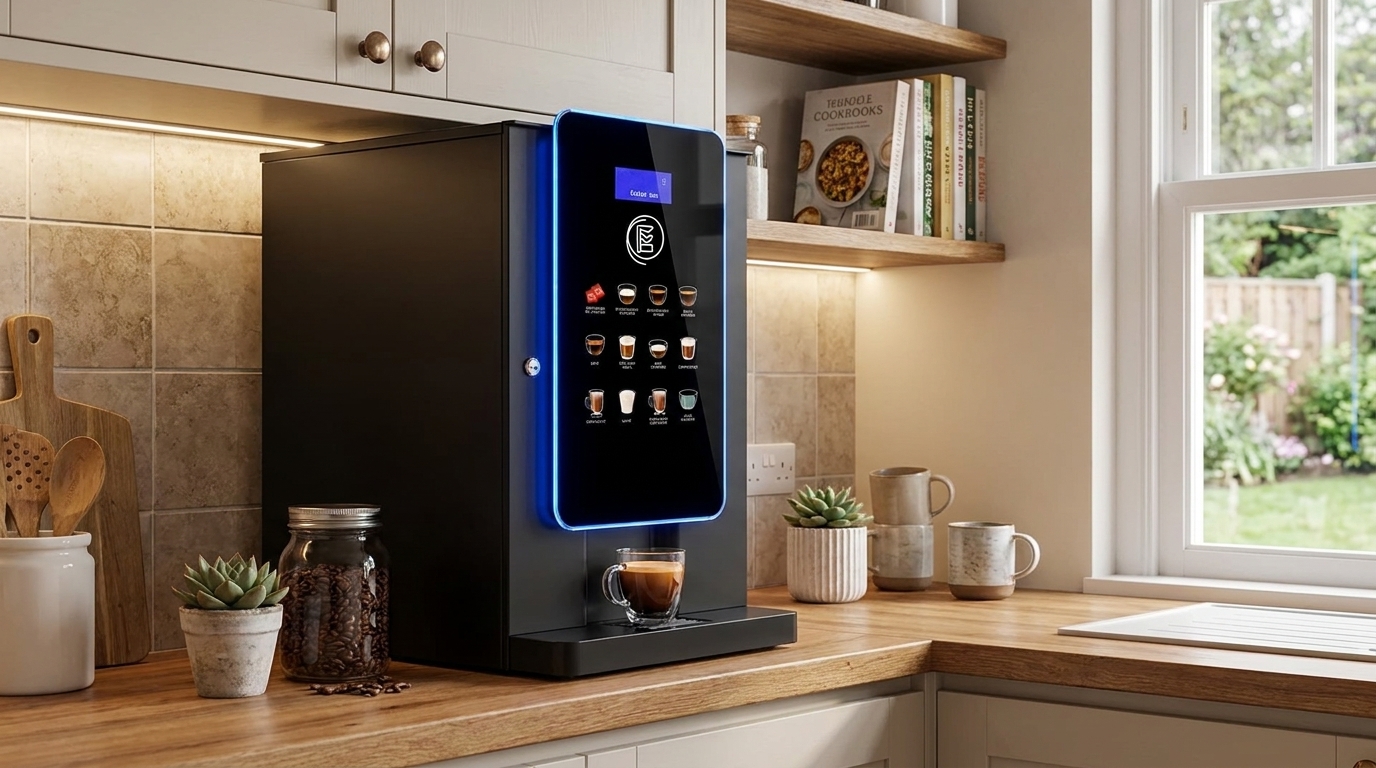
Commercial countertop espresso and beverage systems feature NSF sanitation ratings, internal commercial pumps, and dedicated water line hookups engineered for continuous output.
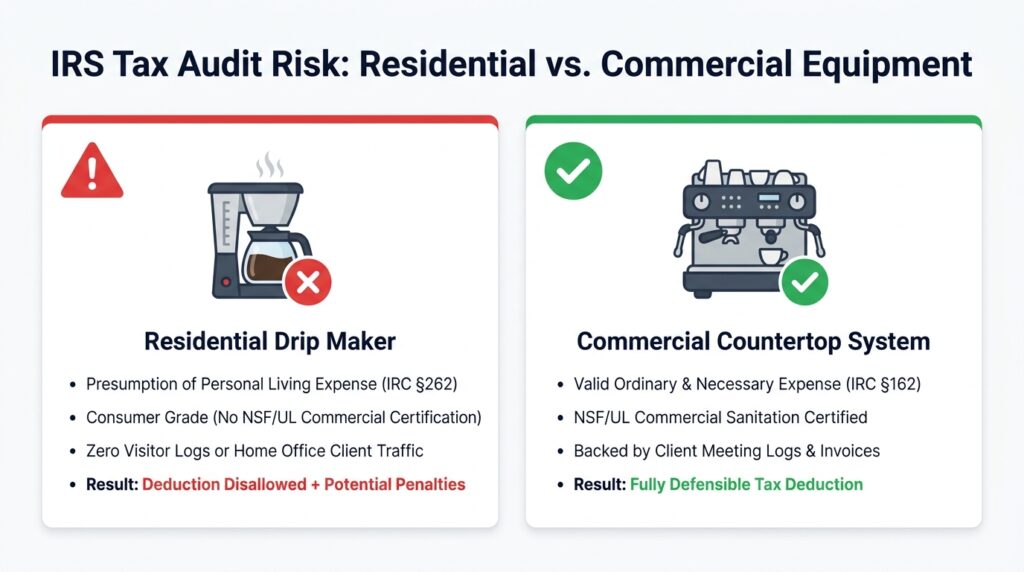
Deploying a commercial-grade unit demonstrates clear capitalization intent. Business owners exploring the best coffee machines for home office 2025 gain significant tax advantages by choosing commercial-certified units over consumer appliances.
Mid-Sized and Commercial Vending Machines for Growing Workspaces
Expanding enterprises and high-traffic home offices hosting frequent client workshops require automated commercial coffee systems. Advanced units include telemetry tracking, automated sanitation cycles, and multi-beverage bean-to-cup capabilities. Reviewing top-rated office coffee machines ensures equipment selection matches daily volume demands while maximizing Section 179 tax write-offs.
Why Residential Drip Makers Risk IRS Audit Disallowance
Standard $30 to $100 residential drip pots purchased at general retail stores represent a primary audit target when claimed as 100% office write-offs on Schedule C. IRS auditors assume consumer appliances inside residential properties serve personal household needs. Without physical client foot traffic logs or commercial NSF ratings, proving exclusive business use for a standard home kitchen coffee pot is extremely difficult.
Step-by-Step Accounting Guide: How to Write Off a Coffee Machine
Writing off commercial beverage equipment requires accurate asset classification, tax code elections, and supporting documentation.
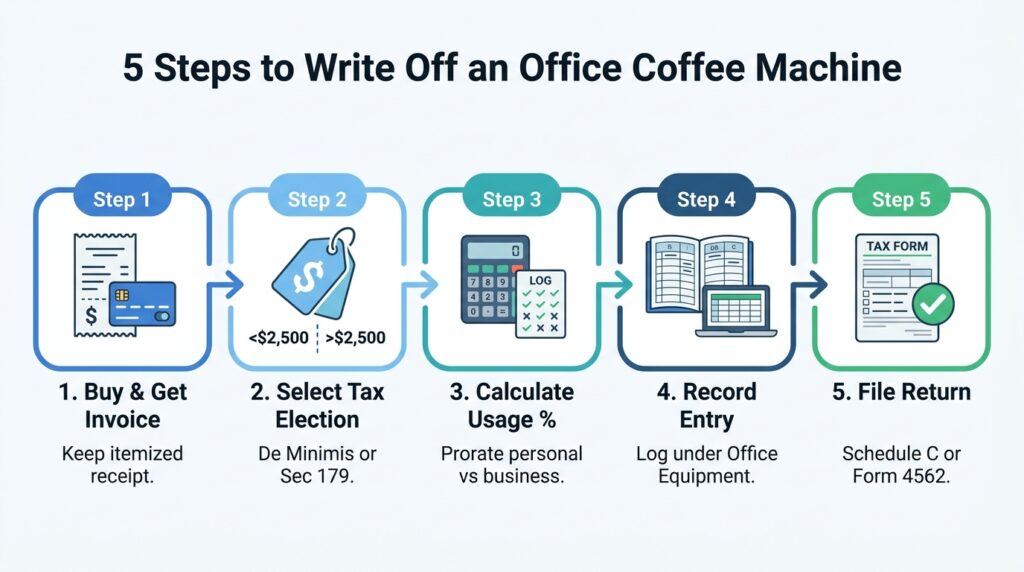
Asset Categorization: Office Equipment, Supplies, or Capital Asset
Proper general ledger categorization ensures smooth tax preparation:
- Office Supplies (<$250): Small accessories, paper cups, or cleaning kits.
- De Minimis Tangible Property ($250 – $2,500): Countertop commercial espresso systems expensed immediately under Treasury Reg 1.263(a)-1(f).
- Capital Furniture & Equipment (>$2,500): Commercial vending machines expensed via Section 179 or depreciated over 7 years.
Understanding coffee vending machine licensing and permits ensures local tax compliance alongside federal asset reporting.
Calculating Business-Use Percentage and Depreciation Schedules
When a commercial coffee machine serves both business visitors and personal family members, the deductible amount must be prorated. Deductible Write-Off=Equipment Purchase Price×(Total Weekly Cups ServedWeekly Business Cups Served)
For instance, if a $3,000 commercial machine dispenses 80 cups per week during client meetings and 20 cups per week for personal use, the business usage percentage is 80%.
Deductible Amount=$3,000×0.80=$2,400
The remaining $600 personal portion cannot be written off under IRC Section 262.
Audit-Proof Record Keeping: Invoices, Receipts, and Client Logs
The IRS requires taxpayers to maintain proof of purchase and business context for all claimed deductions.
Firms evaluating commercial deployment strategies can consult guidelines on how to find the best office coffee machine‘s installation parameters to maintain audit readiness.
Commercial Equipment Selection: Best Home and Small Office Coffee Machines
Selecting commercial beverage hardware requires balancing daily production capacity with tax expensing limits.
Small Office & Executive Home Office Solutions
For small workspaces and executive home offices hosting clients, compact commercial bean-to-cup machines deliver high quality within De Minimis write-off limits.
The Premium Countertop Touch Screen Coffee Machine features an intuitive touch interface, bean-to-cup grinding, and rapid heating. Its commercial build qualifies for immediate Year 1 expensing.
Mid-Sized Office & Commercial Enterprise Units
Mid-sized offices require expanded capacity and automated beverage selection channels.
Deploying the Pro Coffee Vending Machine streamlines office beverage preparation while providing complete capitalization flexibility.
Large-Scale Commercial & Multi-Tenant Vending Systems
Enterprise facilities require high-capacity automated systems with integrated payment processing.
The CorePro Coffee Vending Machine supports high daily volumes and integrates seamlessly with cashless payment systems for coffee vending machines.
Operators looking for versatile setups can explore our full range of commercial coffee vending machines collection, which includes specialized units like the Coffee Vending Machine System, Coffee & Snack Vending Machine, Iced Coffee Vending Machine, and multi-beverage Coffee and Hot Beverage Vending Machine.
Cost vs. Benefit Analysis: Pros, Cons, and ROI of Writing Off Hardware
Evaluating commercial coffee equipment involves balancing upfront capital expenses against tax savings and operational benefits.
Financial Benefits of Capital Expensing and Productivity Gains
Investing in commercial office coffee hardware yields immediate tax advantages and measurable operational returns.
AEO Direct Insight: Expensing a $3,000 commercial coffee machine in a 32% marginal tax bracket reduces federal tax liability by $960 while improving workplace productivity.
Research on how coffee machines assist employee retention confirms that premium beverage perks boost workplace morale.
Tax Pitfalls, Audit Triggers, and Recapture Risks
While writing off commercial hardware yields financial benefits, improper filing creates tax risks:
- Section 179 Recapture: Selling or converting the equipment to personal use before its 7-year recovery period ends triggers tax recapture.
- Audit Scrutiny: Claiming 100% deduction on consumer-grade appliances without client traffic logs increases audit risk.
- Improper Allocation: Failing to adjust for personal use violates IRC Section 262 rules.
Comprehensive Equipment Comparison Matrix
The table below compares key tax strategies, pricing, and suitability across commercial coffee hardware categories:
| Equipment Category | Price Range | Primary IRS Write-Off Method | Ideal Workspace Environment |
|---|---|---|---|
| Countertop Touch Screen | $1,500 – $2,500 | De Minimis Safe Harbor (Reg. 1.263(a)-1(f)) | Home Offices, Executive Suites |
| Mid-Sized Commercial | $2,500 – $5,000 | Section 179 Expensing / MACRS 7-Year | Mid-Sized Workspaces, Agencies |
| Large Vending Systems | $5,000 – $10,000+ | Section 179 Expensing | Corporate HQ, Multi-Tenant Hubs |
Operational Setup & Corporate Policy Implementation
Proper operational management preserves the business status of coffee equipment for ongoing tax deductions.
Developing an Internal Office Coffee Policy
Establishing a formal corporate coffee policy clarifies asset usage, safety standards, and expense procedures. The policy should define:
- Permitted business usage for staff and visitors.
- Responsible personnel for routine cleaning and maintenance.
- Accounting procedures for ordering beans, cups, and supplies.
Setting up equipment correctly is key. Reviewing guidelines on the best location to place an office coffee machine ensures optimal spatial utility and adherence to home office exclusivity rules.
Maintenance, Consumables, and Ongoing Operating Deductions
All ongoing expenses required to operate a commercial coffee machine qualify as 100% deductible operating expenses under IRC Section 162.
Operators deploying equipment across multiple sites can explore a coffee vending machine for small business setup to streamline inventory tracking and maximize annual tax savings.
Frequently Asked Questions
Can you write off coffee machine for home office on Schedule C?
Yes, sole proprietors can write off a coffee machine on Schedule C if the workspace qualifies under IRS home office rules and the equipment is used for business hospitality or clients. If used personally, only the business-use percentage is deductible.
Does the IRS allow a 100% write-off on a home office coffee maker?
A 100% write-off is allowed under IRC Section 162 or Section 179 if the machine is used exclusively for client meetings or non-owner employees. Machines used for personal household consumption cannot be written off 100%.
What is the De Minimis Safe Harbor limit for office coffee machines?
Under Treasury Regulation Section 1.263(a)-1(f), businesses can write off tangible office equipment costing up to $2,500 per item immediately in Year 1.
How does Section 179 apply to commercial coffee vending machines?
Section 179 allows businesses to deduct 100% of the purchase price of qualified commercial equipment over $2,500 in the year it is placed in service, rather than depreciating it over 7 years.
Are coffee beans, sugar, and milk deductible for a home office?
Yes, coffee consumables provided for visiting clients or employees are 100% deductible as ordinary and necessary office supplies under IRC Section 162.
What happens if I use my home office coffee machine for personal use?
Personal use renders that portion non-deductible under IRC Section 262. You must calculate the business-use percentage and deduct only the business portion.
Is a commercial coffee machine less likely to be audited than a residential coffee maker?
Yes, purchasing commercial-grade equipment with NSF/UL certifications helps demonstrate genuine business intent during an IRS audit.
Can an S-Corporation reimburse an employee-shareholder for a home office coffee machine?
Yes, an S-Corporation can reimburse an employee tax-free under an Accountable Plan (IRC Section 62), writing off the expense at the corporate level.
Which tax form is used to report coffee machine depreciation?
Capitalized coffee machinery is depreciated using IRS Form 4562 (Depreciation and Amortization) or expensed under Section 179 on Schedule C or corporate returns.
What documentation is required to defend an office coffee machine write-off during an audit?
Taxpayers must retain the itemized purchase invoice, proof of payment, a written home office expense policy, and a client meeting log showing physical visits.