Employee Office Coffee Machine Policy Template: Complete HR & Facility Guide
Core Purpose and Scope of an Employee Office Coffee Machine Policy
Defining Workplace Beverage Operating Standards
An employee office coffee machine policy template establishes standardized rules governing communal beverage equipment usage, sanitation, supply allocation, and maintenance across corporate facilities. Unwritten breakroom etiquette leads to frequent equipment misuse, sanitation oversights, and unnecessary repair costs. Implementing a formal workplace policy eliminates operational ambiguity by codifying employee expectations, daily upkeep duties, and safety protocols.
A structured policy protects high-value commercial machinery from premature mechanical failure caused by improper operation. Facilities teams reduce emergency technical service calls because staff members follow standardized operating procedures during routine beverage preparation. Managers setting up new beverage stations can review the foundational ultimate guide to office coffee machines to align policy clauses with specific hardware specifications.
Impact on Equipment Lifespan and Operational Costs
Establishing explicit operational guidelines directly increases commercial coffee machine longevity while lowering annual maintenance expenses. Unmonitored employee usage leads to clogged grinders, limescale buildup from unmanaged water tanks, and burned heating elements. Formalized policies reduce equipment downtime because staff members execute basic daily care routines and report mechanical errors immediately.
Clear cost-allocation rules define whether beverage consumables are employer-subsidized or funded via user payments. Facilities departments maintain predictable operational budgets because waste is minimized and ingredient theft is curbed. Organizations evaluating financial models can examine market trends in the coffee vending machine price guide to structure appropriate subsidy frameworks.
Comprehensive Employee Office Coffee Machine Policy Template
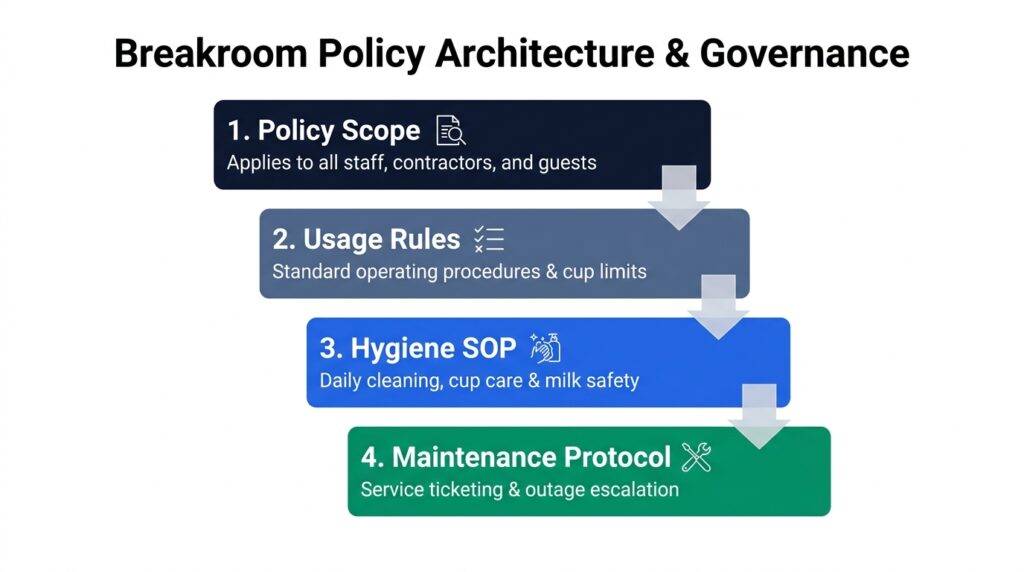
Section 1: Policy Intent and Coverage Scope
This policy establishes standard operating procedures for all commercial beverage equipment located within company facilities. The rules defined herein apply to full-time employees, part-time staff, temporary contractors, interns, and visiting clients. Compliance ensures a clean, safe, and efficient breakroom environment while preserving communal equipment integrity.
Beverage station equipment represents a shared corporate investment designed to enhance employee wellbeing and workplace productivity. Misuse of equipment, deliberate neglect of sanitation duties, or unauthorized modification of machine settings violates facility standards and may result in the revocation of breakroom privileges.
Section 2: Machine Usage and Operational Guidelines
Authorized users must operate commercial coffee machines strictly according to manufacturer specifications and posted operational signage. Employees must inspect water levels and bean hoppers prior to initiating a brew cycle to prevent dry-pumping or grinder jams. Operating instructions for specific units are outlined in how to use a coffee machine in office.
- Approved Consumables: Only company-provided coffee beans, ground coffee, and approved soluble powders may be loaded into machine hoppers. Inserting flavored beans with sugary coatings or non-compliant pods into commercial grinders is strictly prohibited because caramel additives ruin ceramic burrs.
- Cup Size Compatibility: Users must select cup sizes that match the automated pour volume to prevent overflow spills on counter surfaces. Oversized personal travel mugs must fit under the dispensing spout without forcing or tilting the nozzle mechanism.
- Peak Hour Etiquette: During high-volume periods (8:00 AM – 10:00 AM), employees preparing single servings take priority over staff dispensing multi-cup carafes. Carafes for team meetings must be brewed during off-peak windows or dispensed from dedicated batch brewers.
- Personal Mug Standards: All personal mugs must be clean and free of cracks before placement under the brew spout. Direct contact between mug rims and dispensing nozzles must be avoided to maintain hygienic standards.
Section 3: Hygiene, Daily Cleaning, and Breakroom Etiquette
Maintaining breakroom hygiene requires immediate employee intervention whenever spills, drips, or ingredient overflows occur. Bacteria propagate rapidly in warm coffee grounds and residual milk deposits if left unaddressed. The employee who finishes a beverage hopper or empties a water tank is required to refill it immediately for the next user.
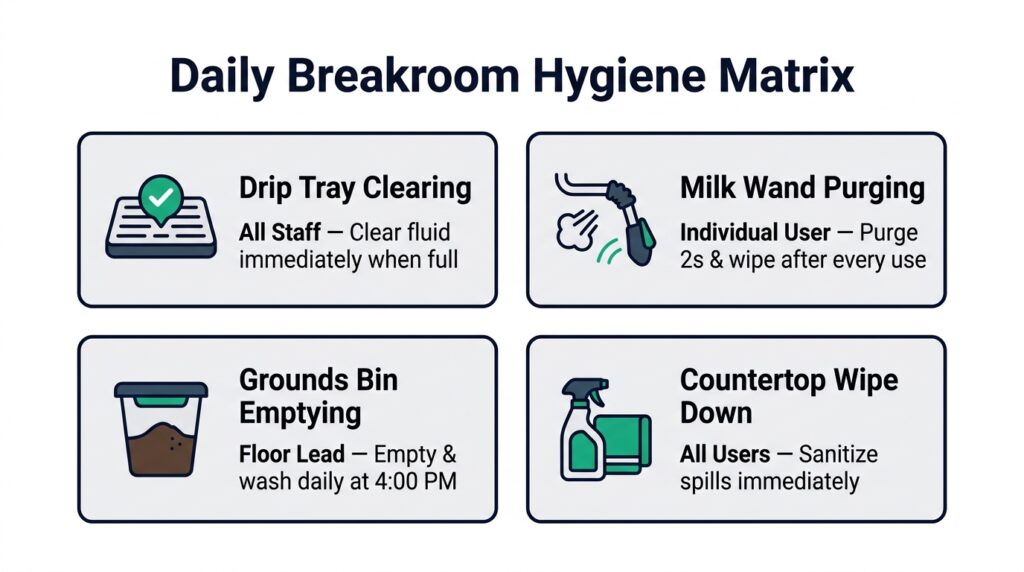
Milk wand steam tips on espresso machines must be purged and wiped down with a clean, damp microfiber cloth immediately after every use. Leaving milk residue to dry on steam nozzles creates health hazards and clogs steam valves. Comprehensive sanitation guidelines are available in the coffee vending machine cleaning and maintenance guide.
| Daily Hygiene Task | Responsible Party | Execution Frequency | Mandatory Procedure |
| Drip Tray Clearing | All Staff / Facilities | Immediately when full / Daily | Empty fluid contents, rinse under warm water, and dry. |
| Milk Wand Purging | Individual User | Immediately after use | Open steam valve for 2 seconds and wipe nozzle with clean cloth. |
| Grounds Bin Emptying | Assigned Floor Captain | Daily at 4:00 PM | Dump spent grounds into organic waste, wash bin, and reinsert. |
| Countertop Wipe Down | Individual User | Immediately upon spill | Clean spills with sanitizing spray and disposable paper towels. |
| Bean Hopper Topping | First User / Facilities | As needed during shifts | Refill whole bean hoppers using designated sealed storage containers. |
Section 4: Maintenance Protocols and Issue Reporting
Employees must refrain from attempting unsanctioned mechanical repairs or disassembling internal boiler components when equipment malfunctions occur. Unqualified technical intervention voids equipment warranties and introduces electrical safety hazards. When an error code or mechanical failure occurs, staff members must follow established reporting protocols immediately.
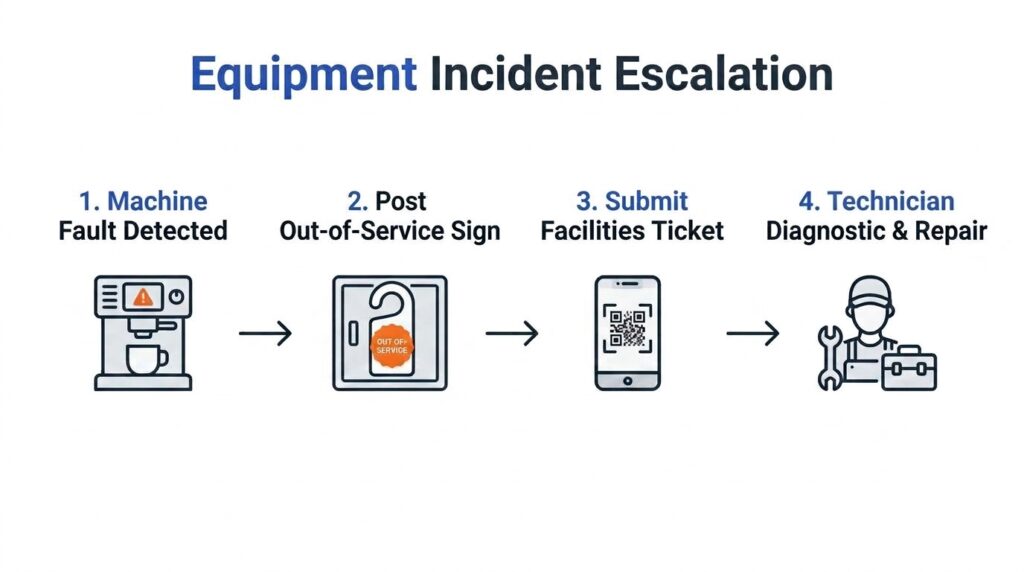
Staff members encountering machine faults must place the physical “Out of Service” sign over the touchscreen or control panel. Submitting a ticket through the corporate facilities portal alerts designated technicians to resolve the issue. Understanding internal mechanics helps personnel describe issues accurately; staff can reference how do coffee vending machines work for technical context.
Section 5: Financial Allocations, Subsidies, and Consumables
Corporate policy defines whether workplace beverage programs operate as a fully subsidized employee perk or a self-sustaining paid amenity. Standard office coffee, dairy milks, and basic sweeteners are funded directly through the facility operating budget. Premium specialty drinks or custom syrup selections may require user contribution via integrated payment systems.
When cashless payment terminals are installed on commercial dispensers, transactions are processed electronically. Employees using paid vending options must comply with standard pricing schedules posted on the machine interface. Financial administrators evaluating program sustainability can review revenue models in are coffee vending machines profitable.
Section 6: Safety Compliance and Emergency Protocols
All commercial coffee equipment must comply with Occupational Safety and Health Administration (OSHA) standards regarding electrical safety and thermal burn prevention. Power cords must remain clear of sink basins and liquid collection trays to eliminate electrical shock risks. Machines drawing high power loads require dedicated wall outlets without extension cord adapters.
In the event of a water leak, electrical spark, or burning odor, employees must disconnect the main power plug or switch off the wall circuit breaker immediately. Scald or burn injuries resulting from hot water exposure must be treated with cold water and reported to HR instantly. Detailed setup safety guidelines are documented in the coffee vending machine installation guide.
Employee Office Coffee Machine Policy
Company Facilities & Human Resources Guideline
1 Policy Intent and Coverage Scope
This policy establishes standard operating procedures for all commercial beverage equipment located within company facilities. It applies to full-time employees, part-time staff, temporary contractors, interns, and visiting clients.
Beverage station equipment represents a shared corporate investment. Misuse, deliberate neglect of sanitation duties, or unauthorized modification of machine settings may result in revocation of breakroom privileges.
2 Machine Usage and Operational Guidelines
Authorized users must operate machines strictly according to manufacturer specifications and posted signage. Inspect water levels and bean hoppers prior to brewing to prevent dry-pumping or grinder jams.
Approved Consumables
Only company-provided coffee beans, ground coffee, and approved soluble powders may be used. Flavored beans with sugary coatings or non-compliant pods are prohibited.
Cup Size Compatibility
Select cup sizes matching the automated pour volume to prevent overflow. Mugs must fit under the dispensing spout without forcing or tilting the nozzle.
Peak Hour Etiquette
During 8:00 AM – 10:00 AM, single servings take priority over multi-cup carafes. Carafes should be brewed off-peak or from dedicated batch brewers.
Personal Mug Standards
Mugs must be clean and crack-free before use. Avoid direct contact between mug rims and dispensing nozzles.
3 Hygiene, Daily Cleaning, and Breakroom Etiquette
Spills and overflows must be addressed immediately. Whoever empties a hopper or water tank must refill it for the next user. Milk wand steam tips must be purged and wiped after every use.
| Task | Responsible Party | Frequency | Procedure |
|---|---|---|---|
| Drip Tray Clearing | All Staff / Facilities | Immediately when full / Daily | Empty, rinse, dry. |
| Milk Wand Purging | Individual User | Immediately after use | Open steam valve 2 sec, wipe nozzle. |
| Grounds Bin Emptying | Assigned Floor Captain | Daily, 4:00 PM | Dump grounds, wash bin, reinsert. |
| Countertop Wipe Down | Individual User | Immediately upon spill | Clean with sanitizing spray. |
| Bean Hopper Topping | First User / Facilities | As needed | Refill using sealed storage containers. |
4 Maintenance Protocols and Issue Reporting
Employees must not attempt unsanctioned repairs or disassemble internal components. When a fault occurs, place the “Out of Service” sign over the control panel and submit a ticket through the facilities portal.
5 Financial Allocations, Subsidies, and Consumables
Standard coffee, dairy milks, and basic sweeteners are funded through the facility operating budget. Premium specialty drinks or custom syrups may require payment via integrated card readers.
6 Safety Compliance and Emergency Protocols
All equipment must comply with OSHA standards for electrical safety and burn prevention. Power cords must stay clear of liquid sources; high-draw machines require dedicated outlets without extension cords.
In case of a leak, spark, or burning odor, disconnect power immediately. Treat scalds with cold water and report to HR at once.
Operational Responsibilities Matrix
HR, Facilities and Employee Duty Breakdown
Clear distribution of operational responsibilities prevents maintenance oversights and maintains breakroom accountability across departments. The Human Resources department oversees policy communication, employee onboarding, and cultural compliance. Facilities management handles vendor contracts, equipment maintenance, technical repairs, and inventory restocking.
Individual employees maintain daily cleanliness, adhere to usage limits, and report equipment defects promptly. The responsibility matrix below details specific duties across organizational roles.
| Organizational Role | Primary Responsibilities | Performance Frequency | Key Deliverables |
| Human Resources (HR) | Policy drafting, staff communication, conflict resolution | Quarterly review / Onboarding | Updated policy document, signed staff agreements. |
| Facilities Management | Vendor management, deep cleaning, component descaling | Weekly / Monthly | Preventative maintenance logs, stocked supplies. |
| Floor Captains / Leads | Mid-day inspection, grounds disposal, inventory check | Daily (Morning & Afternoon) | Clean breakroom station, reported ticket logs. |
| General Employees | Proper operation, immediate spill cleanup, issue reporting | Continuous / Per brew cycle | Hygienic machine state, reported error codes. |
| Third-Party Vendors | Annual overhaul, water filter swaps, emergency repair | Bi-annually / On-demand | Machine uptime certification, fresh filter cartridges. |
Selecting the Right Equipment for Policy Enforcement
Small Offices: Premium Countertop Touch Screen Brewer
The Premium Countertop Touch Screen Coffee Machine ($4,850.00) is engineered for small offices, executive suites, and boutique firms requiring up to 150 cups per fill. Featuring a 10.1-inch interactive display, integrated conical grinder, and a dedicated 1.1 lb decaf bean hopper, this unit simplifies policy enforcement through automated drink recipes.
Operating at 1,150W on a standard 120V US commercial plug, it requires no specialized electrical modifications. The smooth glass touch interface simplifies daily wiping protocols, making hygiene enforcement effortless. Facility managers seeking versatile equipment options can browse the complete commercial coffee vending machines collection.
Medium Offices: Pro Coffee Vending System
The Pro Coffee Vending Machine is designed for medium-sized offices with 50 to 150 employees demanding continuous beverage output. Its larger internal canisters hold higher volumes of coffee beans and soluble powders, reducing the need for mid-day refills by facility staff.
Automated internal monitoring tracks ingredient consumption, aligning with policy directives for scheduled inventory restocking. For organizations evaluating mid-sized options, exploring the full lineup in best office coffee machines provides clear capacity benchmarks.
Enterprise Facilities: CorePro Commercial Vending Station
The CorePro Coffee Vending Machine serves large corporate headquarters, manufacturing plants, and multi-floor facilities requiring up to 500 cups per fill. Built with heavy-duty internal boilers and automated cup dispensers, this machine handles peak morning rushes without operational slowdowns.
Deploying high-capacity floor units enforces policy consistency across corporate campuses because all maintenance is centralized within automated vendor servicing schedules. Executive purchasing teams can review complete procurement criteria in the guide to purchase office coffee machine.
Strategic Equipment Deployment & Placement Considerations
Spatial Footprint and Utility Requirements
Positioning commercial coffee equipment requires verifying structural space allowances, electrical capacity, and water line access prior to installation. Countertop units require dedicated counter space supporting at least 150 pounds of static weight. Freestanding machines demand clear floor area away from primary fire exit routes.
Adequate vertical clearance must be maintained above countertop machines to allow upper hopper lids to open fully during bean refills. Facility layout specifications and exact dimensions are detailed in office coffee machine dimensions.
Employee Retention and Cultural Productivity
Providing premium workplace coffee directly influences employee satisfaction, workplace culture, and staff retention rates. Modern employees view high-quality espresso amenities as a standard workplace perk rather than a luxury privilege. Establishing clear policy guidelines ensures the beverage station remains a positive focal point for informal collaboration.
When coffee stations operate reliably without cleanliness disputes or mechanical breakdowns, employee morale improves. Organizations can explore the connection between workplace perks and staff engagement in how coffee machine helps in retaining employees. Optimizing equipment placement strategies is further detailed in best location to place office coffee machine.
Equipment Maintenance and Cost Allocation Framework
Preventive Maintenance Timelines
Preventive maintenance schedules prevent unexpected hardware failures and maintain beverage flavor quality over time. Commercial bean-to-cup machines require daily surface cleaning, weekly group head rinsing, and monthly water filter inspections. Scaling buildup caused by hard water minerals must be removed through scheduled descaling cycles.
Assigning specific maintenance tasks to facility management or contracted service providers ensures long-term operational reliability. A structured breakdown of servicing intervals is provided below.
| Maintenance Level | Action Items | Execution Responsibility | Operational Impact |
| Tier 1: Daily Care | Empty drip trays, purge steam wands, wipe counter | All Employees / Floor Lead | Prevents mold growth and milk hardening. |
| Tier 2: Weekly Sanitation | Soak milk frothers, clean mixing bowls, wash hoppers | Facilities Team | Maintains drink flavor and powder flow. |
| Tier 3: Monthly Audit | Run chemical descaling, inspect inline water filters | Designated Technician | Removes mineral scale from boilers. |
| Tier 4: Annual Service | Replace wear-and-tear gaskets, calibrate burrs | Certified Factory Vendor | Preserves pump pressure and warranty. |
Capital Investment vs. Consumable Budgeting
Managing office coffee expenses requires separating upfront capital equipment costs from ongoing consumable supply budgets. Capital outlays cover machine acquisition, water line installation, and payment terminal hardware. Consumable budgets account for recurring bean orders, milk powders, paper cups, stirrers, and cleaning chemicals.
Facilities departments offset operational expenses by offering subsidized pricing models where basic espresso is free while specialized milk drinks require minor payments. Comprehensive budgeting guidelines are outlined in vending coffee dispenser prices.
Policy Implementation & Communication Roadmap
Rollout Strategy and Staff Onboarding
Implementing an employee office coffee machine policy requires structured communication during staff onboarding and facility updates. Posting visual infographic summaries directly above breakroom machines improves compliance compared to burying rules within employee handbooks. Digital copies should remain accessible on the company intranet portal.
HR teams should review policy effectiveness semi-annually based on maintenance logs and employee feedback. Updating usage guidelines ensures the policy adapts as workforce size or breakroom machinery evolves.
Frequently Asked Questions
Why does an office need a formal employee coffee machine policy?
A formal policy establishes clear standards for machine operation, daily hygiene, and maintenance responsibility. It reduces equipment breakdowns by up to 40%, lowers repair costs, and eliminates breakroom cleanliness disputes among staff.
What are the essential sections to include in an office coffee machine policy?
An effective policy must include coverage scope, machine usage rules, hygiene and cleaning standards, maintenance escalation protocols, cost allocation policies, and OSHA safety compliance guidelines.
Who is responsible for daily coffee machine maintenance in an office?
Daily hygiene tasks like wiping spills, purging steam wands, and refilling beans belong to individual users. Facilities teams handle deep cleaning, grounds bin emptying, and scheduling professional maintenance.
Can employees bring their own coffee beans or pods for the office machine?
No, employees should only use company-approved coffee beans and supplies specified for the machine. Unapproved beans with oily coatings or incorrect grind sizes can clog commercial grinders and void warranties.
How should milk frothing wands be cleaned after each use?
Users must purge the steam wand for 2 seconds and wipe the nozzle immediately with a damp microfiber cloth. This prevents dried milk buildup, blocks bacterial growth, and keeps steam jets clear.
What safety protocols apply to commercial breakroom coffee machines under OSHA?
OSHA guidelines require keeping electrical cords clear of water sources, placing non-slip mats near liquid dispensers, guarding hot water taps, and providing accessible burn first-aid kits.
What should an employee do if the coffee machine displays an error code?
The employee should stop using the machine, place an “Out of Service” sign over the control panel, and submit a maintenance ticket to facilities immediately. Staff should never attempt internal mechanical repairs.
How can companies fund high-end office coffee machine consumables?
Companies can fully subsidize supplies as an employee perk, or implement a hybrid model where standard coffee is free while specialty drinks are paid via integrated card readers.
How often should an office coffee machine undergo professional maintenance?
Commercial machines require monthly water filter checks and chemical descaling, along with annual factory servicing to replace worn silicone seals and recalibrate grinder burrs.
How do breakroom coffee policies impact employee retention?
Clear policies maintain clean, reliable coffee stations that foster workplace collaboration and boost morale. High-quality, hassle-free coffee amenities directly improve employee satisfaction and retention.