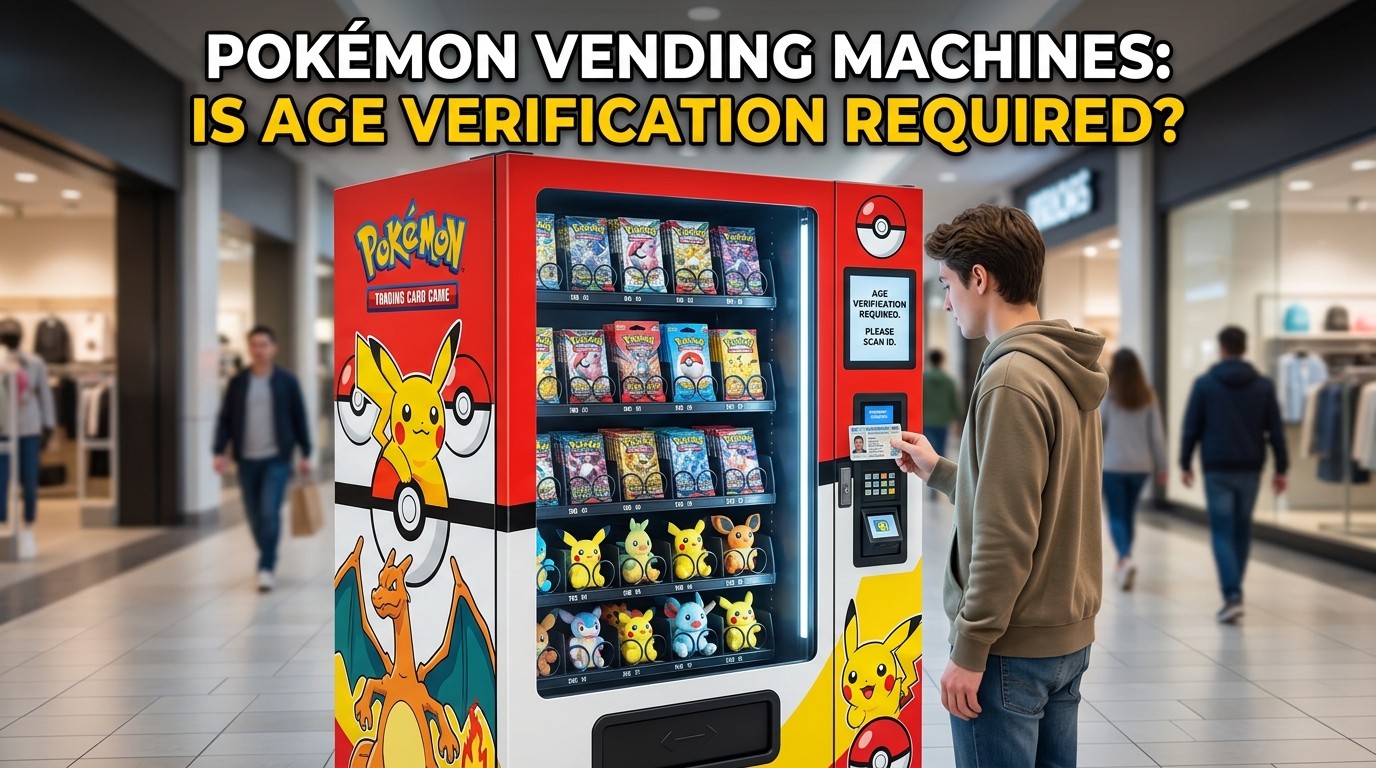
Is Age Verification Required to Sell Pokémon Cards?
No, age verification is not legally required to sell Pokémon cards in the United States, because sealed Pokémon Trading Card Game products are ordinary retail merchandise, not a regulated, age-restricted category like alcohol, tobacco, or lottery tickets. This applies equally to counter retail, vending machines, and online sales, since no federal or state statute currently classifies trading card packs as a product requiring buyer age confirmation. This guide explains why that’s the case, what actually distinguishes an age-restricted product from a Pokémon card pack, and what vending operators should still verify even without an age requirement.
Not legal advice. This article explains the general regulatory status of trading card sales in the United States as of this writing. Laws can change, and specific state or local rules should be confirmed with a business attorney before relying on this information for a commercial decision.
Age Verification and Pokémon Card Sales
Selling Pokémon cards requires no age check because trading cards fall outside every existing age-restricted product category defined in U.S. law, unlike alcohol, tobacco, vape products, or lottery tickets, each governed by specific statutes mandating buyer age confirmation. A broader look at whether it’s legal to sell Pokémon in a vending machine covers this alongside the other compliance categories, like licensing and sales tax, that do apply to vending operators regardless of product type.
Why Pokémon Cards Aren’t Age-Restricted
Age-restricted product categories exist because a specific statute defines them that way, typically tied to health, safety, or gambling concerns unique to that product. Trading cards have never been classified under any of those statutory categories, since a booster pack carries none of the characteristics, intoxicating substances, addictive properties, or wagering mechanics, that trigger age-restriction laws elsewhere.
Comparison With Actually Age-Restricted Products
| Product Category | Age Verification Required | Legal Basis |
|---|---|---|
| Alcohol | Yes | State and federal alcohol control statutes |
| Tobacco/vape products | Yes | Federal Tobacco 21 law and state statutes |
| Lottery tickets | Yes | State lottery and gambling statutes |
| Pokémon trading cards | No | Ordinary retail merchandise, no applicable statute |
Are Randomized Card Packs Regulated Like Gambling?
Physical Pokémon booster packs are not classified as gambling products under current U.S. federal law or the law of any state, because a buyer always receives a tangible item with real resale value regardless of which specific cards they get. This differs from purely digital loot boxes, where the absence of any physical resale value has drawn regulatory scrutiny in some jurisdictions. Since gambling classification is the primary legal pathway that would trigger an age requirement for a randomized product, the fact that trading cards fall outside that classification is the direct reason no age verification applies.
Does This Apply to Vending Machine Sales Specifically?
Yes, the sales channel doesn’t change the underlying product classification, so a vending machine dispensing Pokémon cards carries the same no-age-restriction status as a staffed retail counter selling the identical product. Understanding how Pokémon vending machines work makes this clear at the mechanical level too, since these machines don’t include any age-gating hardware or software, unlike age-restricted vending categories such as tobacco vending, which do require verification technology built into the unit. Even official programs like the Pokémon Company-operated machines found in select Kroger stores, covered in this guide to finding a Kroger Pokémon vending machine, operate without any age check at the point of sale.
International Differences
U.S. rules don’t automatically apply elsewhere, and international card markets sometimes introduce identity-related requirements for reasons unrelated to age.
Japan’s New Identity Verification System
The Pokémon Company has announced plans to introduce an identity verification system for certain high-demand product sales and event registrations in Japan, using the country’s My Number Card system. This system is aimed specifically at limiting bulk purchasing by scalpers and resellers, not at confirming buyer age, and applies only to select online sales and events in Japan rather than general retail or vending purchases anywhere, including the United States.
What Vending Operators Should Still Verify
While no age check is required, operators still carry standard retail compliance obligations independent of age, including business licensing, sales tax registration, and confirming inventory is authentic rather than counterfeit. A complete 2026 operator guide covers these requirements in full, distinguishing clearly between what’s actually mandated and what’s simply good business practice.
- No Age Check Needed
- Standard Retail Rules Still Apply
- Authenticity Still Matters
Legal Basis: Retail Sale of a Genuine Product
Once a business purchases authentic, sealed trading card inventory through a legitimate channel, reselling that product falls under standard retail sale principles rather than any category requiring buyer qualification. This is the same legal footing that allows any retailer to resell a genuine, lawfully acquired product without restriction, distinct from categories where a separate statute layers on additional buyer requirements.
Common Misconceptions About Age Rules for Trading Cards
A common misconception assumes randomized packaging automatically triggers gambling-style regulation, when in fact the presence of guaranteed physical resale value is what has kept trading cards outside that classification so far. Another misconception conflates international developments, like Japan’s scalper-focused identity system, with a general age requirement, when that system explicitly targets bulk-purchase behavior rather than buyer age. A third misconception assumes vending machines carry different rules than staffed retail simply because they’re automated, when the sales channel itself has no bearing on product classification.
The Current No-Age-Restriction Framework: Pros and Cons
Advantages
Simpler compliance for operators, with no verification hardware or process needed. Faster transaction times at vending machines. Broader accessibility for younger collectors and gift purchases.
Trade-offs
No built-in mechanism limiting purchase volume by younger buyers. Relies entirely on parental discretion rather than a regulatory backstop. Framework could shift if future legislation reclassifies randomized products.
Where to Learn More
Age verification is one narrow piece of a broader compliance picture for anyone selling Pokémon products commercially. A full walkthrough of how to use a Pokémon vending machine confirms there’s no age-related step in the purchase process from the buyer’s side, while operators planning a launch should review site criteria through the best places for Pokémon vending machine placement.
For Operators: Legal Groundwork Beyond Age Rules
Operators without a confirmed site can list space requirements through VPlaced’s location owner matching process. On the compliance side, most operators also form an LLC for their vending machine business, with a registered agent for a vending machine business rounding out the basic legal setup independent of any product-specific rules like the age question covered above.
Pokémon Card Vending Machine
No age-verification hardware required — explore machines built for straightforward, compliant retail.
Pokémon Card Vending MachineExplore More Configurations
Compare additional options for dispensing trading card products.
Do I need to check ID to sell Pokémon cards?
No, Pokémon cards are ordinary retail merchandise with no age restriction under U.S. law, so no ID or age check is required to sell them. This is not legal advice — confirm specifics with an attorney if needed.
Why aren’t Pokémon cards treated like alcohol or tobacco?
Age-restricted categories exist because a specific statute defines them that way, typically tied to health, safety, or gambling concerns. Trading cards have never been classified under any of those categories.
Are randomized Pokémon booster packs considered gambling?
No, physical booster packs aren’t classified as gambling under current U.S. law, since buyers always receive a tangible product with real resale value regardless of which specific cards they get.
Does a Pokémon vending machine need age-verification technology?
No, since the product isn’t age-restricted, these machines don’t include age-gating hardware or software, unlike age-restricted vending categories such as tobacco vending machines.
Is Japan introducing age verification for Pokémon card purchases?
No, Japan’s new identity verification system targets bulk-purchasing scalpers for select online sales and events, not buyer age, and doesn’t apply to general retail or vending machine purchases.
Can a minor legally buy Pokémon cards from a vending machine?
Yes, since no statute restricts trading card sales by buyer age, a minor can legally purchase from a Pokémon vending machine the same as an adult.
What compliance rules do apply to selling Pokémon cards, if not age verification?
Standard business licensing, sales tax registration, and sourcing authentic, non-counterfeit inventory all still apply, independent of the age question.
Could Pokémon cards become age-restricted in the future?
It’s possible if future legislation reclassifies randomized physical products, but no current federal or state law treats trading cards this way as of this writing.
Does selling Pokémon cards through a vending machine differ legally from a retail counter?
No, the sales channel doesn’t change the product’s legal classification, so a vending machine carries the same no-age-restriction status as a staffed retail counter selling the same product.
Do official Pokémon Company vending machines require age verification?
No, even official machines, including those operated in select Kroger stores, function without any age check at the point of sale.