Legal & Setup | Mystery Ball Vending | By the VAdviced Team | September 2026
Operators come to capsule machines expecting the easiest category in vending. No refrigeration, no expiry dates, no health department, no cold chain. Compared to a hot food cabinet it looks like a holiday.
On the vending side, that is broadly true, and it is why these are among the easier vending machines to run. What catches people out is that they have stopped thinking of themselves as a vending operator without realising it.
You are running a toy business, and toy law in this country is considerably stricter than vending law. Your customers are largely children, your product is largely imported, and federal children’s product rules apply with full force regardless of the fact that a machine rather than a shop is doing the selling.
There are three federal obligations in this category that most operators have never heard of, and one open question that deserves genuine thought before you build a route.
General information, not legal advice. Product safety, gaming and consumer protection rules interact in ways that depend on your specific product and state. Use this to understand what to ask about, then confirm the specifics for your own operation.
Where this comes from: setting up vending businesses legally is what we do. Capsule and blind box formats look simple and sit on a surprisingly regulated foundation, and these are the questions that come up most.
The Question Everyone Asks First: Is This Gambling?
Let us deal with this properly, because it is the question operators worry about and the answer is more nuanced than either extreme.
Most state gambling definitions turn on three elements together: consideration, meaning the customer pays something, chance, meaning the outcome is not determined by skill, and prize, meaning something of value is won. A mystery capsule involves payment, and the customer does not know which item they will receive.
What generally keeps a conventional capsule machine on the right side of that line is the prize element. Every customer receives a product of broadly equivalent value. Nobody walks away with nothing, and nobody walks away with something worth many times what they paid. In that structure the customer has bought a toy and the surprise is a feature of the packaging rather than a wager.
The risk appears when operators start pulling the format toward something more exciting, and the moves that increase revenue are precisely the moves that create exposure:
- Rare items of significantly higher value. Introducing a scarce item worth far more than the purchase price starts to look like a prize won by chance rather than a product bought. The wider the value gap, the more attention it invites.
- Advertised odds or jackpot framing. Marketing that emphasises the chance of winning something, rather than the product being sold, changes how the whole arrangement reads.
- Anything redeemable for cash or credit. The moment a capsule can contain something convertible to money, you are in a different conversation entirely.
- State by state variation. Some states regulate this area far more tightly than others, and a structure that is unremarkable in one place can be a problem in another. Worth establishing before you expand a route across state lines with VPlaced.
The practical rule we would give an operator: keep the value of what is inside broadly consistent, and make sure the customer is always buying a toy rather than a chance at one. If your marketing copy leans on the odds, or if one capsule in fifty is worth twenty times the rest, get advice before you scale rather than after somebody asks.
The Cylinder That Decides What You Can Sell
Now the part that genuinely catches operators, because it is specific, testable and enforced.
Federal law defines a small part using a physical test. There is a cylinder, set out in the regulations at 16 CFR 1501.4, measuring 2.25 inches long by 1.25 inches wide, sized to approximate the fully expanded throat of a young child. Anything that fits entirely inside that cylinder, in any orientation, without being compressed, is a small part.
Crucially, that includes pieces that come off during normal use and abuse testing, not merely parts that were loose to begin with. A toy that breaks into small components is treated as containing small parts.
From there the rules stack by age:
| Intended age | What applies |
|---|---|
| Under 3 | Small parts are banned outright. No warning label makes this permissible. The part has to go or the product cannot be sold for that age |
| 3 to under 6 | A choking hazard cautionary statement is required where the toy is or contains a small part |
| Small balls and marbles | Treated as higher risk, with warning requirements extending to children under 8 |
That third row deserves attention in this category specifically, because a great deal of capsule product either is a small ball or contains one, and the age threshold there is higher than most operators assume. It also affects which product you can responsibly put into the compact formats in the mini vending machines range, which frequently sit in family venues.
The Rule That Reaches Your Machine, Not Just Your Product
This is the finding we would most want a capsule operator to sit with, because it is the point where a product rule becomes a machine rule.
The choking hazard labelling requirement does not stop at the packaging. Under 16 CFR 1500.20, advertising for children’s toys that are subject to the warning requirement must carry the same cautionary statement.
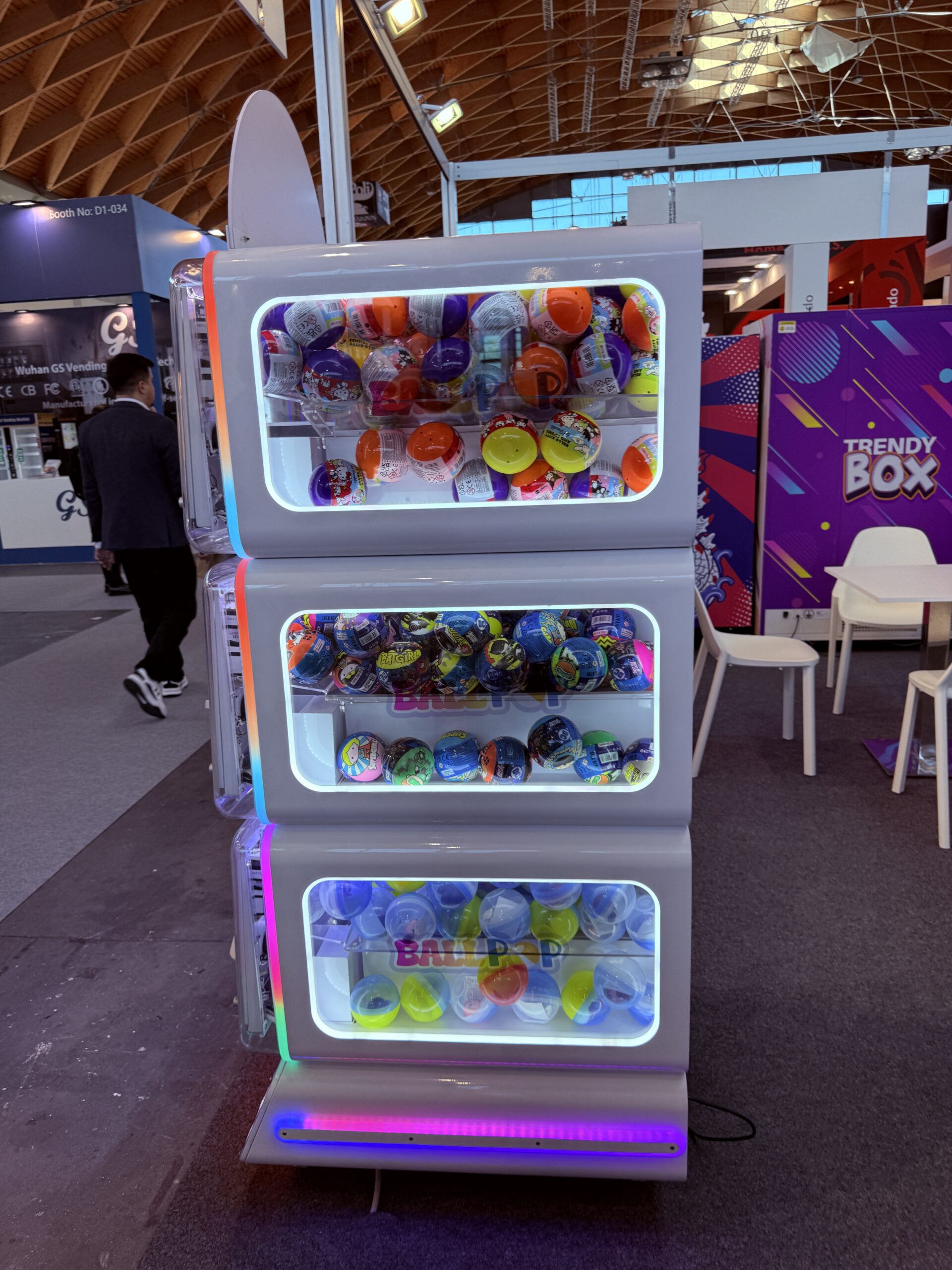
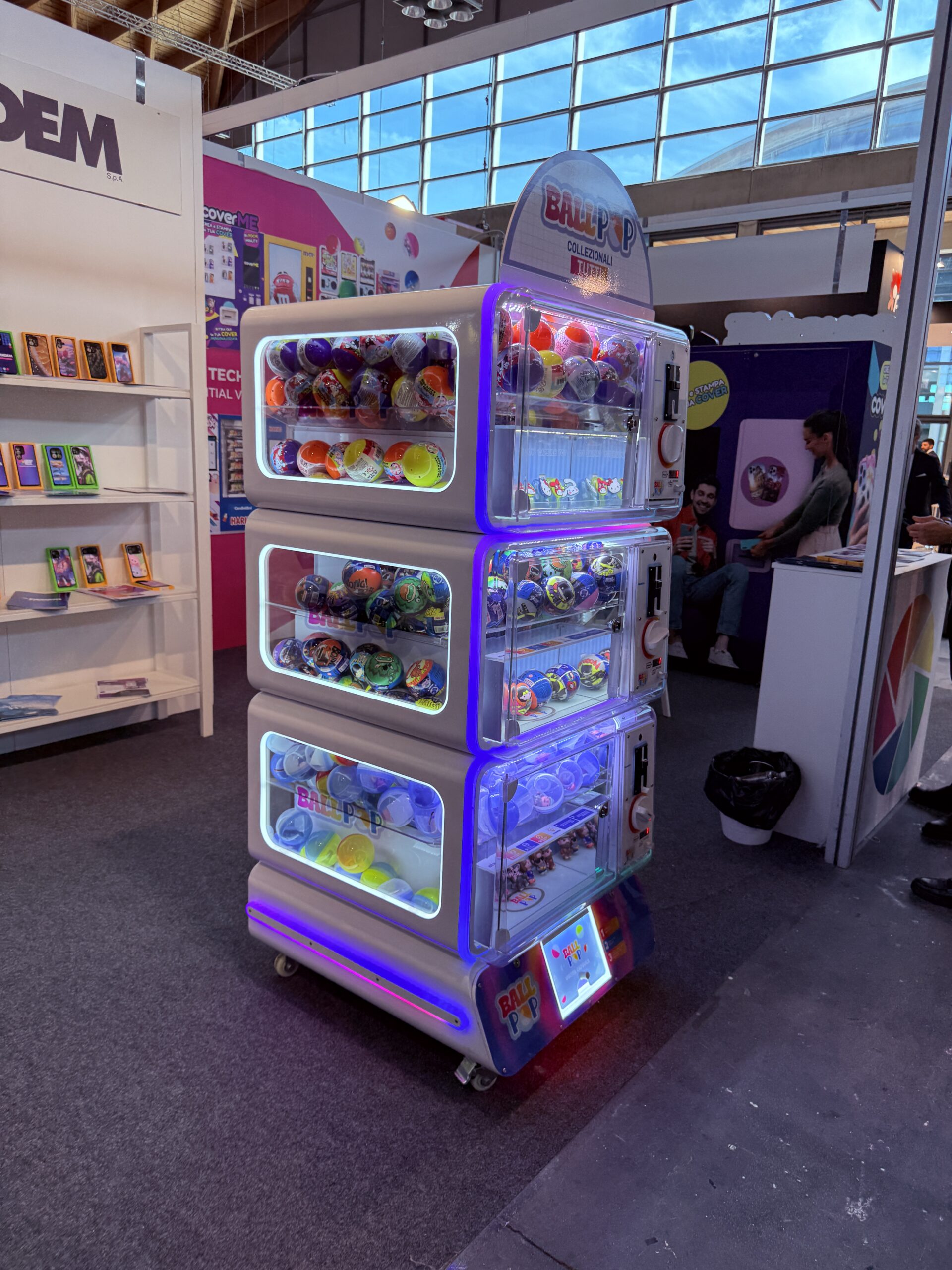
Now look at what a capsule machine actually is. A lit display window showing the toys, frequently with graphics identifying what is inside, positioned to attract customers. That is a promotional display for children’s products, and an operator should assume the warning obligation follows onto the machine itself rather than assuming it stops at a capsule nobody sees until after purchase.
Practically, that means treating the machine as part of the labelling rather than as furniture:
- Display the cautionary statement on the machine, clearly and legibly, at the point where somebody decides to buy rather than somewhere on the back panel.
- Match the wording to the regulation. The required statements have prescribed language, and inventing your own version is not a substitute.
- Match the warning to the actual contents. A machine carrying small balls needs the small ball warning rather than a generic one, and if you rotate stock into a different risk category the machine’s labelling has to change with it.
- Remember it applies per module. A stacked unit with different product tiers may need different warnings on different modules, which is a design consideration worth raising with whoever produces your machine graphics before anything is printed.
There is also a preemption point worth knowing. The Child Safety Protection Act generally prevents states from imposing their own non identical cautionary labelling requirements in this area, which at least means the federal wording is the standard everywhere rather than fifty variations.
If You Import, You Certify
The second obligation, and one that sits directly on most operators in this category, because capsule product overwhelmingly comes from overseas.
Under the Consumer Product Safety Act, manufacturers and importers of children’s products subject to a CPSC rule, standard or ban must certify compliance by issuing a Children’s Product Certificate. For the small parts ban that certificate cites the relevant part of the regulations, and it has to be based on testing rather than on a supplier’s word.
If you buy capsule product directly from a factory abroad, you are the importer, and that obligation is yours. Buying through a domestic distributor who already holds the certification is a materially different position, and it is the route we would suggest to most operators for exactly this reason.
What to ask a supplier, in writing, before ordering: is there a Children’s Product Certificate for this product, what testing was it based on, which accredited laboratory performed it, and is there a tracking label on the product. A supplier who cannot answer those four questions is handing you their compliance problem along with the capsules.
The Reporting Duty Nobody Mentions
The third obligation, and in our experience the least known of the three.
There is a dedicated federal regulation, 16 CFR Part 1117, requiring the reporting of choking incidents involving marbles, small balls, latex balloons and other small parts. It came in under the Child Safety Protection Act and it sets out what has to be reported, to whom, and within what timeframe.
That is a live duty for anybody distributing this kind of product, and it means an operator needs a process for it rather than discovering the requirement in the middle of an incident. Somebody has to know that a report may be required, know where the information goes, and be able to act quickly.
Which practically means keeping records you would otherwise not bother with:
- Which product went into which machine, and when
- Supplier details and certification for every batch
- A route for a customer or a site owner to reach a person quickly
- A written internal procedure for what happens if a complaint arrives
None of that is burdensome to set up in advance. All of it is very difficult to assemble retrospectively.
Licensed Characters Are Not a Grey Area
Capsule product leans heavily on recognisable characters, because recognition is what drives collecting. It is also the fastest route to a problem in this category.
The distinction is simple and the consequences are not:
- Officially licensed product bought through a legitimate channel is fine, and you should hold documentation showing the chain.
- Unlicensed product featuring protected characters is counterfeit merchandise, and selling it exposes you regardless of whether you knew. Entertainment brands run permanent enforcement programmes and a lit machine in a family venue is not discreet.
- Suspiciously cheap capsule product is the warning sign. If licensed characters are available at a price that seems impossible, there is usually a reason.
- Your own machine graphics carry the same rule. Displaying protected characters on the cabinet is your use rather than a supplier’s, and it is the most visible thing about the machine.
The Ordinary Setup, Which Is Genuinely Lighter Here
Having spent this article on the obligations, it is worth being fair about what does not apply. Compared to food vending this category is straightforward.
- Business entity. An LLC or similar separating personal and business liability, which matters here because your exposure is product related rather than operational.
- Sales tax registration and a resale certificate. Standard retail sales, and you will want to buy capsule product wholesale without paying tax twice.
- Vending licence and per machine decals. Required in many states and cities, and some jurisdictions treat coin operated amusement or bulk vending as its own licensing category, so ask specifically.
- No food establishment permit, no temperature logging and no health inspection, which is a genuine advantage and the reason this format suits a first machine.
- Insurance, with product liability confirmed explicitly rather than assumed, because a children’s product carries a different exposure profile from a bag of chips.
That fifth point is the one to check carefully. Ask your broker directly whether children’s products are covered, and get the answer in writing before the first machine goes out.
Put These in the Placement Agreement
- Who is responsible if a product complaint arises, and how it is escalated
- Whether the venue may specify or veto product themes, which family venues frequently want
- Where exactly the machine stands, since a family venue may have views on visibility to young children
- Who handles a customer whose capsule did not dispense, and how quickly
- Confirmation that required warnings will be displayed and maintained on the machine
Family venues ask sharper questions than a break room manager, so arriving with these already answered helps considerably. Securing those sites is work our partners at VPlaced handle, and property owners can list space through their location owners page.
How We Help
- Working out what applies to your product. Age grading, small parts, warning requirements and whether your particular mix raises the chance question at all.
- Supplier due diligence. The four questions above, asked properly, plus reviewing what a supplier actually provides against what they claim.
- Machine labelling. Making sure required cautionary statements appear correctly on the cabinet and per module rather than only on packaging nobody sees before buying.
- Entity, tax and licensing. Formation, sales tax, resale certificate, vending or amusement licences and decals handled properly.
- Records and incident procedure, so a complaint becomes a process you follow rather than a scramble.
You can see the full scope on our services page, follow the process on how we work, begin through Order Now, or talk to us first. On the equipment side, module configuration affects how you display warnings and rotate product, so it is worth specifying deliberately across the VMFS USA shop. Once machines are live and compliant, listing them on VendingFinder helps collectors find them.
Before You Load the First Capsule
- What age is this product graded for, and does that match where the machine will stand?
- Does the product, or anything that could break off it, fit the small parts cylinder?
- Is there a Children’s Product Certificate, and have you seen it?
- Who is the importer of record, and is that you?
- Is the correct cautionary statement displayed on the machine, per module?
- Are small balls or marbles involved, triggering the higher age threshold?
- Is all licensed character product genuinely licensed, with documentation?
- Is the value of capsule contents broadly consistent across the machine?
- Do you have an incident reporting procedure and batch records?
- Does your insurance explicitly cover children’s products?
Frequently Asked Questions
Are mystery ball vending machines legal in the US?
Yes, and they are widely operated. The obligations are children’s product safety rules rather than gambling rules, provided capsule contents are of broadly equivalent value so the customer is buying a toy rather than a chance at a prize. Introducing rare items worth far more than the purchase price is what moves a machine toward a different legal analysis.
Do I need a choking hazard warning on the machine itself?
You should assume so. The labelling rules extend to advertising for children’s toys subject to the warning requirement, and a lit display window promoting the toys inside is doing exactly that. Display the prescribed wording clearly at the point of purchase, matched to what is actually in each module.
What is the small parts test?
A physical cylinder set out in the regulations, 2.25 inches long by 1.25 inches wide, approximating a young child’s throat. Anything fitting inside it uncompressed is a small part, including pieces that break off in use and abuse testing. Products for children under 3 cannot contain small parts at all, and no warning label changes that.
Do I need certification if I import capsules myself?
Yes. Importers of children’s products subject to a CPSC rule must issue a Children’s Product Certificate based on appropriate testing, exactly as a manufacturer would. Buying through a domestic distributor who already holds that certification puts you in a considerably lighter position and is what we suggest to most operators.
Is this really easier than food vending?
Operationally, considerably. There is no cold chain, no expiry, no health permit and no temperature logging, which is why it suits a first machine. The obligations simply sit somewhere different, in product safety and sourcing rather than in food handling, and they are entirely manageable once you know they exist.
Simple Machine, Regulated Product
We work out what applies to your product, check your suppliers properly, get the machine labelling right and set up the records this category needs. Sorted before the first capsule loads.