Is It Legal for Employers to Charge Employees for Office Coffee?
Yes, it is legal for employers to charge employees for office coffee under United States federal law, provided that participation remains voluntary and any payroll deduction does not reduce an employee’s net compensation below the statutory federal minimum wage.
Under the Fair Labor Standards Act (FLSA) “free and clear” wage regulations (29 C.F.R. 531.35), employers cannot force workers to pay for breakroom amenities if doing so cuts into minimum wage or overtime earnings. While providing free coffee is standard practice across corporate breakrooms, businesses can legally implement user-pay systems—such as coin-operated units, point-of-sale micro-markets, or voluntary coffee clubs—without violating labor statutes.
Understanding the boundary between permissible perk charges and illegal wage kickbacks requires analyzing federal statutes, state-level payroll laws, tax classifications, and commercial breakroom equipment models.
Is It Legal for Employers to Charge Employees for Office Coffee under Federal Law?
Federal labor law permits employers to charge for office coffee as long as the fee is optional or compliant with FLSA minimum wage restrictions. The United States Department of Labor (DOL) does not mandate that employers furnish beverages or snacks to employees.
Workplaces operating under a standardized office coffee machine policy template clarify whether coffee service is an employer-sponsored perk or a self-funded employee program. When businesses choose to pass beverage costs onto workers, legal compliance hinges on how charges are collected and whether participation is required.
The Fair Labor Standards Act (FLSA) and the “Free and Clear” Principle
The FLSA “free and clear” rule under 29 C.F.R. 531.35 stipulates that mandatory employee expenses cannot reduce wages below the minimum statutory threshold or cut into overtime pay. Wages are not legally considered paid if an employer requires an employee to return a portion of their earnings directly or indirectly for company expenses.
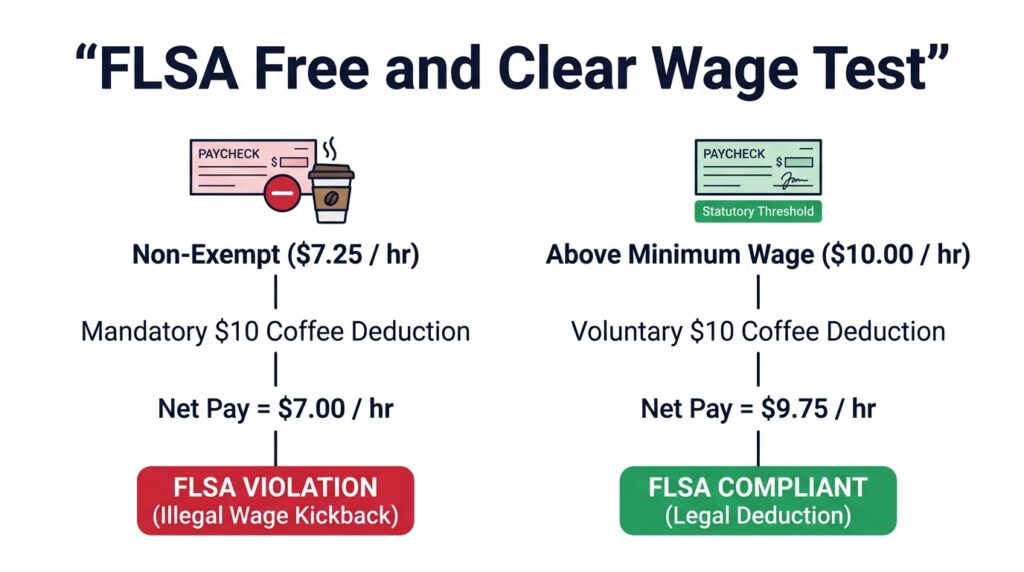
If an employer mandates that workers pay a fixed fee for workplace coffee, courts view that fee as an employment-related charge. For non-exempt workers earning the federal minimum wage of $7.25 per hour, any mandatory fee constitutes an illegal wage kickback under FLSA regulations.
Mandatory vs. Voluntary Coffee Payment Structures
Voluntary coffee payment structures are legal across all federal and state jurisdictions because they do not constitute mandatory employment costs or forced wage kickbacks. An employer may set up a point-of-sale machine or vending system where employees pay out-of-pocket for individual cups.
When coffee purchases are entirely optional, employees retain full discretion over their compensation. Legality is maintained because workers who opt out experience zero wage reduction or employment penalties.
FLSA Wage Deductions and Minimum Wage Floor Thresholds
Payroll deductions for non-essential amenities like office coffee violate the FLSA whenever they push an employee’s effective hourly rate below $7.25 per hour. The Department of Labor evaluates compliance on a single-workweek basis by dividing net wages by total hours worked.
| Hourly Wage Rate | Weekly Hours | Gross Earnings | Coffee Deduction | Net Hourly Rate | FLSA Compliance Status |
| $7.25 / hr | 40 hours | $290.00 | $10.00 / week | $7.00 / hr | NON-COMPLIANT (Illegal) |
| $10.00 / hr | 40 hours | $400.00 | $10.00 / week | $9.75 / hr | COMPLIANT (Legal) |
| $15.00 / hr | 40 hours | $600.00 | $15.00 / week | $14.62 / hr | COMPLIANT (Legal) |
| $7.25 / hr (Overtime) | 48 hours | $377.00 | $5.00 / week | Cuts Overtime | NON-COMPLIANT (Illegal) |
Employers must calculate weekly payroll thresholds accurately before setting up direct payroll deductions for breakroom services. Even a minor $2.00 weekly charge violates federal law if applied to minimum-wage workers.
State Labor Laws and Payroll Deduction Requirements
State labor statutes often enforce stricter employee pay protections than federal FLSA guidelines. While federal law permits voluntary deductions above minimum wage, state labor codes dictate the exact legal mechanisms required to execute paycheck deductions.
Written Authorization Mandates across Jurisdictions
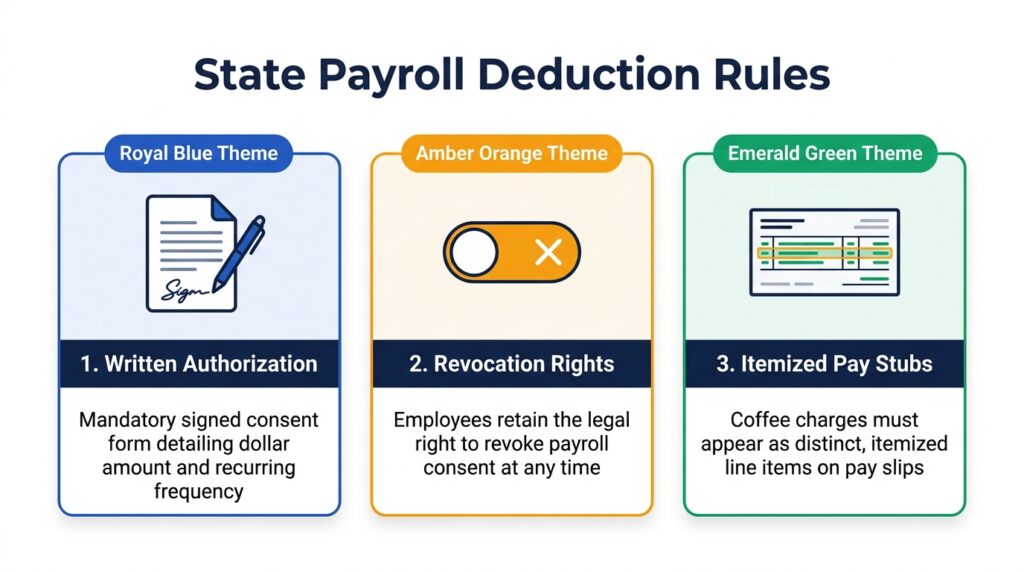
State laws in jurisdictions such as California, New York, Texas, and Connecticut mandate explicit, written consent before an employer can deduct funds from an employee’s paycheck. A general policy handbook clause does not satisfy state legal standards for ongoing amenity deductions.
- Individual Authorization Forms: Employees must sign a dedicated document detailing the exact dollar amount and recurring frequency of the coffee charge.
- Revocation Rights: Workers retain the legal right to revoke payroll deduction consent at any time without retaliation.
- Itemized Pay Stubs: State wage disclosure laws require coffee deductions to appear as distinct, itemized line items on pay slips.
Failure to secure written authorization exposes businesses to state labor commissioner audits, civil penalties, and mandatory wage restitution.
Prohibitions on Employer Profit and Forced Purchases
California Labor Code § 450 and similar state statutes make it illegal for employers to compel employees to purchase food, lodging, or goods from the employer. Forcing workers to buy coffee exclusively from an internal office machine violates state coerced-purchase statutes.
Additionally, under 29 C.F.R. § 531.29, when employers furnish non-cash facilities or amenities, they are prohibited from deriving a net financial profit if those costs are credited against employee wages. Operating breakroom equipment purely as a profit center at the expense of captive employees invites severe regulatory scrutiny.
Tax Implications of Charging Employees vs. Providing Free Office Coffee
Tax classifications dictate how office coffee expenditures are treated on corporate income tax filings and employee W-2 forms. The Internal Revenue Service (IRS) handles free workplace beverages differently than paid amenity programs.
IRS De Minimis Fringe Benefit Classification
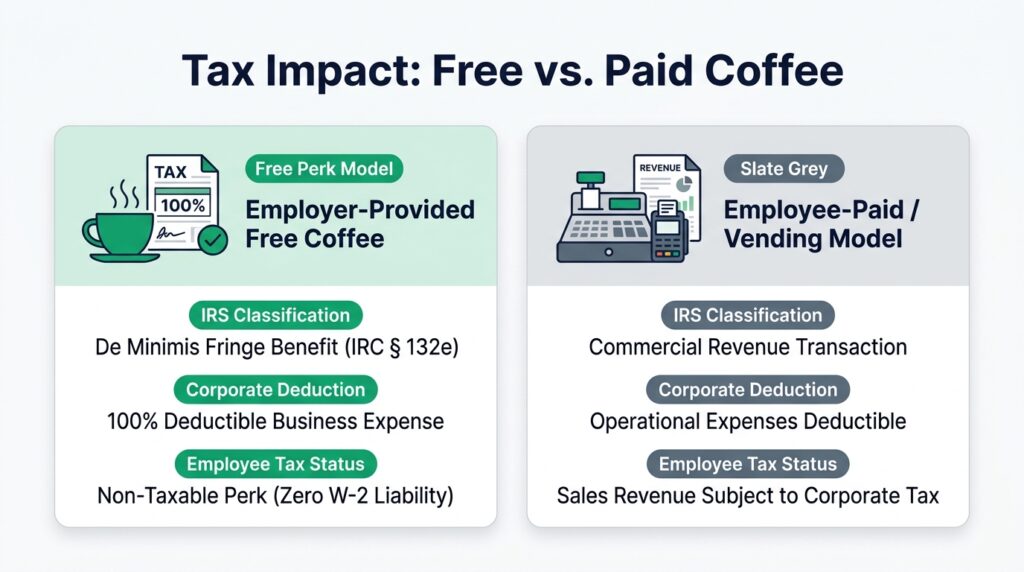
Under Internal Revenue Code (IRC) Section 132(e), free coffee, tea, and soft drinks provided to employees on business premises qualify as de minimis fringe benefits. The IRS classifies these items as tax-free perks because their value is so small that accounting for them is administratively impractical.
When an employer provides free coffee, the entire expense is typically 100% deductible as an ordinary and necessary business expense under IRC § 162. Employees incur zero taxable income liability for consuming free workplace coffee.
Tax Deductibility and Corporate Expense Accounting
Charging employees for coffee alters corporate tax obligations. Payments collected from employees generate gross taxable income for the business, while hardware depreciation and coffee supplies remain deductible operational expenses.
| Expense Category | Free Coffee Model | Employee-Paid Vending Model | Tax Impact Analysis |
| Coffee Beans & Supplies | Fully Deductible Expense | Fully Deductible Expense | Offsets gross sales revenue |
| Equipment Leasing | Fully Deductible Expense | Fully Deductible Expense | Deductible under operational overhead |
| Employee Revenue Collected | $0.00 | Gross Taxable Income | Subject to corporate income tax |
| Employee W-2 Reporting | Non-Taxable Benefit | Exempt (Out-of-Pocket) | No payroll tax withholding required |
Businesses must weigh the administrative complexity of tracking micro-transactions against the straightforward corporate tax deductions offered by free beverage programs.
Office Coffee Payment Models: Vending, Subscriptions, and Payroll Deductions
Companies seeking to offset breakroom beverage costs utilize structured payment systems to ensure legal compliance and smooth daily operation.
Cashless Vending and Commercial Dispenser Payment Systems
Modern commercial coffee units integrate credit card readers, mobile tap payments, and RFID employee badge scanners directly into the chassis. Installing cashless payment systems for coffee vending machines eliminates cash handling, automates revenue collection, and ensures transactions remain strictly voluntary.
Equipping commercial units with cashless hardware ensures that coffee purchases occur independently of payroll systems, insulating the business from FLSA wage deduction violations. Modern vending systems can also be configured to provide employees with daily subsidization credits (e.g., two free cups per day) before charging per cup thereafter.
Coffee Clubs and Employee Co-op Purchasing Models
Small to mid-sized offices frequently set up voluntary employee “coffee clubs.” In this structure, participating workers pool funds to buy premium whole beans, specialized creamers, and craft syrups.
Management must keep coffee club accounting completely separate from corporate payroll. Coffee clubs should be managed by designated employee committees rather than enforced by human resources, maintaining clear legal separation from mandatory workplace duties.
Direct Payroll Deductions and Administrative Compliance
If a company implements direct payroll deductions for beverage services, it must maintain a robust administrative paper trail.
- Clear Opt-In Protocols: Utilize formal enrollment forms rather than passive consent.
- Pre-Tax vs. Post-Tax Rules: Coffee deductions must be processed post-tax; they do not qualify for pre-tax salary reduction under IRC 125 cafeteria plans.
- Audit Records: Retain signed deduction agreements for at least three years to comply with FLSA recordkeeping requirements under 29 C.F.R. 516.
Establishing clear operational guidelines using a standardized office coffee machine policy template protects management against employee disputes regarding unauthorized deductions.
Pros and Cons of Charging Employees for Breakroom Beverages
Deciding whether to charge staff or absorb beverage costs requires balancing financial overhead against workforce productivity and company culture.
Strategic Benefits and Cost Containment
Charging employees or operating user-pay coffee systems helps organizations manage operational budgets while maintaining access to premium beverages.
- Expense Reduction: Direct cost recovery eliminates thousands of dollars in annual breakroom supply expenses.
- Waste Reduction: Pay-per-cup models eliminate half-full discarded pots and bean squandering.
- Variety Upgrades: Collecting user fees allows offices to fund premium espresso units that would otherwise exceed standard perk budgets.
Drawbacks, Morale Impacts and Recruitment Risks
Imposing beverage charges can negatively impact employee perception, company culture, and employer branding.
- Perceived Cheapness: Employees often view coffee fees as micro-managing perks, damaging overall team morale.
- Productivity Loss: Workers forced to pay for office coffee often leave the premises to visit off-site cafes, increasing break durations from 5 minutes to 25 minutes.
- Retention Vulnerability: Competitive employers utilize premium coffee perks to boost workplace satisfaction; understanding how coffee machine helps in retaining employees highlights why free coffee remains a high-ROI retention tool.
Commercial Coffee Machine Purchasing and Breakroom Implementation
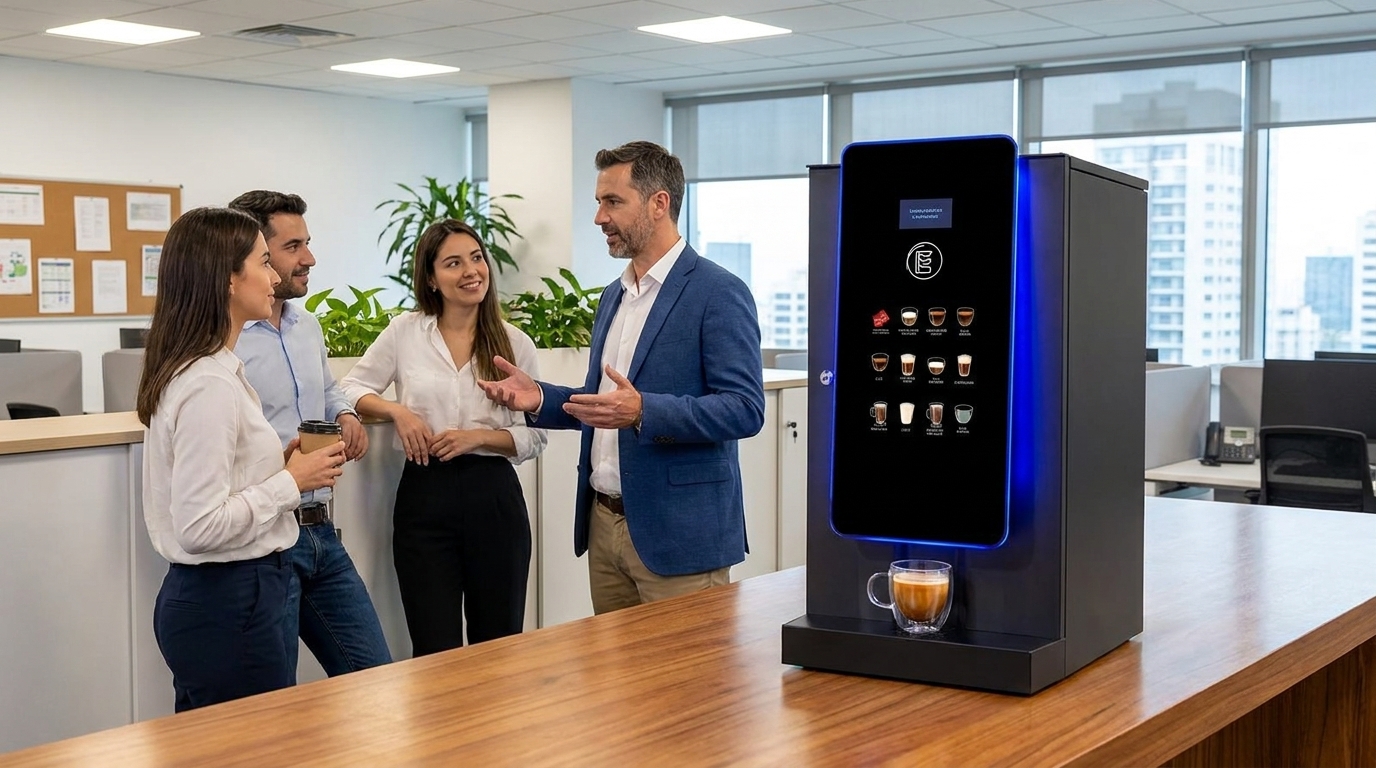
Selecting appropriate commercial equipment ensures seamless beverage delivery, whether operating a free perk program, a subsidized setup, or a user-pay commercial vending model.
Hardware Comparison: Office Coffee Solutions for Every Scale
Workplaces require commercial-grade equipment built to withstand daily brewing volume without frequent mechanical breakdowns.
| Machine Model | Ideal Office Size | Key Features | Operating Cost Profile | Recommended Setup |
| Premium Countertop Touch Screen Coffee Machine | Small (1–20 Employees) | Compact footprint, intuitive touch menu, low energy draw | Low daily maintenance | Countertop perk or honor system |
| Pro Coffee Vending Machine | Medium (20–75 Employees) | High-speed dispensing, robust grinder, cashless payment option | Balanced cost per cup | Subsidized or commercial vending |
| CorePro Coffee Vending Machine | Large Corporate (75+ Employees) | Dual bean hoppers, high hourly throughput, automated cleaning | Lowest cost per cup at high volume | Full commercial vending / free perk |
Choosing the right machine depends on daily cup capacity and breakroom layout. Review the comprehensive industry analysis on best office coffee machines to match hardware specs with your workforce demands.
Understanding spatial requirements before purchasing prevents costly installation delays; consult the guide on office coffee machine dimensions and ensure your breakroom is properly configured by following the best location to place office coffee machine guide.
Return on Investment (ROI) and Breakdown of Operating Expenses
Analyzing total cost of ownership (TCO) helps managers evaluate whether to purchase, lease, or charge for coffee equipment.
A mid-sized office of 50 employees consuming 2 cups per day generates 2,000 cups per month. At an average supply cost of $0.25 per cup, total beverage expenses equal $500 per month.
- Free Perk Model: The company absorbs $500/month as a 100% tax-deductible operational expense.
- Subsidized Model: Charging $0.50 per cup recovers $1,000/month, fully covering supply costs while subsidizing machine leasing.
- Commercial Vending Model: Charging $1.50 per cup generates $3,000/month in revenue, turning the breakroom into a profitable revenue center.
To explore commercial machine options, browse the full coffee vending machines collection. For detailed procurement strategy, review the guide to purchase office coffee machine and evaluate coffee vending machine rental cost structures before finalizing your breakroom plan.
Proper maintenance protects your investment; ensure staff follows the coffee vending machine cleaning and maintenance guide to prevent scaling and keep equipment running smoothly.
Frequently Asked Questions
Is it legal for employers to charge employees for office coffee under the FLSA?
Yes, it is legal for employers to charge employees for office coffee under the FLSA, provided that participation is strictly voluntary and charges do not reduce non-exempt employee pay below the federal minimum wage ($7.25/hr) or cut into overtime earnings.
Can an employer automatically deduct coffee fees from an employee’s paycheck?
An employer cannot automatically deduct coffee fees from a paycheck without written employee consent. Most state laws require explicit signed authorization before any non-statutory payroll deduction can occur.
What happens if a coffee payroll deduction drops an employee below minimum wage?
If a coffee payroll deduction drops an employee’s effective hourly rate below the minimum wage threshold, the employer violates Section 6 of the Fair Labor Standards Act. The employer faces back-pay liabilities, civil money penalties, and liquidated damages.
Is free office coffee considered taxable income for employees?
No, free office coffee is classified by the IRS as a de minimis fringe benefit under IRC 132(e). It is non-taxable to employees, and employers can typically deduct 100% of the cost as an ordinary business expense.
Can employers profit from selling coffee to their own employees?
Employers can legally profit from selling coffee through workplace vending machines or micro-markets, provided purchases are entirely optional. However, under 29 C.F.R. § 531.29, employers cannot profit from mandatory wage credits or compulsory amenity charges.
Are coffee clubs managed by employees legal in the workplace?
Yes, voluntary employee coffee clubs are legal as long as participation is completely optional and management does not force employees to contribute or utilize payroll deductions to collect club dues.
Can an employer require employees to pay for damaged breakroom coffee equipment?
An employer generally cannot deduct the cost of damaged breakroom coffee equipment from an employee’s pay if doing so reduces wages below minimum wage or if state law prohibits deductions for property damage.
What is the best payment method for an office coffee vending setup?
Installing cashless payment systems—such as credit card readers or RFID badge scanners—is the best setup because it processes voluntary transactions independently of payroll, avoiding FLSA wage deduction compliance issues.
Does providing free coffee improve workplace productivity?
Yes, providing free coffee increases employee productivity by keeping staff on-site during break periods, boosting energy levels, and fostering collaborative workplace interactions that drive employee retention.
Where can businesses buy commercial coffee vending machines?
Businesses can purchase or lease commercial equipment directly through specialized suppliers; explore high-capacity models in the coffee vending machines collection to find certified machines for offices of all sizes.