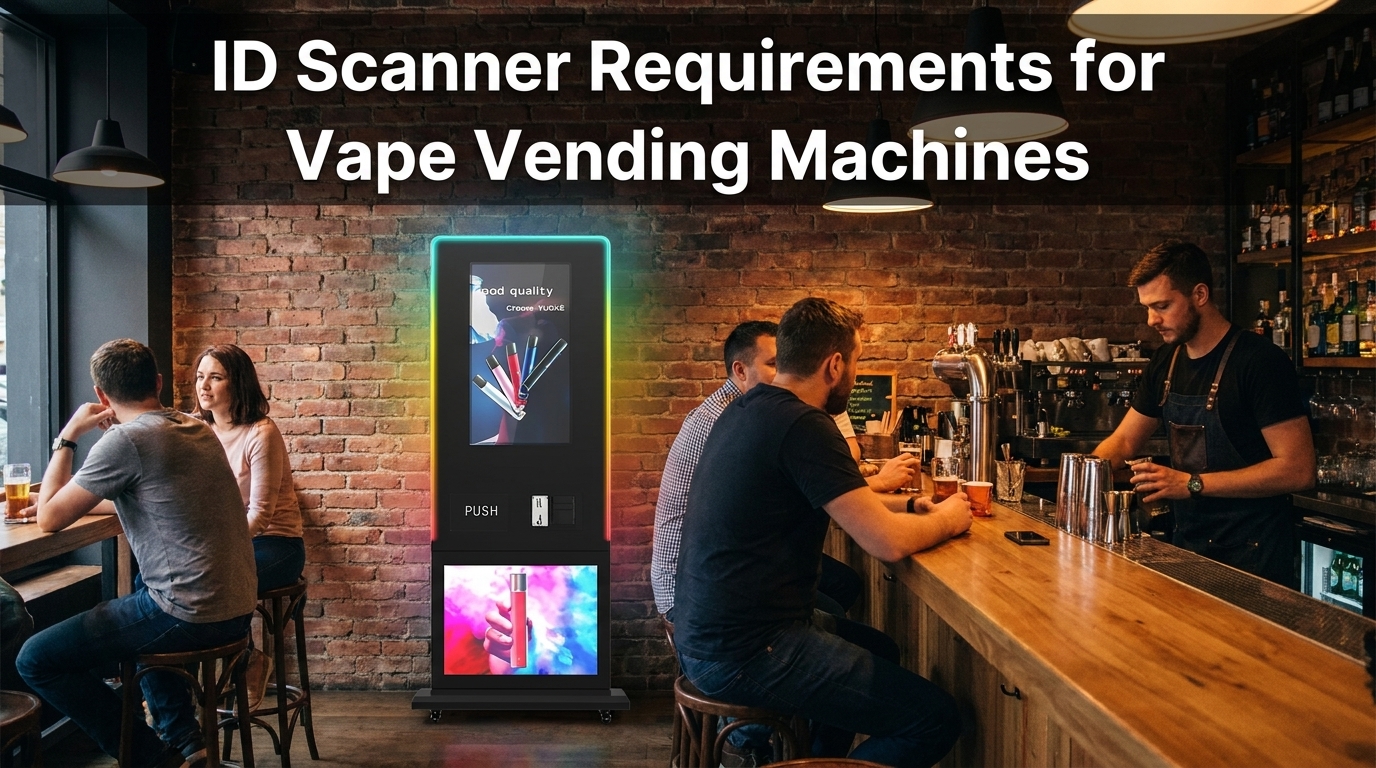
ID Scanner Requirements for Vape Vending Machines – Compliance & Implementation Guide
What Are ID Scanner Requirements for Vape Vending Machines?
ID scanner requirements for vape vending machines mandate that automated dispensing equipment must verify the buyer’s age (21+ in the United States) through government-issued identification before unlocking the product delivery mechanism.
These hardware and software specifications mandate physical document scanning, cryptographic authentication of state-issued barcodes, and real-time age calculation to prevent underage sales of electronic nicotine delivery systems (ENDS).
Modern operators running a vape vending machine business must equip hardware with specialized age verification modules to comply with federal tobacco statutes and local retail licensing rules.
Federal, State, and Local Regulatory Frameworks
Federal law under the Family Smoking Prevention and Tobacco Control Act requires retail tobacco and vapor sales to restrict access exclusively to individuals aged 21 and older. The U.S. Food and Drug Administration (FDA) enforces strict rules regarding automated tobacco sales, prohibiting unmonitored vending machines in locations accessible to minors.
State statutes often require vending equipment dispensing age-restricted products to be placed exclusively inside adult-only venues where individuals under 21 are legally prohibited from entering. Equipment supplied by VMFS USA integrates compliant lockouts to ensure vending hardware satisfies state excise board requirements and municipal enforcement codes.
Technical Standards for ID Verification Hardware
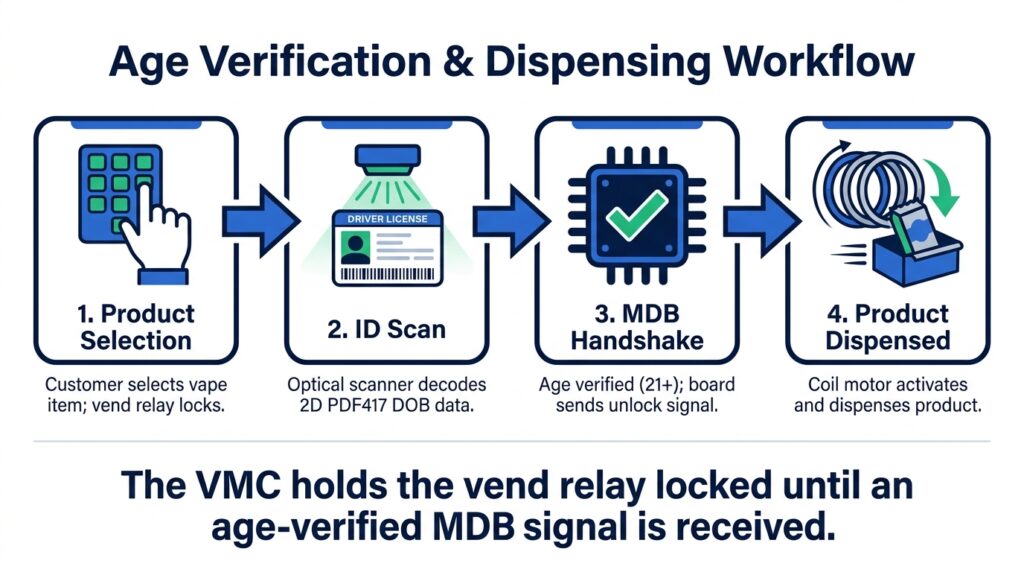
Compliant ID scanners read American Association of Motor Vehicle Administrators (AAMVA) standard 2D PDF417 barcodes printed on the reverse side of U.S. state driver’s licenses and state identification cards. Scanners process encrypted demographic data fields containing Date of Birth (DOB), document expiration date, document discriminator numbers, and issuer identification numbers (IIN).
Advanced optical scanners utilize infrared light sources (850nm wavelength) and ultraviolet illumination to detect physical document tampering, micro-printing anomalies, and fake identification cards. Understanding diverse hardware configurations across different types of vending machines allows operators to select optical assemblies designed for high-throughput commercial environments.
Selecting purpose-built specialty vending machines equipped with factory-installed ID readers eliminates aftermarket wiring failures and ensures seamless integration with internal control boards.
2D Barcode Scanning vs. Biometric Age Estimation
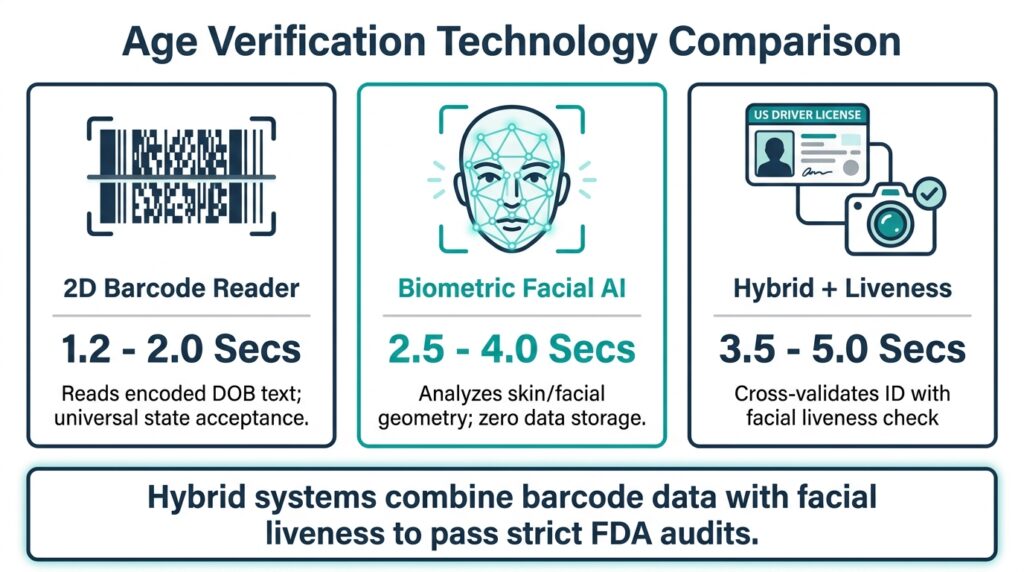
2D PDF417 barcode scanning extracts encoded textual data directly from physical identification cards to confirm that the birthdate meets or exceeds the 21-year threshold. Biometric facial age estimation analyzes facial geometry and skin texture through optical cameras using machine learning algorithms to predict user age without storing personal data.
Dual-technology systems combine PDF417 barcode reading with facial liveness detection to ensure the person presenting the card matches the identity on the government document. Deployment of next-generation AI grab-and-go vending machines enables operators to utilize hybrid computer vision models that streamline customer transactions while maintaining verification security.
Hardware Integration and MDB Protocol Handshakes
ID scanners communicate with vending machine main logic boards (VMC) through standard Multi-Drop Bus (MDB) protocols or auxiliary serial RS-232 interfaces.
When a customer selects a vape item, the VMC holds the vend relay in a locked state until the ID scanner sends a verified age signal over the MDB bus. Upon receiving an affirmative verification packet, the VMC releases the motor drive circuit to dispense the requested vapor product.
Prior to installing hardware, operators should review guides on buying a vending machine to ensure selected machine control boards support external MDB age-verification peripherals. Routine maintenance schedules outlined in keeping the money flowing essential vending machine maintenance tips prevent optical lens contamination and maintain high scan accuracy rates over time.
Operational and Technical Comparisons
Comparative Analysis of Verification Technologies
Automated verification technologies differ significantly across scan speed, hardware cost, forgery detection capabilities, and compliance acceptance rates across state jurisdictions.
| Feature / Metric | 2D PDF417 Optical Scanner | Biometric Facial Age Estimation | Hybrid ID + Liveness System | Manual Remote Video Verification |
| Transaction Speed | 1.2 – 2.0 Seconds | 2.5 – 4.0 Seconds | 3.5 – 5.0 Seconds | 15.0 – 30.0 Seconds |
| Hardware Cost Range | $250 – $550 | $400 – $800 | $700 – $1,400 | $150 – $300 + Monthly API |
| Fake ID Detection | Moderate (AAMVA Checksum) | High (Anti-Spoofing Liveness) | Very High (Cross-Validation) | Low (Human Error Prone) |
| State Regulatory Acceptance | Universal (50 States) | Regional / Emerging | High (Passes FDA Audits) | Variable / Restrictive |
| Privacy / Data Retention | Zero Storage (Ephemerally Read) | Anonymized Vector Embeddings | Temporary Encryption | Video Stream Logging |
Pros and Cons of Automated Age Verification Systems
Deploying automated ID verification hardware offers distinct operational advantages alongside specific technical limitations that operators must evaluate prior to route setup.
Operational Advantages
Automated ID verification provides continuous 24/7 compliance without requiring dedicated human oversight at the point of sale. Systems process transactions rapidly, eliminating long queues in high-volume adult venues while capturing detailed audit logs that shield operators from liability during regulatory compliance checks.
Maintaining strict age compliance directly protects the overall vending machine profit margin by preventing costly municipal fines, license revocations, or asset forfeitures resulting from illegal sales to minors.
Operational Limitations
Hardware components require routine cleaning to prevent dust buildup on optical sensors, which can cause transaction delays or false document rejections. Damaged, worn, or folded identification cards with scratched barcodes may fail to read, causing occasional customer drop-off at the machine.
Site Selection and Legal Requirements
Location Rules and Site Placement Agreements
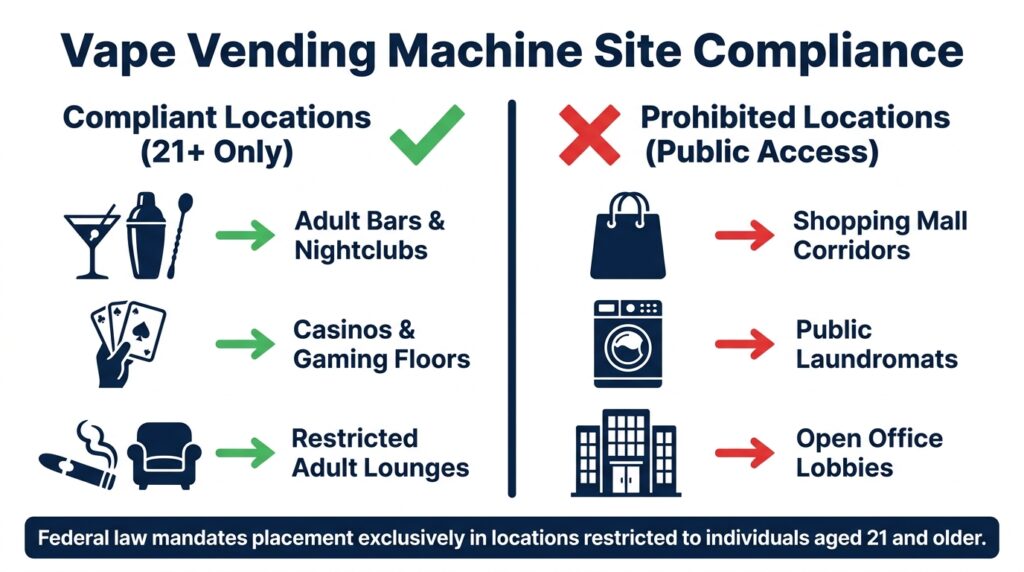
Vape vending machines must be positioned within venues restricted to individuals aged 21 and older, such as bars, nightclubs, casinos, and restricted lounge environments.
State laws strictly prohibit placing tobacco or vapor dispensing equipment in public laundromats, shopping mall corridors, gas stations, or unmonitored building lobbies. Commercial property owners seeking to monetize unused floor space can utilize structured programs to streamline machine installations and maintain regulatory standards.
Property managers interested in hosting age-verified automated retail units can list space details directly through VPlaced Location Services to connect with qualified local operators.
Operators analyzing prospective sites should review guides on identifying smart places to put a vending machine and strategies on how to choose a profitable vending location to maximize product throughput. Executing structured agreements using proven strategies for finding vending machine location contracts and drafting formalized terms with a compliant vending machine contract template protects route profitability and limits venue liability.
Business Formation and Compliance Infrastructure
Operating age-restricted automated retail routes requires a solid corporate framework to insulate personal assets from potential regulatory penalties or commercial liability. Operators must secure federal Employer Identification Numbers (EINs), state tobacco retail licenses, sales tax permits, and local vending operation permits prior to machine deployment.
Setting up a formal corporate structure shields business owners from commercial operational risks. Operators can establish proper business foundations, state business registrations, and tax compliance foundations by completing their LLC formation for a vending machine business through professional corporate formation services.
Maintaining comprehensive coverage outlined in a dedicated vending machine insurance guide protects assets against property damage, theft, and third-party liability claims. Implementing physical hardening techniques from guarding your investment essential tips for vending machine security prevents break-ins and protects high-value inventory.
Reviewing industry benchmarks on how to start investing in vending machines costs risks ROI and beginner steps helps new operators balance hardware capital expenditures against route earnings.
Frequently Asked Questions
What type of ID scanner is required for vape vending machines?
Vape vending machines require 2D optical barcode scanners capable of decoding AAMVA-compliant PDF417 barcodes printed on state driver’s licenses and identification cards. Scanners must process Date of Birth data instantly and integrate directly with the machine’s control board via MDB or serial protocols.
Does federal law allow vape vending machines in public locations?
No, federal FDA regulations prohibit tobacco and vape vending machines in unmonitored public locations. Equipment must be located exclusively in adult-only facilities where individuals under 21 are legally prohibited from entering at all times.
How does an ID scanner connect to a vending machine controller?
The ID scanner connects to the Vending Machine Controller (VMC) using Multi-Drop Bus (MDB) harness connections or an RS-232 serial interface. The scanner transmits an electronic handshake signal to release the product dispense motor only after validating a 21+ birthdate.
Can fake IDs bypass 2D barcode scanners on vending machines?
Basic fake IDs with cloned barcodes may pass simple age math checks, but advanced commercial scanners detect counter-checksum errors, expired document signatures, and demographic formatting discrepancies. Systems with infrared illumination and optical character recognition further reduce fake ID acceptance risks.
What happens if an ID scanner fails or loses power?
Vape vending machine control boards are configured with default-locked security logic. If the ID scanner loses power, disconnects, or experiences hardware faults, the machine automatically disables the vend circuit and prevents all transactions.
Do age verification ID scanners store customer personal data?
Compliant ID scanners read barcode data ephemerally in RAM memory solely to perform the mathematical age calculation. Once the transaction completes or times out, the system purges demographic records to ensure privacy compliance under state data protection statutes.
How much does an ID scanner module cost for a vending machine?
Commercial 2D PDF417 optical ID scanner modules cost between $250 and $600 per unit, depending on optical resolution, enclosure weatherproofing, and MDB interface hardware. Complete biometric or dual-factor hardware assemblies range from $700 to $1,400.
Are state state laws different regarding vape vending machine ID verification?
Yes, state laws vary significantly regarding automated age verification. While some states permit 2D PDF417 scanning in 21+ establishments, others require biometric liveness checks, live video monitoring, or prohibit automated tobacco sales entirely.
How do I clean and maintain an ID scanner on a vape vending route?
Clean the optical glass window bi-weekly using lint-free microfiber cloths and isopropyl alcohol to clear fingerprints and dust. Inspect internal wiring harnesses and test barcode reading responsiveness during routine restocking visits.
Can I retrofit an older vending machine with an ID scanner?
Yes, older vending machines equipped with MDB-compliant control boards (version 3.0 or higher) can be retrofitted with external ID scanner kits. Machines using legacy pulse or Micromech protocols require a control board logic upgrade prior to scanner installation.