An AI vending machine LLC separates your personal assets from business liability and lets you deduct expenses through a formal entity, while a sole proprietorship keeps setup instant and cost-free but leaves your personal savings, car, and home exposed to any claim tied to a machine you own. The right choice depends almost entirely on how many machines you’re running and how much liability exposure that fleet creates — a single test machine in a friend’s break room carries different risk than fifteen units spread across five property owners’ buildings. This guide breaks down exactly how each structure works for a vending operator, where the real risk sits, and when the switch from sole proprietor to LLC actually pays for itself.
Because AI vending machines cost more upfront than traditional coin-and-coil units, the capital at risk behind each entity decision is also higher — which is exactly why business structure deserves attention before, not after, you sign your first placement agreement.
The Real Difference Between an LLC and a Sole Proprietorship
Liability Protection: The Core Distinction
A sole proprietorship has no legal separation between you and your business — if a machine causes an injury or a contract dispute leads to a lawsuit, your personal assets are on the table. An LLC creates a legal shield: the business itself, not you personally, is typically the party liable, because forming an LLC creates an entity distinct from its owner in the eyes of the law.
How Each Structure Is Taxed
Both structures use pass-through taxation by default, meaning profits are reported on your personal tax return rather than taxed at the entity level first. The practical difference shows up in flexibility: an LLC can elect S-corporation tax treatment later to reduce self-employment tax as income grows, while a sole proprietorship has no such election available.
Why Business Structure Matters More for a Vending Fleet
Multiple Locations Mean Multiple Liability Exposures
Every additional machine placement adds a new location where something can go wrong — a refrigeration fault, a slip near the unit, a payment dispute. Because each location multiplies exposure independently, the liability math changes fast as a fleet grows from one machine to ten, even if nothing about the machines themselves has changed.
Property Owners, Contracts, and Legal Risk
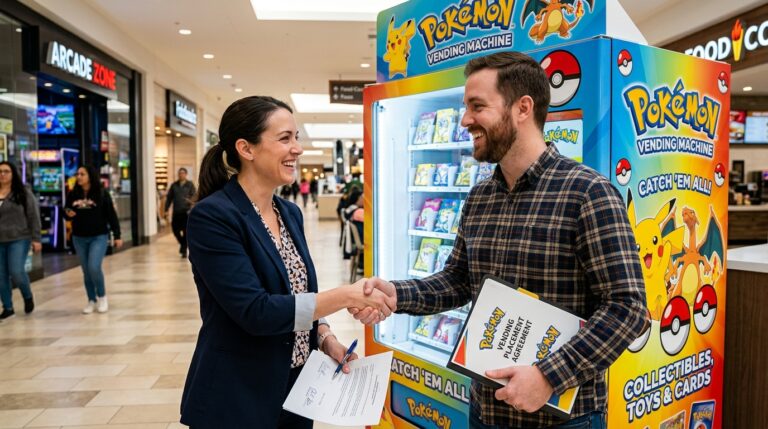
Property owners increasingly expect to sign with a formal business, not an individual, since a registered entity signals accountability and makes insurance and indemnification terms easier to negotiate. Every placement should still be backed by a proper AI vending machine placement contract template regardless of entity type, since the contract and the entity protect against different kinds of risk.
Sole Proprietorship for an AI Vending Machine Business
How It Works and Who It Fits
A sole proprietorship requires no formal registration in most states — you simply start operating under your own name or a assumed business name. It fits an operator testing the model with one or two machines before committing capital to formal structure, where the low personal liability exposure of a small trial run doesn’t yet justify the paperwork.
The Risks of Staying a Sole Proprietor as You Scale
Every machine added while still operating as a sole proprietor adds directly to personal liability, because there’s no legal wall between the business and your own finances. Operators who wait too long to formalize often end up restructuring under pressure — after a contract dispute or an injury claim — rather than on their own timeline.
LLC for an AI Vending Machine Business
How LLC Formation Protects Vending Operators
Forming an LLC for a vending machine business puts a legal barrier between your personal assets and anything that happens at a machine location, so a lawsuit tied to one unit generally can’t reach your personal bank account or home. That protection becomes proportionally more valuable as the number of locations — and the number of ways something could go wrong — increases.
Single-Member vs. Multi-Member LLC
A single-member LLC is taxed identically to a sole proprietorship by default, so the liability shield comes without added tax complexity for a solo operator. A multi-member LLC becomes relevant once a partner contributes capital or manages a separate territory, since it clarifies ownership percentages and profit splits in writing before disagreements happen. Either version should tie back to a documented AI vending machine business plan that spells out growth assumptions and capital contributions.
Ready to put a liability shield around your vending fleet?Form an LLC for Vending
Side-by-Side Comparison
Placed next to each other, the two structures diverge on exactly the factors that matter most to a growing vending operation.
| Factor | Sole Proprietorship | LLC |
|---|---|---|
| Liability protection | None — personal assets exposed | Personal assets generally shielded |
| Setup complexity | Minimal, often no filing required | State filing and ongoing compliance |
| Taxation | Pass-through, no election options | Pass-through by default, S-corp election available |
| Credibility with property owners | Lower — signs as an individual | Higher — signs as a registered business |
| Best for | One or two machines, testing the model | Multi-location fleets and growing exposure |
Pros and Cons of Each Structure
| Structure | Pros | Cons |
|---|---|---|
| Sole Proprietorship | Free or near-free to start, no ongoing filings, simplest tax return | Unlimited personal liability, harder to bring on partners, less credible to property owners |
| LLC | Personal asset protection, flexible tax elections, stronger contracting credibility | State filing fees, annual compliance requirements, slightly more paperwork |
Cost and Setup Time Compared
A sole proprietorship costs nothing to start in most states beyond an optional assumed-name filing, and it’s operational the same day. An LLC involves a state filing fee and, in many states, an annual report or franchise fee — a real but generally modest cost relative to the value of one machine, let alone a fleet of them. Once formed, an LLC also needs a registered agent for the vending business, which ensures legal and compliance notices reach you even across multiple states of operation.
Tax Differences That Affect Vending Operators
Self-Employment Tax and Pass-Through Taxation
Both structures pay self-employment tax on net profit by default, since income passes straight through to your personal return either way. The LLC’s advantage appears once profit grows large enough that an S-corp election meaningfully reduces the portion of income subject to self-employment tax — a threshold worth revisiting annually as fleet revenue climbs.
EIN, Sales Tax, and Vending-Specific Filing Requirements
An EIN is required for an LLC and recommended even for a sole proprietor once bank accounts, payment processors, or employees enter the picture. Sales tax registration and a vending-specific tax filing structure apply regardless of entity type, since sales tax obligations are tied to the transactions themselves, not to how the business is legally organized.
Other Business Structures Worth Knowing
LLC and sole proprietorship cover most vending operators, but a handful of other structures fit specific situations — multiple owners, outside investors, or nonprofit placements.
| Structure | Fits Best When |
|---|---|
| Partnership | Two or more owners sharing capital and routes without a formal LLC |
| LLP | Multiple owners wanting shared liability protection each |
| Limited Partnership | Bringing in investors while retaining operational control |
| S-Corporation | An existing LLC electing tax status to reduce self-employment tax |
| C-Corporation | Larger fleets seeking outside investment or eventual sale |
| Nonprofit Corporation | Vending operations tied to a mission-driven or charitable purpose |
When to Upgrade From Sole Proprietor to LLC
The clearest signal to formalize is adding a second location, since that’s the point where liability stops being theoretical and starts compounding with every new site. Reviewing how to scale an AI vending machine business makes clear that expansion plans and entity formation need to move together, not sequentially — waiting until after the third or fourth machine just means restructuring while already exposed. Tracking AI vending machine ROI also helps quantify the decision: once fleet profit comfortably covers LLC filing and compliance costs, the protection is effectively free.
Protections You Still Need Beyond Entity Choice
Forming an LLC protects personal assets, but it doesn’t replace location agreements, vendor and supplier contracts, or revenue-sharing documentation — those protect the business itself, not just the owner. A complete resource on how to start an AI vending machine business walks through formation and these supporting contracts together, since skipping either one leaves a real gap.
Getting Machine- and Location-Ready Once You’re Formalized
Selecting the Right AI Vending Machines
With the legal structure in place, machine selection becomes the next decision point. A full AI vending machine buyer’s guide and a review of established AI vending machine manufacturers in the USA help avoid one-off purchases that complicate parts and service later, and matching machines to the best products for an AI vending machine keeps early sales data clean and useful.
Finding and Securing Locations
A formally registered business also strengthens location outreach — property owners take a registered LLC more seriously than an individual pitching a machine. Platforms built for AI vending machine placement and guidance on finding a location for an AI vending machine both work better once you can sign as a business entity rather than a private individual.
Know a property owner who wants vending on-site?List a Location on VPlaced
Browse machines built for your newly formed vending business:
AI Smart Fridge Vending Machine AI Smart Combo Vending Machine AI Smart Cooler Vending Machine
Software, Costs, and Ongoing Operations
Software That Runs Your Fleet
Understanding how an AI vending machine works and choosing the right AI vending machine software both matter more once you’re operating under a registered business, since accurate reporting feeds directly into the bookkeeping and tax filings your new entity now requires.
Ongoing Costs and Maintenance
Budgeting realistically means separating one-time formation costs from the recurring reality of running machines — a full AI vending machine cost breakdown, dependable AI vending machine repair services, and a working knowledge of the AI vending machine parts breakdown keep your entity’s books accurate and your machines running.
Why the Right Foundation Matters at Scale
A detailed case study on finding the sweet spot for AI vending machines shows how quickly a well-placed fleet grows past the point where a sole proprietorship makes sense, and broader coverage of the AI vending machine experiment reshaping smart retail shows the category isn’t slowing down. As the AI vending machine market size continues expanding, operators who formalize early are better positioned to compare how AI-powered vending machines optimize sales across a growing, properly protected fleet — rather than scrambling to restructure once the fleet has already outgrown its original entity.
Neither structure is universally correct — a sole proprietorship is a reasonable way to test one machine, and an LLC is the reasonable next step the moment a second location, a partner, or real liability exposure enters the picture. Deciding early, rather than reactively, is what actually protects the business you’re building.