Office Coffee Machine Depreciation Rate – Asset Lifecycle Management
Navigating the office coffee machine depreciation rate requires understanding IRS asset classification, capital expenditure accounting, and hardware wear cycles. Under the Modified Accelerated Cost Recovery System (MACRS), commercial coffee equipment generally qualifies as 5-year property, allowing businesses to systematically deduct hardware costs against taxable revenue.
Proper accounting of office coffee equipment directly impacts corporate tax liability, net cash flow, and asset replacement schedules. Business owners must evaluate straight-line depreciation, accelerated MACRS schedules, and immediate Section 179 expensing to optimize the financial recovery of their commercial breakroom investments.
Understanding Office Coffee Machine Depreciation Rate and IRS Asset Classification
The baseline office coffee machine depreciation rate is determined by IRS asset class guidelines that govern commercial food service and office beverage dispensing equipment. Accounting protocols mandate that tangible business assets losing value over time must be written off across their recovery period rather than expensed entirely in the purchase year, unless specific tax elections apply.
IRS MACRS Asset Classifications: 5-Year vs 7-Year Recovery Periods
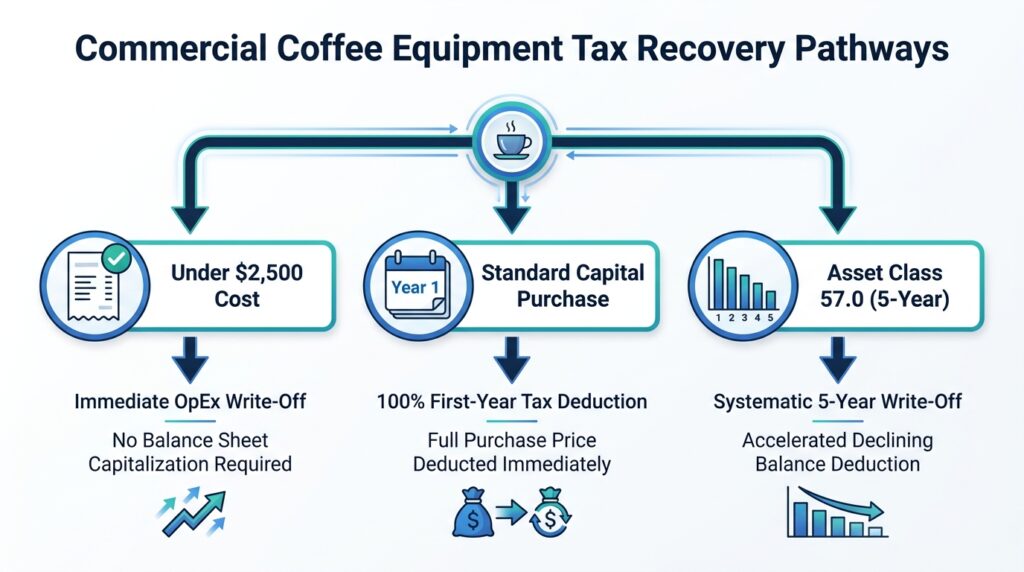
Commercial coffee machines are classified under IRS Asset Class 57.0 (Distributive Trades and Services) or Asset Class 00.12 (Information Systems/Equipment), assigning them a 5-year recovery period. Standard office furniture and non-electrical fixtures fall into a 7-year category, whereas motorized beverage dispensing hardware qualifies for the faster 5-year recovery schedule.
Classifying coffee hardware as 5-year property allows businesses to recover capital investments faster than general office fixtures. Reviewing a comprehensive guide to purchase office coffee machine helps clarify initial capitalization requirements before establishing depreciation schedules.
Section 179 Expensing vs Bonus Depreciation Rules
Section 179 of the Internal Revenue Code allows qualifying businesses to write off 100% of the purchase price of eligible commercial coffee machines in Year 1. Rather than spreading deductions over five years, Section 179 treats the asset as an immediate expense up to statutory annual dollar limits.
Kitchenall
Bonus depreciation provides an additional first-year write-off mechanism for commercial equipment placed in service. Combining Section 179 with bonus depreciation allows companies purchasing commercial beverage systems to deduct total equipment costs immediately, substantially lowering taxable net income in the acquisition year.
Kitchenall
Tax Code Compliance and Capital Asset Thresholds
Capitalization thresholds dictate whether a coffee machine is depreciated over time or expensed immediately under de minimis safe harbor rules. IRS safe harbor provisions permit businesses to write off purchases under $2,500 per item (or $5,000 for entities with Applicable Financial Statements) as standard operational expenses.
High-capacity equipment, automated dispensers, and touch-screen espresso machines exceeding these cost thresholds must be capitalized on balance sheets. Evaluating the total coffee vending machine price guide ensures accountants properly tag assets before filing IRS Form 4562.
Depreciation Calculation Methods for Commercial Coffee Equipment
Calculating commercial coffee machine depreciation requires choosing between straight-line, MACRS declining balance, or accelerated double declining balance methods based on tax strategy. The selected method dictates annual tax shield timing, net book value accuracy, and corporate balance sheet strength.
  Straight-Line Method               MACRS 200% Declining Balance
  +-----------------------+          +-----------------------+
  | Year 1: 20%           |          | Year 1: 20.00%        |
  | Year 2: 20%           |          | Year 2: 32.00%        |
  | Year 3: 20%           |          | Year 3: 19.20%        |
  | Year 4: 20%           |          | Year 4: 11.52%        |
  | Year 5: 20%           |          | Year 5: 11.52%        |
  +-----------------------+          | Year 6:  5.76%        |
                                     +-----------------------+
Straight-Line Depreciation Method
The straight-line depreciation method divides the asset’s depreciable basis evenly across its useful life after subtracting estimated salvage value. This method provides predictable, steady tax deductions across five years.
The standard formula for straight-line depreciation is:
Annual Depreciation Expense=Useful Life (Years)Purchase Price−Salvage Value
For example, a commercial espresso system purchased for $5,000 with an estimated salvage value of $500 over a 5-year useful life generates an annual depreciation deduction of $900:
Annual Expense=5$5,000−$500=$900 per year
MACRS 200% Declining Balance Method
The MACRS 200% Declining Balance method front-loads tax deductions into the early years of the coffee machine’s life cycle. The IRS applies the half-year convention, assuming the equipment was placed in service mid-year regardless of the exact purchase date.
AssetAccountant+ 1
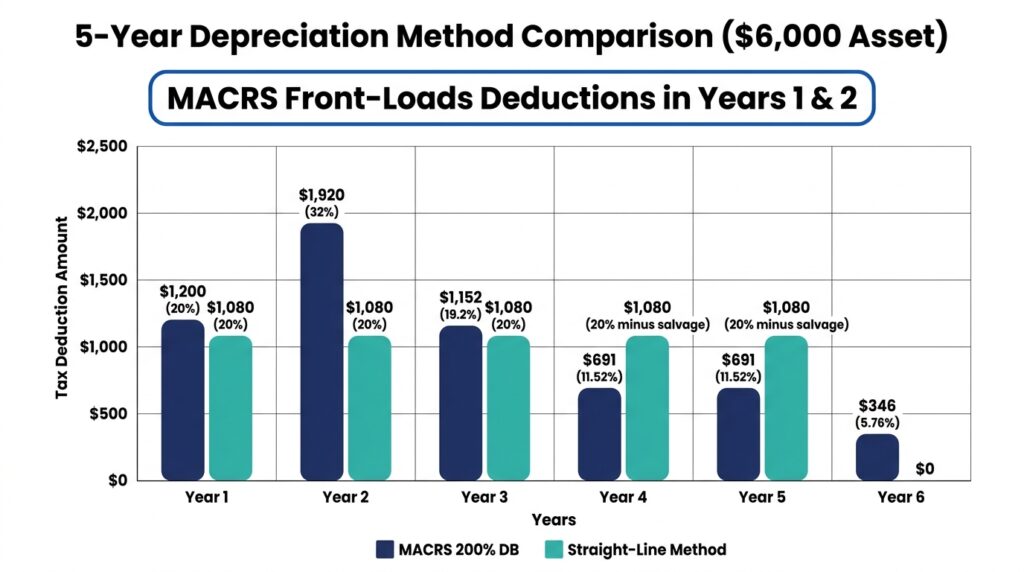
Under 5-year MACRS property rules, fixed percentages are applied to the initial unadjusted cost basis across six tax years:
- Year 1: 20.00% fbaum.unc.edu
- Year 2: 32.00% fbaum.unc.edu
- Year 3: 19.20% fbaum.unc.edu
- Year 4: 11.52% fbaum.unc.edu
- Year 5: 11.52% fbaum.unc.edu
- Year 6: 5.76%
Double Declining Balance (DDB) Accelerated Method
The Double Declining Balance method doubles the straight-line depreciation rate and applies it to the remaining book value at the beginning of each period. It accelerates cost recovery faster than straight-line, matching heavy initial equipment wear with higher upfront deductions.
Kitchenall
The DDB depreciation rate formula is:
DDB Rate=(Useful Life1)×2=(51)×2=40% per year
For a $5,000 asset, Year 1 depreciation equals $2,000 ($5,000 × 40%). Year 2 depreciation equals $1,200 ($3,000 remaining book value × 40%). Depreciation continues until the remaining book value reaches the estimated salvage threshold.
Kitchenall
Comparative Depreciation Schedule Table
The comparative table below demonstrates tax deduction schedules for a $6,000 commercial office coffee machine over a 5-year period using three standard accounting methods (assuming $600 salvage value for straight-line):
| Year | Straight-Line ($) | MACRS 200% DB ($) | Double Declining Balance ($) |
|---|---|---|---|
| Year 1 | $1,080 | $1,200 | $2,400 |
| Year 2 | $1,080 | $1,920 | $1,440 |
| Year 3 | $1,080 | $1,152 | $864 |
| Year 4 | $1,080 | $691.20 | $518.40 |
| Year 5 | $1,080 | $691.20 | $177.60 (to salvage cap) |
| Year 6 | $0 | $345.60 | $0 |
| Total Deducted | $5,400 | $6,000 | $5,400 |
Physical Degradation and Operational Lifecycle Factors
Physical depreciation of commercial coffee machines stems from mechanical wear, thermal stress, hydraulic cycling, and mineral scale accumulation. Operational degradation frequently outpaces accounting depreciation if equipment maintenance schedules are neglected.
Limescale Build-Up and Thermal Component Wear
Limescale accumulation inside boilers and thermoblocks represents the primary physical driver of coffee machine failure. Calcium and magnesium carbonate deposits coat heating elements, insulating thermal components and forcing heating circuits to work longer to reach extraction temperatures.
Excessive thermal cycling degrades heating element resistance wires, leading to thermal fuse failures and temperature instability. Implementing routine filtration systems slows physical decay, extending hardware life beyond tax depreciation schedules. Understanding proper protocols outlined in a coffee vending machine cleaning and maintenance guide helps protect internal boiler health.
Brew Group Mechanical Cycles and Pump Volumetrics
Brew group assemblies, internal gearboxes, and rotary vane pumps undergo mechanical friction with every beverage cycle. High-volume office environments executing 100+ daily extractions cause seal wear, pressure drops, and inconsistent flow rates.
Vibration rotary pumps experience internal vane erosion over time, lowering extraction pressure from 9 bars down to uncalibrated levels. Mechanical gear wear causes brew chamber misalignment, leading to coffee puck channeling and premature structural component replacement.
Maintenance Routines and Extended Useful Life Impact
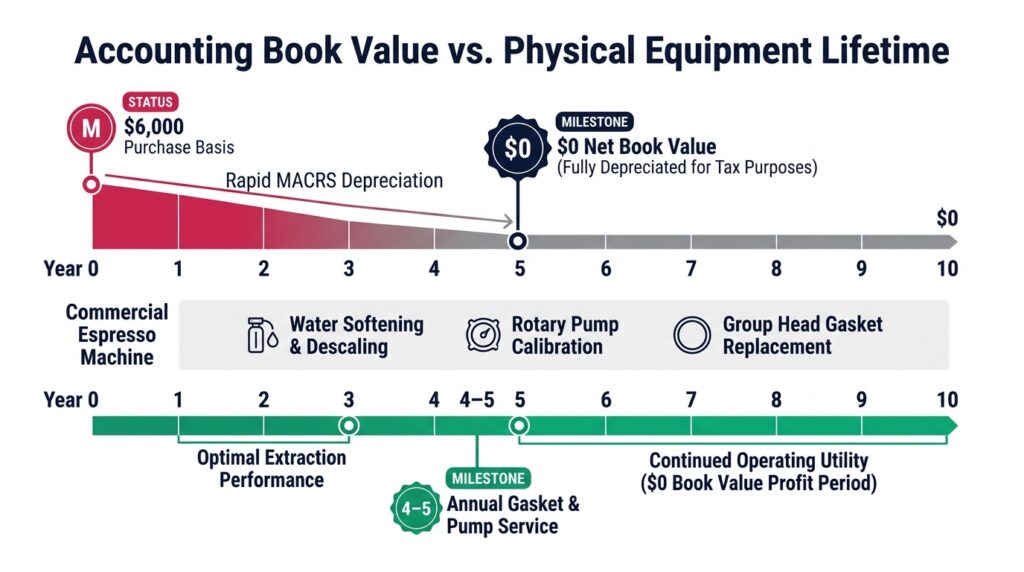
Preventive maintenance directly mitigates physical depreciation, allowing machines to maintain functional reliability long after reaching zero book value. Routine backflushing, group gasket replacements, and descaling cycles prevent catastrophic internal component failure.
Daily Care (Rinsing & Waste Clearing)
   │
   ▼
Monthly Maintenance (Deep Descaling & Group Head Cleaning)
   │
   ▼
Annual Overhaul (Gasket Replacement & Pump Recalibration)
   │
   ▼
Extended Operating Life (7-10 Years Total Utility)
Well-maintained commercial units routinely outlast their 5-year MACRS schedule, achieving 7 to 10 years of productive service. Extending physical operational life while generating tax deductions enhances total Return on Investment (ROI).
Evaluating Commercial Coffee Machines: Depreciation, Cost, and ROI
Evaluating commercial coffee equipment requires analyzing initial capital expenditure, operational costs, employee productivity gains, and potential automated retail revenue. Selecting hardware suited to office headcount prevents early equipment burn-out and premature write-offs.
Commercial Machine Architecture: Countertop vs Industrial Units
Countertop machines offer compact footprints ideal for corporate breakrooms, administrative suites, and conference spaces. Industrial floor-standing coffee vending units feature higher capacity hoppers, internal cup dispensers, and robust internal boilers designed for high-throughput environments.
Reviewing office coffee machine dimensions ensures breakrooms have adequate counter clearance, ventilation, and plumbing access. Placing high-volume equipment in optimized locations maximizes usage while reducing wear from improper operational handling.
Cost Breakdown: Small, Medium, and Enterprise Office Setups
Equipment capital outlay scales directly with employee count and daily cup volume demands. Matching equipment capacity to workplace volume prevents premature mechanical failure:
[Small Office: 10-30 Staff]  --> Countertop Touchscreen Units ($1,500 - $3,500)
[Medium Office: 30-100 Staff] --> Commercial High-Volume Machines ($3,500 - $7,000)
[Enterprise: 100+ Staff]     --> Floor-Standing Vending Systems ($7,000 - $12,000+)
Selecting top-rated equipment from curated guides on the best office coffee machines ensures appropriate balance between durability, price, and operational feature sets.
Revenue Generation and Cost Recovery via Integrated Cashless Payments
Commercial coffee machines equipped with telemetry and payment systems transform breakroom amenities into self-sustaining, revenue-generating assets. Modern organizations use pay-per-cup models to offset machine depreciation and bean acquisition expenses.
Integrating advanced cashless payment systems for coffee vending machines allows touch-to-pay transactions via credit cards and mobile wallets. Generating consistent cup revenue transforms a standard expense into a profitable asset, accelerating capital cost recovery. Reviewing industry analyses on whether coffee vending machines are profitable assists financial managers in structuring internal pricing strategies.
VMFS USA Core & Core Pro: Modern Office Coffee Solutions
VMFS USA engineers premium commercial beverage dispensers designed specifically for demanding office environments, automated breakrooms, and commercial facilities. Their machines feature durable internal components, intuitive interfaces, and streamlined maintenance protocols to optimize long-term asset value.
Explore the complete catalog on the VMFS USA Coffee Vending Machines Collection page to compare model specs and commercial pricing.
VMFS USA Core Premium Countertop Touch Screen Coffee Machine
The VMFS USA Core Premium Countertop Touch Screen Coffee Machine delivers barista-quality espresso beverages in a sleek, space-saving footprint engineered for small-to-medium offices.
+-------------------------------------------------------------------+
|               VMFS USA CORE COUNTERTOP FEATURE CARD               |
+-------------------------------------------------------------------+
|  Footprint: Heavy-Duty Commercial Countertop                      |
|  Interface: High-Definition Intuitive Touch Screen                |
|  Capacity: Ideal for 10-50 Daily Users                            |
|  Grinder: Precision Ceramic Burrs for Extraction Accuracy         |
|  Boiler System: Fast-Heating Dual Thermoblock Architecture        |
|  Best For: Small Offices, Executive Suites, Client Lounges        |
+-------------------------------------------------------------------+
Featuring bean-to-cup grinding, automated milk frothing, and programmable drink menus, the Core Countertop unit reduces employee downtime while providing a high-end coffee experience. Its modular interior components simplify servicing, keeping maintenance costs minimal throughout its 5-year depreciation lifecycle.
VMFS USA Pro Coffee Vending Machine
The VMFS USA Pro Coffee Vending Machine provides reliable mid-capacity performance designed for medium-sized corporate offices and busy commercial floors.
+-------------------------------------------------------------------+
|                  VMFS USA PRO FEATURE CARD                        |
+-------------------------------------------------------------------+
|  Footprint: Medium Standalone / Heavy Countertop Hybrid           |
|  Interface: Commercial Push-Button / Digital Display              |
|  Capacity: Ideal for 50-150 Daily Users                           |
|  Hopper Capacity: Dual High-Volume Bean & Soluble Canisters       |
|  Payment Options: Optional Cashless Reader Integration           |
|  Best For: Mid-Sized Businesses, Call Centers, Corporate Wings   |
+-------------------------------------------------------------------+
Engineered for continuous daily extractions, the VMFS USA Pro features commercial-grade boilers and heavy-duty grinder assemblies. Its high-capacity ingredient hoppers require less frequent restocking, significantly reducing operational labor requirements.
VMFS USA Core Pro Commercial Coffee Vending Machine
The VMFS USA Core Pro Commercial Coffee Vending Machine represents enterprise-level coffee dispensing technology designed for high-volume offices, hospitals, and commercial vending routes.
+-------------------------------------------------------------------+
|                VMFS USA CORE PRO FEATURE CARD                     |
+-------------------------------------------------------------------+
|  Footprint: High-Capacity Standalone Floor/Counter Unit           |
|  Interface: Large Interactive Touch Screen Display                |
|  Capacity: Built for 150+ Daily Users / Enterprise Scale          |
|  Payment Integration: Full Telemetry, Cashless, NFC, MDB Support  |
|  Cup Handling: Internal Automated Cup Dispensing System           |
|  Best For: Enterprise Campuses, Industrial Facilities, Venues     |
+-------------------------------------------------------------------+
Equipped with telemetry monitoring, advanced cashless payment options, and automated internal cup dropping, the Core Pro delivers maximal uptime. Its industrial-grade components maximize long-term operational life, easily outlasting standard IRS tax depreciation windows.
Pros and Cons Analysis of High-Volume Commercial Machines
Evaluating commercial coffee equipment involves balancing tax benefits and operational efficiency against capital requirements.
Pros:
- Accelerated Tax Deductions: Qualifies for 100% Section 179 first-year write-offs.
- Employee Productivity: Saves an average of 15 minutes per employee daily compared to off-site coffee runs.
- Revenue Generation: Integrated payment processing turns coffee amenities into income streams.
- High Durability: Commercial components handle heavy daily extraction volumes with lower failure rates.
Cons:
- Upfront Capital Commitment: High-performance units require greater initial capital allocation.
- Preventive Maintenance Required: Water filtration and routine descaling are necessary to prevent physical decay.
- Plumbing and Power Needs: Commercial machines require dedicated water lines and higher electrical capacity.
Financial Strategy: Maximizing Tax Benefits and Salvage Value
Integrating capital equipment planning with corporate tax strategy ensures maximum cost recovery and optimal balance sheet management. Companies must establish clear financial policies governing commercial coffee hardware acquisitions.
                              CAPEX vs OPEX STRATEGY
                                        │
        ┌───────────────────────────────┴───────────────────────────────┐
        ▼                                                               ▼
   CapEx Purchase                                                 OpEx Lease
   - Owned Asset on Balance Sheet                                 - Off-Balance Sheet
   - MACRS 5-Yr / Sec 179 Write-Off                                - 100% Monthly Tax Deduction
   - Depreciates over time                                        - Ongoing Operational Cost
Capital Expenditure (CapEx) vs Operational Expenditure (OpEx)
Purchasing a commercial coffee machine constitutes a Capital Expenditure (CapEx), creating a fixed balance sheet asset depreciated over time. CapEx purchases unlock property ownership benefits, long-term asset value, and Section 179 first-year tax write-offs.
Leasing coffee hardware classifies transactions as Operational Expenditure (OpEx). Lease payments are deducted as direct operating expenses in the month incurred. Organizations seeking to conserve liquid cash often prefer OpEx leasing, whereas companies seeking maximum tax reduction prefer upfront CapEx purchasing.
Salvage Value and Secondary Market Resale Accounting
Salvage value represents the estimated residual value of a coffee machine at the end of its accounting useful life. IRS rules require subtracting salvage value from the cost basis when applying straight-line depreciation.
Kitchenall
Initial Cost Basis ($6,000) ──► MACRS Depreciation ($6,000) ──► Net Book Value ($0)
                                                                       │
                                                                       ▼
                                 Secondary Market Sale ($1,200) ──► Depreciation Recapture Tax
If a fully depreciated machine with a $0 book value is sold on the secondary market for $1,200, the proceeds are taxed as ordinary income under IRS depreciation recapture rules.
Machine Lease vs Purchase Tax Implications
Choosing between leasing and purchasing impacts corporate tax structures and equipment replacement flexibility:
| Strategy Factor | Direct Purchase (CapEx) | Equipment Leasing (OpEx) |
|---|---|---|
| Tax Impact | Section 179 immediate write-off or 5-year MACRS | 100% of monthly lease payments deductible |
| Balance Sheet | Tangible fixed asset addition | Operating expense liability |
| Maintenance | Owner responsible for servicing | Frequently bundled in lease terms |
| Total Lifetime Cost | Lower overall total cost | Higher long-term cost due to interest |
Implementing a structured corporate breakroom policy guided by an office coffee machine policy template ensures clear guidelines for equipment usage, maintenance responsibility, and replacement timelines.
Frequently Asked Questions
What is the standard IRS depreciation rate for an office coffee machine?
Under IRS MACRS guidelines, commercial office coffee machines are classified as 5-year recovery property. Under the 200% declining balance method, the annual depreciation rates are 20% in Year 1, 32% in Year 2, 19.20% in Year 3, 11.52% in Year 4, 11.52% in Year 5, and 5.76% in Year 6.
Kitchenall+ 1
Can I fully deduct an office coffee machine in the first year using Section 179?
Yes, eligible commercial coffee machines qualify for 100% first-year write-offs under Section 179, provided the equipment is placed in service during that tax year and used for business purposes more than 50% of the time.
Kitchenall
What asset class do commercial coffee and beverage vending machines belong to?
Commercial coffee and beverage vending machines fall under IRS Asset Class 57.0 (Distributive Trades and Services) or general commercial food service equipment, assigning them a 5-year MACRS recovery period.
Kitchenall
How does straight-line depreciation differ from MACRS for coffee hardware?
Straight-line depreciation deducts equal expense amounts every year over 5 years after subtracting salvage value. MACRS front-loads deductions into the early years using declining balance formulas without subtracting salvage value upfront.
Kitchenall+ 1
What is the average physical useful life of a commercial coffee vending machine?
A high-quality commercial coffee machine typically lasts 7 to 10 years with routine preventative maintenance, water filtration, and descaling, continuing to operate effectively long after its 5-year tax depreciation schedule ends.
Tractian
How do I calculate the salvage value of a commercial espresso machine?
Salvage value is calculated by estimating the machine’s secondary market resale value or scrap value at the end of its useful life, typically ranging between 5% and 15% of the original purchase price.
Are coffee machine lease payments fully tax-deductible?
Yes, operating lease payments for office coffee machines are categorized as operational expenditures (OpEx) and are 100% tax-deductible as ordinary business expenses in the year they are paid.
What happens if I sell a fully depreciated coffee machine?
If you sell a fully depreciated coffee machine with a $0 book value, the total sale proceeds are subject to IRS depreciation recapture rules and taxed as ordinary business income.
Do small countertop coffee makers qualify for immediate expensing?
Yes, under the IRS de minimis safe harbor rule, coffee makers costing under $2,500 per item can be expensed immediately as routine office supplies rather than capitalized and depreciated.
How does water hardness impact physical depreciation on coffee machines?
Unfiltered hard water causes rapid limescale buildup inside boilers and solenoid valves, causing thermal stress, reduced extraction pressure, and premature component failure if not managed with proper water softening filtration.