Vending Machine Operator Insurance: Complete Coverage Guide
Vending machine operator insurance protects a vending business against financial losses arising from customer injuries, property damage, product-related claims, stolen or damaged equipment, employee injuries, vehicle accidents, and other operational risks. The right policy depends on the machines you operate, products you sell, locations you service, employees you hire, vehicles you use, and contractual requirements imposed by property owners.
A vending machine is often installed away from the operator’s own premises. That creates a distinctive risk profile: the operator owns equipment located on someone else’s property, sells products directly to consumers, transports inventory and machines, and may access multiple commercial properties every week. Insurance therefore should be treated as part of the vending business infrastructure, alongside machine selection, location agreements, payment systems, inventory controls, and compliance.
For context, Insureon reports median monthly costs of about $37 for general liability insurance and $58 for a business owner’s policy (BOP) among vending machine businesses purchasing policies through its platform. These are not universal vending insurance prices; actual premiums depend on the business and policy.
What Is Vending Machine Operator Insurance?
Explaining vending machine operator insurance
Vending machine operator insurance is a group of commercial insurance coverages designed to protect businesses that own, install, stock, maintain, and service vending machines at locations they do not own.
Unlike a standard retail store, a vending operator may have machines spread across offices, hotels, apartment buildings, factories, gyms, schools, and other third-party properties. This creates exposure to third-party bodily injury, property damage, product liability, equipment loss, theft, employee injuries, vehicle accidents, and cyber risks.
There is no single policy that automatically covers every vending operation. An operator typically combines several coverages according to the business’s actual risks.
Why vending businesses have unique insurance risks
A vending machine can malfunction, fall, leak, overheat, damage surrounding property, accept a payment without dispensing a product, or contribute to a customer injury. The products themselves create another layer of exposure. Food, beverages, supplements, toiletries, electronics, toys, and other merchandise can generate different liability risks.
The Hartford specifically identifies risks including property damage, inventory loss, customer bodily injury, food poisoning, and machine malfunction for vending businesses.
Insurance principle: Protect the liability you create, the equipment you own, the products you sell, the people who work for you, and the vehicles you use.
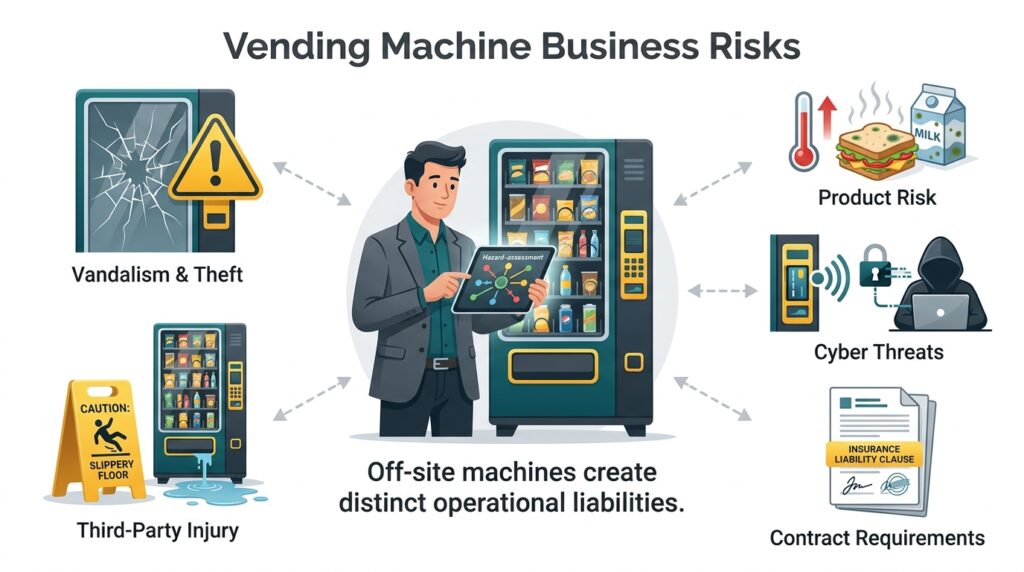
Why Vending Machine Operators Need Insurance
A vending machine can create liability
Suppose an operator installs a beverage machine inside an office building. A customer reaches for a product and is injured by a machine component. The property owner could also become involved in the dispute. General liability coverage is designed to address certain third-party bodily injury and property damage claims, subject to the policy’s terms, conditions, limits, and exclusions.
The risk becomes more significant as the route expands. One machine creates one exposure; 50 machines across 50 locations create a much larger network of assets and third-party interactions.
Property owners may require insurance
Insurance is not always merely an operator’s choice. A landlord, hotel, corporate facility, property manager, school, or other location owner may require proof of insurance before allowing a vending machine to be installed. The agreement may specify minimum liability limits and require the property owner to be listed as an additional insured.
That means insurance can directly affect your ability to win and retain vending locations. Insureon notes that appropriate coverage can give operators an advantage when pursuing vending contracts because property managers are concerned about liability.
Types of Vending Machine Insurance
Core vending insurance coverages
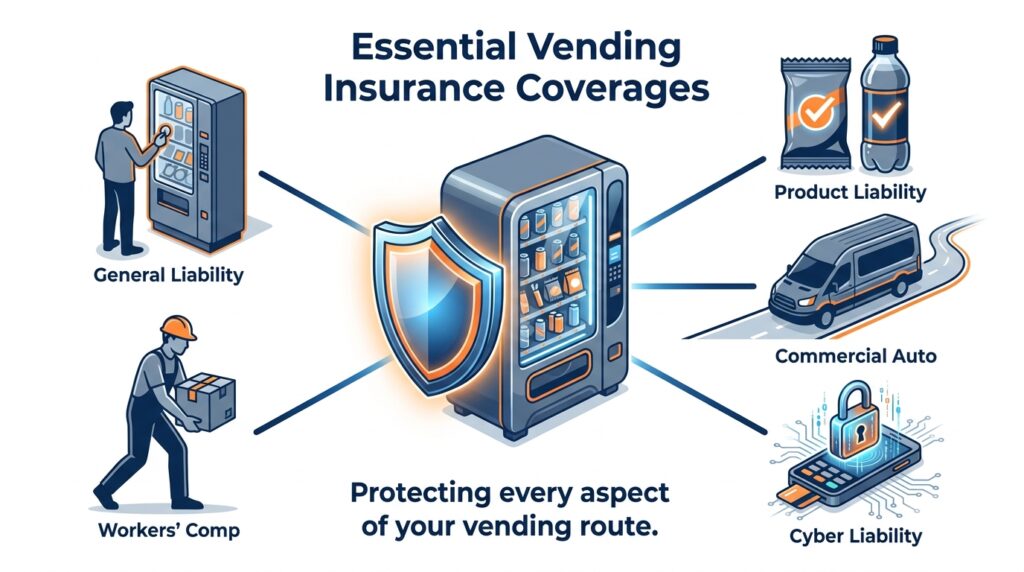
The appropriate insurance package depends on your operation, but these are the major coverages operators should understand:
| Coverage | Primary purpose | Typical vending exposure |
|---|---|---|
| General liability | Third-party bodily injury and property damage | Customer injured by machine |
| Product liability | Product-related injury or damage | Food or merchandise causes harm |
| Commercial property | Protects business property | Machine damaged by covered event |
| BOP | Bundles liability and property | Small vending operation |
| Inland marine | Protects certain movable/off-site business property | Machines or inventory away from premises |
| Workers’ compensation | Employee workplace injuries | Route worker injured while servicing |
| Commercial auto | Business vehicle accidents | Van transporting machines |
| Cyber liability | Data breach and cyber incidents | Connected payment systems |
| Commercial umbrella | Additional liability limits | Large claim exceeds underlying limit |
Coverage names and availability vary by insurer, state, and policy form. The policy contract—not the marketing description—determines what is actually covered.
General Liability Insurance
What does general liability insurance cover for vending machines?
General liability insurance primarily protects against covered third-party claims involving bodily injury, property damage, and certain personal or advertising injuries. For vending operators, examples can include a customer being injured while using a machine or accidental damage to property at a host location.
Insureon reports a median general liability premium of $37 per month, or $442 annually, among vending businesses buying this coverage through its platform, with a commonly purchased limit of $1 million per occurrence and $2 million aggregate. Actual premiums and appropriate limits vary by operator.
Why general liability is usually the starting point
General liability addresses one of the most fundamental vending risks: interaction with the public. An operator might never own the building where a machine sits, but the business still creates activity there. Customers interact with the equipment, employees enter the premises for servicing, and products are sold to the public. For that reason, general liability is often the foundation around which other vending business insurance is built.
Product Liability Insurance
What is product liability insurance for vending operators?
Product liability insurance helps protect a business against covered claims alleging that a product it sold caused bodily injury or property damage. This matters particularly for operators selling food, beverages, supplements, prepared foods, cosmetics, electronics, toys, and other consumer products.
Many commercial general liability policies include product liability coverage, but operators should verify the actual policy wording, limits, exclusions, and product classifications. Insureon explains that product liability coverage is often included within commercial general liability policies.
Food vending creates additional exposure
Food and beverage vending introduces risks involving temperature control, expiration, contamination, allergens, labeling, and storage. Insurance does not replace food safety procedures. An operator still needs proper inventory rotation, temperature management where applicable, supplier controls, cleaning procedures, and compliance with applicable regulations.
Insurance transfers certain financial risks; it does not eliminate the underlying operational responsibility.
Commercial Property Insurance
Does insurance cover the vending machine itself?
Commercial property insurance can protect eligible business property against covered causes of loss, depending on the policy. For vending operators, the relevant property can include machines, equipment, inventory, tools, supplies, and other business property.
The Hartford specifically identifies business property coverage as protection for equipment and property used in vending operations, while a BOP can combine property and liability protection. The critical question is where the property is located.
A vending operator may own a machine but keep it permanently inside a third-party building. The policy must be structured to address that off-premises exposure rather than assuming ordinary premises coverage automatically applies.
Business Owner’s Policy
What is a BOP for a vending business?
A Business Owner’s Policy (BOP) combines commercial property and general liability coverage into one package for eligible small businesses. This can make a BOP attractive to vending operators who need both liability protection and coverage for business property.
Insureon reports a median BOP cost of $58 per month, or $698 annually, among vending machine businesses purchasing BOP coverage through its platform. Its example policy uses $1 million per occurrence, $2 million aggregate limits, and a $500 deductible, but these figures should not be treated as a universal recommendation.
BOP vs. standalone liability insurance
| Factor | BOP | General liability only |
|---|---|---|
| General liability | Yes | Yes |
| Commercial property | Typically included | No |
| Machine/property protection | Potentially | Generally not the purpose |
| Inventory protection | Potentially | Generally not the purpose |
| Business interruption | May be available | Usually not included |
| Best fit | Operators needing property + liability | Businesses primarily seeking liability coverage |
A BOP can be efficient, but it does not automatically solve every vending insurance requirement.
Business Personal Property and Inland Marine Coverage
Why off-site vending equipment needs special attention
Vending machines are frequently located away from the operator’s main business premises. That makes the location of insured property a critical underwriting issue. Inland marine coverage can protect certain business property while it is transported or located away from the primary premises, depending on the policy.
Insureon specifically identifies inland marine insurance as a potential additional coverage for vending machine operators whose business property is stored or used off-site. An operator with machines across multiple properties should tell the insurer exactly where the machines are located, how they are transported, and what property is stored at each site.
Commercial Auto Insurance
Do vending operators need commercial auto insurance?
Operators may need commercial auto insurance when vehicles are owned or used for business activities such as transporting machines, inventory, tools, or employees. A route operator driving a van loaded with inventory has a different exposure from someone occasionally driving a personal car to a single machine.
Insureon reports a median commercial auto premium of $171 per month, or $2,054 annually, among relevant retail businesses purchasing the coverage through its platform. Actual premiums depend on vehicle type, driving history, use, location, limits, and other underwriting factors. If employees use personal vehicles for business, ask an insurance professional whether hired and non-owned auto coverage is appropriate.
Workers’ Compensation Insurance
When does a vending operator need workers’ compensation?
Workers’ compensation generally becomes relevant when a vending business hires employees, but exact requirements are determined by state law. Route workers can face lifting injuries, slips, vehicle accidents, repetitive strain, and other workplace hazards. Insureon reports a median workers’ compensation cost of $86 per month, or $1,036 annually, among vending businesses purchasing the coverage through its platform. State rules and payroll classifications can materially change the premium.
A growing operator should verify workers’ compensation requirements before hiring fillers, technicians, drivers, or route employees.
Cyber Liability Insurance
Why does a vending machine operator need cyber insurance?
Connected vending machines increasingly process electronic payments and may communicate with remote management platforms. Cyber liability insurance can help address certain costs associated with covered data breaches and cyber incidents, depending on the policy.
This becomes more relevant as operators deploy cashless payment terminals, telemetry, cloud dashboards, remote inventory systems, and connected smart vending technology. Insureon specifically identifies cyber insurance as a consideration for vending businesses handling payment card information or other personal information.
Operators exploring connected machines can learn more about the technology in this guide to AI vending machines.
Commercial Umbrella Insurance
What does umbrella insurance do for vending operators?
Commercial umbrella insurance provides additional liability limits above certain underlying policies when a covered claim exceeds those limits. This can become important for larger vending routes or contracts requiring higher liability limits.
For example, Insureon explains that a landlord could require $3 million in liability protection, potentially leading an operator to combine underlying liability coverage with a $1 million umbrella policy.
Umbrella insurance is not a replacement for the underlying policy. It sits above qualifying primary coverage and remains subject to its own terms and exclusions.
What Does Vending Machine Insurance Cover?
Common covered risks
Depending on the policies purchased, vending insurance can address several major risks:
| Risk | Potentially relevant coverage |
|---|---|
| Customer bodily injury | General liability |
| Product-related injury | Product liability/general liability |
| Damaged vending machine | Commercial property/BOP |
| Stolen equipment | Property coverage, subject to covered causes |
| Inventory loss | Property/BOP or applicable endorsement |
| Employee injury | Workers’ compensation |
| Business vehicle accident | Commercial auto |
| Cyber incident | Cyber liability |
| Large liability claim | Commercial umbrella |
| Covered business interruption | Business income coverage, if included |
The word “potentially” matters. Insurance coverage depends on the actual policy, exclusions, deductibles, limits, endorsements, location, and facts of the claim.
What Does Vending Machine Insurance Not Cover?
Common exclusions and limitations
No vending insurance policy covers every possible loss.
Potential exclusions or limitations can involve:
- Unapproved products or business activities
- Intentional acts
- Certain outdoor equipment
- Specific high-risk products
- Normal wear and tear
- Mechanical breakdown without applicable equipment coverage
- Certain cyber incidents
- Uninsured vehicles
- Losses exceeding policy limits
- Property not properly scheduled or described
The Hartford, for example, notes that some vending policies may exclude or handle separately exposures involving outdoor locations, hot beverage dispensers, tobacco products, electronic cigarettes, ATMs, and photo booths.
This illustrates why operators should never assume that a generic vending policy automatically covers every machine or product.
How Much Does Vending Machine Operator Insurance Cost?
Average vending insurance costs
Insurance premiums vary based on business size, machine count, revenue, products, locations, claims history, employees, vehicles, coverage limits, deductibles, and endorsements.
One current benchmark from Insureon shows the following median monthly premiums among vending-related businesses purchasing these policies through its platform:
| Insurance policy | Median monthly cost | Approx. annualized cost |
|---|---|---|
| General liability | $37 | $442 |
| Business owner’s policy | $58 | $698 |
| Workers’ compensation | $86 | $1,036 |
| Commercial umbrella | $59 | $707 |
| Commercial auto | $171 | $2,054 |
These are marketplace-specific median figures, not guaranteed quotes.
The Hartford also emphasizes that vending insurance costs vary according to machine count, products, payment methods, and additional coverage selected.
What makes vending insurance more expensive?
Premiums can rise as the risk profile becomes more complex.
An operator with 100 machines, several employees, refrigerated food, multiple commercial vehicles, high-value equipment, and locations with significant foot traffic generally presents a different underwriting profile from a one-machine operator.
The insurer may consider:
Machine count + revenue + products + locations + claims history + employees + vehicles + coverage limits + deductibles.
That is why comparing a flat “vending insurance cost” online can be misleading.
Insurance Requirements in Vending Machine Contracts
Why location agreements often require insurance
A property owner allowing a vending machine onto its premises is taking on an additional business relationship.
The location agreement may require the operator to maintain specified liability limits and provide a certificate of insurance before installation.
This is particularly common in professionally managed commercial properties.
Insurance requirements should therefore be reviewed before signing the placement agreement, not after the machine has been purchased.
If you are reviewing a vending location agreement, learn about vending machine placement contract red flags.
Common contract insurance requirements
A vending placement agreement may address:
| Contract requirement | Purpose |
|---|---|
| Minimum liability limit | Establishes required protection |
| Certificate of Insurance | Provides proof of coverage |
| Additional insured | Extends specified liability protection to another party |
| Workers’ compensation | Protects against employee injury exposure |
| Commercial auto | Applies to business vehicle operations |
| Cancellation notice | Provides advance notice of certain policy changes |
| Waiver requirements | May alter certain insurer recovery rights |
| Indemnification | Allocates contractual responsibility |
Never assume that an indemnification clause replaces insurance. Indemnity and insurance serve different legal and financial functions.
Common Insurance Mistakes Vending Operators Make
Assuming general liability covers everything
General liability is important, but it does not automatically protect every machine, vehicle, inventory item, employee, cyber exposure, or contractual risk. Operators need to map each major exposure to an appropriate coverage.
Forgetting machines are located off-site
A machine sitting inside another company’s property is still your business property. Tell the insurer where your machines are located and how they are used.
Buying coverage after signing the location contract
This can create an avoidable problem if the property owner requires limits or endorsements that your policy does not provide. Review the insurance requirements before signing.
Underinsuring inventory
An operator with dozens of machines can have significant inventory distributed throughout a route. Insurance should be evaluated against realistic property values rather than the inventory sitting in a single storage room.
Ignoring cashless payment technology
Modern vending machines increasingly use electronic payments and connected systems. Operators should discuss cyber and payment-related risks with an insurance professional instead of assuming that standard liability coverage handles every technology-related incident.
Vending Machine Insurance Checklist
Before purchasing a policy
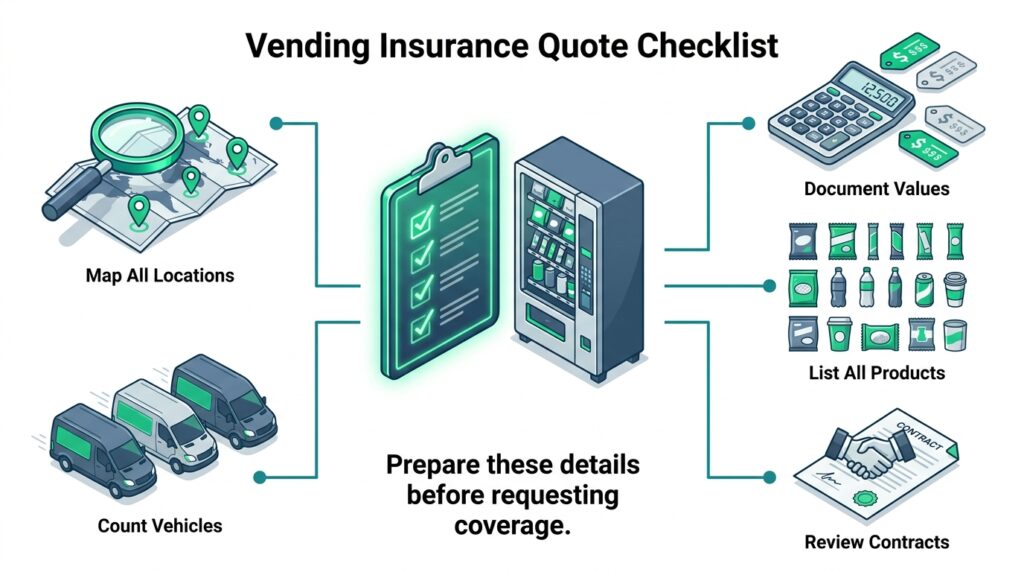
Use this practical checklist when preparing for insurance quotes:
- Count all current machines and planned machines.
- Document machine values and serial numbers.
- List every product category sold.
- Identify indoor and outdoor locations.
- Estimate annual revenue.
- Identify employees and contractors.
- List business-owned vehicles.
- Review every location contract.
- Record required liability limits.
- Ask whether additional-insured endorsements are needed.
- Confirm how off-site equipment and inventory are treated.
- Review deductibles and exclusions.
- Obtain certificates of insurance for locations that require them.
This information allows an insurance professional to evaluate the operation more accurately.
Pros and Cons of Vending Machine Insurance
Advantages of carrying appropriate coverage
| Benefit | Business impact |
|---|---|
| Liability protection | Helps address covered third-party claims |
| Equipment protection | Can reduce financial impact of covered property losses |
| Contract compliance | Helps satisfy property-owner requirements |
| Business continuity | Certain policies can address covered interruptions |
| Professional credibility | Demonstrates risk-management discipline |
Potential disadvantages
| Issue | Consideration |
|---|---|
| Premium expense | Adds recurring operating costs |
| Deductibles | Operator may still pay part of a covered loss |
| Exclusions | Some risks require separate coverage |
| Administrative work | Policies and certificates require management |
| Coverage limits | Limits can be insufficient as the business grows |
Insurance is an operating expense, but so are repairs, fuel, inventory, payment processing, and location commissions. The correct question is not whether insurance costs money; it is whether the retained risk is worth the potential financial exposure.
Building an Insured Vending Business
Insurance should scale with the route
The insurance strategy for a one-machine operation should not remain unchanged after the business reaches 50 or 100 machines. As the route expands, equipment values increase, more locations are involved, employees may be added, vehicle exposure grows, and contractual requirements become more complex.
The operator should periodically review liability limits, property values, inventory, vehicles, employees, products, locations, and technology.
Combine legal structure and insurance correctly
Insurance and business structure solve different problems. An LLC or corporation establishes a legal structure, while insurance transfers certain financial risks to an insurer under the policy terms. Operators should not treat an LLC as a substitute for insurance.
If you’re building a multi-machine operation, review LLC considerations for a multi-machine vending business before expanding.
Protect the business before expanding the route
The strongest vending operators build risk management into the route from the beginning. That means using written placement agreements, maintaining machines properly, documenting inventory, training employees, accepting secure payments, keeping financial records, and maintaining appropriate insurance.
Location acquisition matters just as much. A property owner looking for a professional vending provider can connect with vending operators through VPlaced. The objective is not to buy the maximum amount of insurance possible. It is to build a coverage structure that matches the actual risks of the vending business.
Frequently Asked Questions
What insurance does a vending machine operator need?
Most operators should evaluate general liability, product liability, property coverage, and potentially a BOP, commercial auto, workers’ compensation, cyber liability, and umbrella insurance. The exact combination depends on the machines, products, locations, employees, vehicles, and contractual requirements.
Is vending machine insurance required by law?
There is no single nationwide rule requiring every vending operator to carry one specific insurance policy. However, state laws, local requirements, leases, and vending placement contracts can impose different obligations.
How much does vending machine operator insurance cost?
Costs vary significantly by business size and risk profile. As a current benchmark, Insureon reports median monthly costs of $37 for general liability and $58 for a BOP among vending businesses purchasing those policies through its platform.
Does general liability insurance cover vending machines?
General liability primarily addresses covered third-party bodily injury, property damage, and certain advertising or personal injury claims. It should not be assumed to cover physical damage or theft of the vending machine itself; property coverage may be needed.
Does vending insurance cover products inside the machine?
Potentially, depending on the policy and cause of loss. Inventory coverage and product liability address different risks, so operators should distinguish between damage or theft of inventory and claims alleging that a product caused injury.
Does a vending machine operator need product liability insurance?
Operators selling consumer products should evaluate product liability coverage because customers can make claims alleging that a product caused injury or property damage. Product liability is often included within commercial general liability, but operators should confirm the actual policy language.
Do vending operators need workers’ compensation insurance?
Workers’ compensation requirements are determined primarily by state law and employment circumstances. Operators hiring employees to stock, maintain, transport, or service machines should verify the applicable state requirements before hiring.
Does insurance cover a vending machine at another business?
It can, but the operator must disclose that machines are located at third-party properties. Off-site equipment may require appropriate property or inland marine coverage depending on how the policy is structured.
Do property owners require vending operators to have insurance?
Many commercial property owners and managers require vendors to carry liability insurance and provide a certificate of insurance. Some contracts may also require specific liability limits or additional-insured status.
Can I operate vending machines without an LLC and still get insurance?
Insurance availability does not automatically require an LLC. A vending business can operate under different legal structures, but the appropriate structure depends on liability, tax, ownership, and business goals; insurance and entity formation should be evaluated separately.