Compliance Audits for Automated Vape Dispensers: Complete Regulatory & Operational Guide
Executing compliance audits for automated vape dispensers requires a systematic evaluation of identity verification hardware, point-of-sale (POS) transaction logs, age-gating algorithms, and federal product authorization databases. Automated Electronic Nicotine Delivery System (ENDS) kiosks operate in a high-risk regulatory environment governed by strict federal, state, and municipal mandates.
Key Takeaway: A compliant automated vape dispenser must achieve zero underage transactions through hardware-level age verification, enforce location-based flavor bans, maintain detailed PACT Act telemetry logs, and dispense exclusively FDA-authorized ENDS products.
Federal Regulatory Frameworks: FDA, PACT Act, and ATF Guidelines
Federal tobacco regulations require automated vape dispensers to enforce 21+ age limits, maintain full supply chain traceability, and restrict inventory strictly to legally marketed nicotine products. The U.S. Food and Drug Administration (FDA) Center for Tobacco Products (CTP) regulates all ENDS hardware and e-liquids under the Federal Food, Drug, and Cosmetic Act.
[Federal Compliance Hierarchy for ENDS Vending]
       │
       ├── FDA Center for Tobacco Products (CTP) ──► PMTA Verification & Flavor Restrictions
       │
       ├── ATF & Prevent All Cigarette Trafficking ──► PACT Act Registration & State Tax Reporting
       │
       └── State & Local Licensing Boards ─────────► 21+ Adult-Only Venue Access & Excise Tax
Under federal law, operators can only stock products with active Premarket Tobacco Product Applications (PMTA) that have received FDA Marketing Granted Orders (MGO). Stocking unauthorized synthetic nicotine or flavored disposable devices exposes operators to civil money penalties, product seizures, and federal injunctions.
The Bureau of Alcohol, Tobacco, Firearms and Explosives (ATF) enforces the Prevent All Cigarette Trafficking (PACT) Act. PACT Act compliance mandates that operators shipping ENDS products across state lines register using ATF Form 5070.1 and file monthly inventory reporting statements with state tax administrators. Failure to submit PACT Act reports results in federal misdemeanor charges and inclusion on the ATF Non-Compliant List, blocking supply chain inventory access.
Key Audit Modules in Compliance Audits for Vape Dispensers
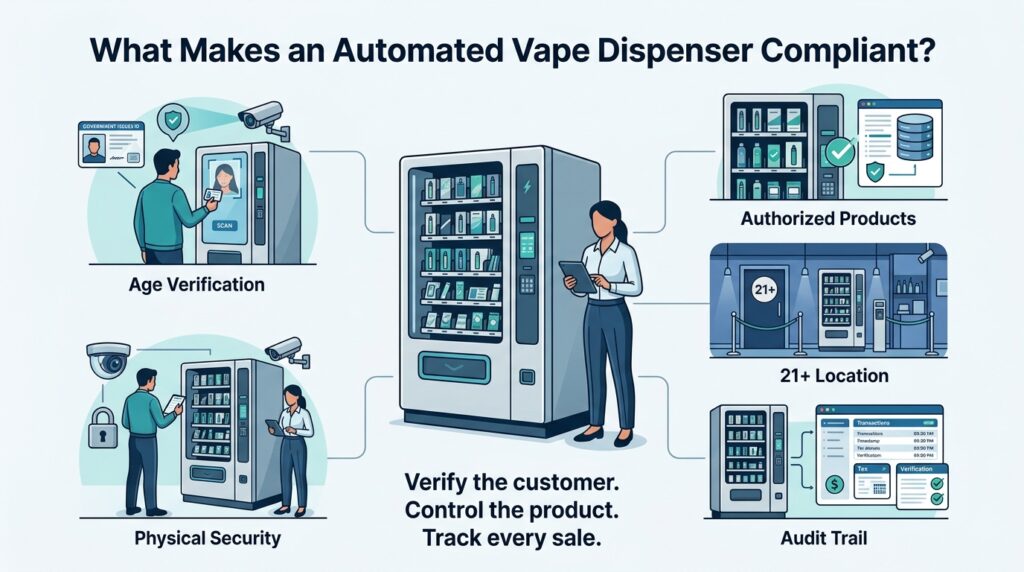
Comprehensive compliance audits for automated vape dispensers evaluate five core operational pillars: access control, catalog restrictions, age authentication, tax compliance, and physical security. Conducting audits on a quarterly schedule prevents regulatory infractions caused by hardware degradation or software configuration shifts.
Regulatory Alert Card: Mandatory Audit Scope
- Module 1: Identity & Age Authentication – Verify PDF417 optical scanner calibration and biometric liveness threshold settings.
- Module 2: Geofenced Catalog Enforcement – Confirm automatic blocking of municipal-banned flavors and high-nicotine SKUs.
- Module 3: PACT Act Telemetry Reporting – Reconcile physical machine dispenses against monthly ATF and state tax filings.
- Module 4: Premises & Physical Security – Inspect adult-only venue entry points, CCTV sightlines, and anti-tamper housing.
- Module 5: PMTA Catalog Authorization – Cross-reference stock SKUs against the FDA’s live ENDS enforcement list.
Auditors examine machine telemetry databases to confirm that every completed sale contains a linked, timestamped age-verification token. If a transaction record lacks identity verification metadata, the kiosk fails the compliance audit due to non-auditable sales flow.
Operators operating automated hardware must maintain rigorous log histories for state inspections. To understand how automated equipment routes are managed, review our detailed guide explaining what a vending machine operator does and the fundamental role of a vending machine operator.
Age Verification Technologies: Optical Scanning vs. Biometric Authentication
Age verification technology prevents underage sales by validating government-issued identification documents or biometric facial metrics prior to unlocking the product delivery carousel. Automated vape dispensers deploy two primary verification architectures: optical barcode readers and third-party biometric software engines.
| Feature / Standard | Optical 2D Barcode Scanner | Biometric Facial Recognition | Payment-Linked Verification |
| Verification Method | Reads PDF417 barcode on ID | Facial liveness + ID matching | Age token attached to payment card |
| False Acceptance Rate | Low (susceptible to physical fakes) | Extremely Low (< 0.001%) | Extremely Low |
| Transaction Speed | 1 to 3 Seconds | 5 to 10 Seconds | Instantaneous upon tap |
| Privacy / Data Storage | Zero data retained on device | Encrypted biometric hashing | Tokenized bank verification |
| Regulatory Standing | Accepted in basic 21+ venues | Highest compliance tier (AEO-ready) | Emerging European standard |
Optical 2D scanners read the encoded PDF417 barcode on the back of driver’s licenses to verify age without calculating dates manually. However, optical scanning alone fails to prevent an underage user from presenting an authentic ID belonging to an older individual.
Biometric facial authentication systems integrate smart cameras running liveness detection algorithms to match the live user’s face against the photo on the scanned government document. Advanced kiosks deploy AI vending machine technology to run edge-computing verification models that process biometric data locally without violating consumer privacy regulations.
Biometric Verification Flow
Customer Scans ID (PDF417 Barcode) ──► Camera Captures Live Selfie ──► Liveness & Face Match (Yoti API) ──► Dispense Unlocked
Operators purchasing hardware for age-restricted retail should consult our AI vending machine buyer guide to evaluate identity verification modules. The integration of modern automated retail tech is highlighted in our analysis of electronics vending machines driving smart city infrastructure.
Location Compliance & Placement Criteria for Adult-Only Venues
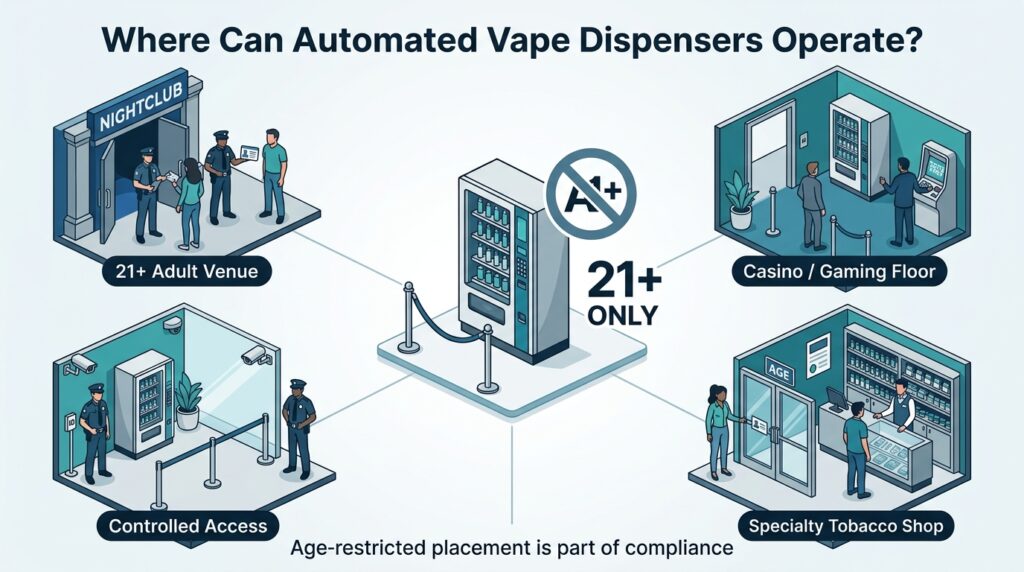
State and municipal tobacco laws mandate that automated vape dispensers operate exclusively within age-restricted, 21+ adult-only venues where minors are legally prohibited from entering. Installing automated ENDS dispensers in unsegregated commercial space violates federal access rules, triggering immediate confiscation and license revocation.
Location Compliance Rule: Vending machines dispensing nicotine products must be positioned behind physical access barriers (e.g., age-gated door control) or within direct, line-of-sight supervision of venue staff.
Permitted venue types for automated vape hardware include:
- Nightclubs and Adult Bars: Entry restricted to individuals aged 21 and older via door security personnel.
- Casinos and Gaming Floors: Regulated environments enforced by state gaming control boards.
- Specialty Tobacco Shops: Dedicated retail environments with age-gated entrance controls.
Kiosks installed in hybrid spaces (such as hotel lounges or event halls) require software-enforced operational lockouts. When on-site bouncers or security staff are not present, telemetry scheduling must automatically lock the machine screen to prevent unsupervised sales.
Operators evaluating potential sites can review our playbooks covering specialty venue vending placements, hospitality vending venue playbooks, and corporate office placement restrictions. For broader venue ideas, consult our list of places that need vending machines alongside our smart vending location placement guide.
POS Telemetry, Transaction Logs, and Inspector Audit Trails
Point-of-sale telemetry systems log transaction data to generate immutable audit trails required during state tax and FDA compliance inspections. Auditors require exportable digital logs covering 30 to 90 days of operational history, itemizing sales down to individual SKU levels. A compliant POS transaction log must contain distinct metadata fields for every purchase:
- Timestamped Verification Records: Exact date, time, and identity verification status attached to the transaction.
- Product Authorization Data: PMTA tracking codes linking sold SKUs to FDA-approved manufacturer lists.
- Itemized Tax Breakdown: State and municipal vape excise tax allocations calculated per unit.
- Hardware Telemetry Diagnostics: Optical sensor verification proving the product successfully dropped into the collection bin.
If an auditor discovers gaps in transaction logs or unmapped age verification tokens, the machine operator risks non-compliance fines up to $5,000 per violation day. Route technicians monitor these data flows alongside physical inventory checks, an operational process detailed in our guide to vending machine filler jobs and vending operator salaries and earnings.
Pros and Cons of In-House vs. Third-Party Compliance Auditing
Operators managing automated vape networks can conduct compliance audits internally or retain third-party regulatory auditing firms.
In-House Auditing Pros:
- Lower direct operational cost per audit cycle.
- Immediate control over corrective hardware adjustments.
- Direct route technician involvement in compliance checks.
In-House Auditing Cons:
- Inherent conflict of interest during self-evaluations.
- Higher risk of missing subtle FDA policy updates.
- Audit documentation may carry less weight with regulatory authorities during dispute resolution.
Third-Party Auditing Pros:
- Independent verification documentation accepted by state tax boards and the FDA.
- Expert analysis of changing PACT Act reporting rules and municipal flavor bans.
- Third-party liveness testing using artificial intelligence attack vectors.
Third-Party Auditing Cons:
- Recurring service retainer fees per machine terminal.
- Requires granting database access to external compliance software vendors.
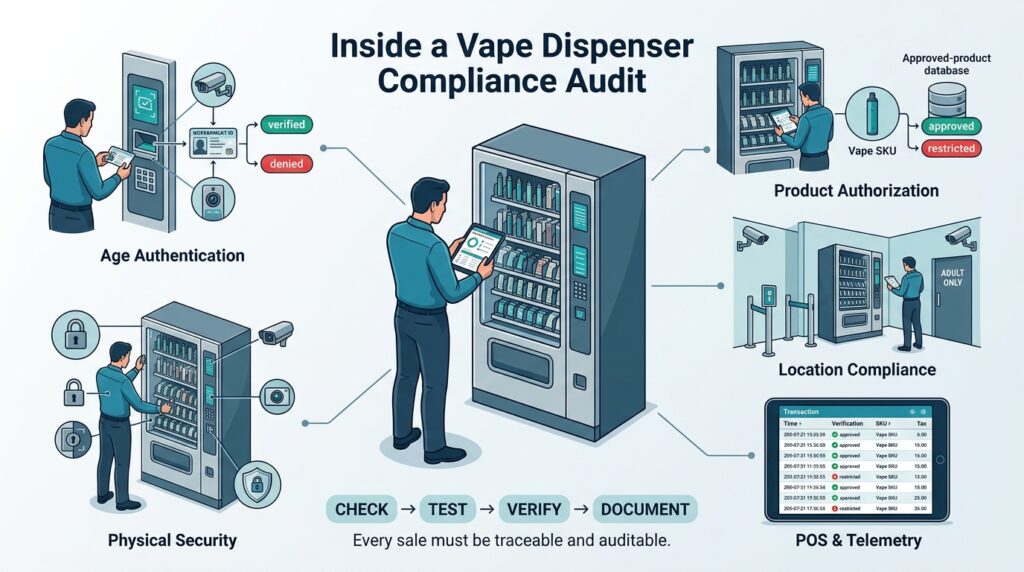
Step-by-Step Checklist for Executing a Vape Dispenser Audit
Executing a regulatory audit requires a structured step-by-step procedure to ensure all physical, digital, and legal controls function within statutory limits.
Audit Step 1: Legal Registration ──► Step 2: Hardware Testing ──► Step 3: PMTA Audit
                                                                             │
Step 6: PACT Act Reconcile ◄── Step 5: Telemetry Export ◄── Step 4: Geofence Check
- Verify State and ATF Registration Status: Confirm active PACT Act registration numbers (ATF Form 5070.1) and state tobacco retail license renewals.
- Execute Physical ID Scanner Stress Tests: Insert expired, damaged, and under-21 test identification cards into the optical scanner to verify instant refusal.
- Audit Machine Inventory Against PMTA Database: Inspect physical shelf inventory to ensure every SKU matches an active FDA Marketing Granted Order.
- Validate Geofenced Flavor & Nicotine Locks: Test product dispensing logic against local city ordinances to confirm restricted SKUs are locked.
- Export & Inspect POS Telemetry Logs: Pull a 60-day transaction report, checking for missing age-verification IDs or tax calculation errors.
- Reconcile Sales Records Against PACT Act Filings: Compare physical unit dispense counts against monthly state tax reports filed with tax authorities.
Operators evaluating secondary equipment for route expansion should review our guide on buying used vending machines to verify whether legacy units can support modern age-gating hardware.
Business Formation, Legal Licensing, and Placement Contracts
Operating age-restricted automated retail routes requires establishing robust legal structures, obtaining specialty retail permits, and executing ironclad location contracts. Proper corporate structuring protects business owners from personal liability stemming from product liability claims or regulatory infractions.
| Legal Phase | Regulatory Obligation | Legal / Business Resource |
| Business Formation | Register LLC entity, obtain EIN, structure liability caps | Form an LLC for a Vending Business |
| Contractual Compliance | Draft location agreements, review indemnity clauses | Placement Contract Red Flags |
| Venue Negotiations | Pitch property managers, establish 21+ access compliance | Pitching Property Managers for Placement |
| Corporate Expansion | B2B outreach to adult venue portfolios | Cold Emailing Corporate Accounts |
| Operator Selection | Partner with licensed ENDS route operators | How to Find Vending Machine Operators |
| Multi-Machine Route Legal | Scale corporate entity for multi-terminal compliance | LLC for a Multi-Machine Vending Business |
Legal & Corporate Formation CTA
Setting up a compliant automated retail operation requires proper corporate structuring, EIN registration, state tobacco retail permits, and liability protection documentation. Protect your business against regulatory penalties by establishing a dedicated limited liability company.
Form your legal entity correctly throughV-Adviced LLC Formation Services.
Operators expanding beyond specialty vape units into standard retail or collectible machines can reference our guides on how to find Pokémon vending machines, Pokémon machine restock schedules, the complete Pokémon vending operator guide, and overall vending location discovery tools.
Specialized Placement CTA for Property & Location Owners
Venue owners operating 21+ adult environments can monetize unused square footage by installing compliant automated vape dispensers without equipment capital outlay.
Location Owner Automated Setup Workflow:
- List your location (share space details and requirements).
- VPlaced finds and matches qualified operators.
- Compare and connect with interested operators to choose the best fit.
- Get vending setup hassle-free.
Connect directly with licensed automated retail operators viaVPlaced Location Placement Services.
For high-grade commercial vending hardware, visit VMFS USA.
Frequently Asked Questions
What is a compliance audit for automated vape dispensers?
A compliance audit for automated vape dispensers is an evaluation of an automated retail kiosk’s identity verification hardware, POS transaction logs, location restrictions, and inventory PMTA status. The audit ensures the machine complies with FDA, PACT Act, state excise tax, and municipal 21+ age regulations.
Are vape vending machines legal in the United States?
Vape vending machines are legal under federal law only when installed inside 21+ adult-only venues where minors are prohibited. State and local laws impose additional restrictions, with some municipalities banning automated ENDS sales entirely.
How do automated vape dispensers verify customer age?
Automated vape dispensers verify age by scanning the 2D PDF417 barcode on government-issued IDs or by utilizing biometric facial recognition software with liveness detection. These technologies prevent underage sales by matching the user’s face against the scanned ID before unlocking inventory.
What is the PACT Act and how does it affect vape dispenser operators?
The Prevent All Cigarette Trafficking (PACT) Act requires sellers shipping ENDS products across state lines to register with the ATF and submit monthly inventory reports to state tax authorities. Failure to file PACT Act reports results in federal penalties and inclusion on the ATF Non-Compliant List.
Can vape vending machines sell flavored e-cigarettes?
Vape vending machines can only sell e-cigarette flavors authorized by the FDA under Premarket Tobacco Product Applications (PMTA) and permitted by local laws. If a municipality bans flavored ENDS products, the machine POS catalog must automatically geofence and block those SKUs.
What happens if an automated vape dispenser fails an FDA inspection?
Failing an FDA inspection results in Warning Letters, civil money penalties exceeding $19,000 per violation, product seizure, or federal court injunctions. Repeat violations permanently revoke the operator’s tobacco retail authorization.
What data must be stored in a vape machine POS audit log?
POS audit logs must store timestamped transaction IDs, verification metadata (ID type and age result), itemized SKU details, PMTA authorization codes, and state excise tax calculations. Logs must be retained for at least 2 to 4 years depending on state regulatory standards.
How often should an operator audit automated vape dispensers?
Operators should conduct internal compliance audits quarterly and execute automated remote telemetry audits daily. Immediate audits are required whenever state tobacco laws change, local flavor bans pass, or machine software updates occur.
Can a property owner face legal liability for an non-compliant vape dispenser?
Yes, property owners who permit unvetted or illegal automated vape dispensers on their premises can face joint state citations, business license reviews, or lease termination notices. Property owners should ensure operators provide liability documentation and compliance certificates.
How do I structure a legal entity for a vape vending machine route?
Vape vending operators should form a Limited Liability Company (LLC) or C-Corporation to isolate business liability, secure state tobacco wholesale/retail licenses, register for PACT Act compliance, and open dedicated corporate bank accounts.