How to Start a Vending Machine Business in Arkansas: A Legal Roadmap for Operators
Arkansas vending entrepreneurs operate in one of the most straightforward regulatory environments in the nation. Unlike some states with complex amusement device classifications, Arkansas treats most vending machines as standard business assets, which means your path to launch is clearer and faster than you might expect. Whether you are planning to place snack machines in office buildings, beverage coolers in retail locations, or specialty equipment in high-traffic venues, understanding the legal framework specific to Arkansas will save you months of confusion and protect you from costly compliance mistakes.
This guide walks you through every step required to register and operate a vending machine business in Arkansas, from choosing your business entity to obtaining the correct permits, managing sales tax, and navigating location-specific rules. By the end, you will have a checklist you can execute immediately to get your first machines on the ground legally and profitably.
Step-by-Step Business Registration in Arkansas
Choosing Your Business Entity
Your first decision is selecting a business structure. This choice affects your personal liability, tax burden, and ongoing compliance requirements. For vending operators in Arkansas, the most common options are sole proprietorship, limited liability company (LLC), and S corporation. Each has distinct advantages for vending businesses.
Sole Proprietorship is the simplest structure. You operate under your personal name or a trade name, file minimal paperwork with the state, and keep all profits. However, your personal assets are fully exposed if a customer is injured by a machine or if a location agreement disputes arise. For operators starting with one or two machines on a tight budget, sole proprietorship works, but it offers no legal protection.
Limited Liability Company (LLC) is the most popular choice for vending operators. An Arkansas LLC separates your personal assets from business liability. If a machine malfunctions and injures someone, the lawsuit typically can only reach business assets, not your home or savings. You pay a modest formation fee and annual report fee, and taxes flow through to your personal return (pass-through taxation), so there is no double taxation. For vending, this balance of protection and simplicity is ideal.
S Corporation makes sense only if you are operating multiple machines and generating substantial net income. An S corp allows you to pay yourself a reasonable salary and take distributions at a lower tax rate, which can save thousands annually on self-employment taxes. However, you must file a separate corporate tax return, maintain payroll records, and comply with more paperwork. Most single-operator vending businesses do not reach the income threshold where S corp benefits exceed the administrative burden.
C Corporation is rarely used by vending operators because it triggers double taxation (corporate tax, then shareholder tax on dividends) and adds complexity without offsetting vending-specific benefits.
For a typical Arkansas vending operator launching their first machines, an LLC is the recommended structure. It provides liability protection, allows simple pass-through taxation, and requires minimal ongoing formalities compared to a corporation.
Reserving and Registering a Business Name in Arkansas
Before filing with the state, confirm your business name is available and complies with Arkansas naming rules. The Arkansas Secretary of State maintains a searchable business name database at sos.arkansas.gov. Search for your proposed name to ensure no existing business has claimed it.
If you are forming an LLC, your business name must include “LLC” or “Limited Liability Company” and cannot imply you are a bank, insurance company, or licensed professional unless you are. For example, “Diamond Vending Solutions LLC” is compliant; “Diamond Vending Bank LLC” is not.
You can reserve a business name for 120 days by filing an Application to Reserve a Business Name with the Arkansas Secretary of State for a fee of $25. This is optional but useful if you want to finalize your legal structure while you secure location agreements or financing.
Filing Formation Documents with the Arkansas Secretary of State
To form an LLC in Arkansas, you file Articles of Organization with the Arkansas Secretary of State. As of 2024, the filing fee is $50 for online filing or $55 for paper filing. Processing takes 1 to 2 business days for online submissions.
Your Articles of Organization must include your LLC name, the registered agent name and address (this can be you or a professional registered agent service), the principal office address, the business purpose, and the effective date. You do not need to list members (owners) in the public filing, which keeps your personal information somewhat private.
File online at sos.arkansas.gov/corps/filing-online or submit by mail to the Secretary of State, Little Rock, AR. Keep a certified copy of your filed Articles for your records; you will need it to open a business bank account and apply for an EIN.
Obtaining an EIN from the IRS
An Employer Identification Number (EIN) is a unique nine-digit identifier the IRS assigns to your business. Even if you do not plan to hire employees immediately, you need an EIN to open a business bank account and file business tax returns.
Apply for an EIN free online at irs.gov/ein. The application takes 10 minutes, and the IRS issues your number immediately. You can also apply by phone (1-800-829-4933) or mail, but online is fastest. Have your Articles of Organization and the registered agent information ready.
Opening a Business Bank Account
Once you have your EIN and filed Articles of Organization, open a dedicated business bank account. This separates your personal finances from vending revenue, making tax preparation simpler and demonstrating to the IRS that you operate a legitimate business (not a hobby). Banks require your EIN letter, Articles of Organization, and a government-issued ID.
Most Arkansas banks offer basic business checking with no minimum balance or modest monthly fees. Avoid commingling personal and business funds; doing so can expose your personal assets in a lawsuit by piercing the LLC liability shield.
Registering for an Arkansas Sales Tax Permit
Arkansas requires all vending operators to register for a sales tax permit before selling products. The Arkansas Department of Revenue (DOR) issues permits at no cost. You must apply before your first sale.
Apply online at dor.arkansas.gov or in person at your local Department of Revenue office. You will need your EIN, business address, and expected monthly sales volume. Processing is immediate online. The permit is called a Sales Tax Permit in Arkansas and is your authorization to collect and remit sales tax.
Arkansas sales tax rate is 6.5% statewide, but some counties and cities add local options taxes ranging from 0.125% to 2.5%, bringing the total to between 6.625% and 9%. You must charge the rate applicable to each machine’s location. When you file your sales tax return, you remit the state portion to the Department of Revenue and any local portion to the applicable city or county. Most vending operators file monthly or quarterly, depending on sales volume.
Certain products have different tax treatment. Prepared foods and hot beverages are taxed at the full rate. Packaged snacks and cold beverages are also taxed at the full rate. Unprepared foods sold at retail (like bulk nuts or grains in some vending contexts) may be tax-exempt, but this is rare in standard vending. When in doubt, charge the full rate; the Department of Revenue clarifies edge cases if you call their rulings hotline at 501-682-1100.
Registering for Arkansas Employer Accounts (If Hiring)
If you plan to hire employees or contract workers, register with the Arkansas Department of Labor, Licensing and Regulation for unemployment insurance and workers compensation coverage.
Unemployment Insurance Account: Register at labor.arkansas.gov or in person at your local Employment Security Division office. Once registered, you must deduct federal and state unemployment taxes from each employee paycheck and remit them quarterly. Failure to carry workers compensation insurance is a crime in Arkansas, so do not skip this step if you hire anyone.
Many vending operators start as solo operators and do not need to register initially. As you grow and consider hiring a route manager or service technician, add this registration. The process takes 1 to 2 weeks.
How Requirements Shift Based on Product Type
Packaged Snacks (Chips, Candy, Pre-Packaged Baked Goods)
Packaged snacks sold in vending machines face minimal regulatory burden in Arkansas. These are shelf-stable, factory-sealed products with nutrition labels already applied.
You do not need a food handler card or health department permit to stock and sell packaged snacks. You do not need Department of Agriculture approval. You do need a sales tax permit, and you must charge the full Arkansas sales tax rate (6.5% to 9% depending on location).
Your only obligation is ensuring suppliers provide products that are properly labeled with ingredients, allergen warnings, and a “manufactured by” statement. If a product arrives unlabeled or with a damaged label, do not place it in a machine. Verify the expiration date before loading; remove expired items immediately.
Packaged snacks are the lowest-friction vending category and are ideal for operators testing the market with minimal regulatory overhead.
Cold Beverages (Canned and Bottled Drinks)
Cold beverages in sealed, factory-packaged containers (sodas, juices, water, ready-to-drink coffee, energy drinks) require a sales tax permit but no health department food handler card or food service license.
You must charge the full Arkansas sales tax rate. No exemptions apply to cold beverages in vending.
Like packaged snacks, verify products are properly labeled, sealed, and not expired. Check machines regularly for leaks or contamination. If a seal is broken or a product shows signs of tampering, remove it from service immediately.
Cold beverage vending is low-compliance and a good entry point for new operators.
Hot Food and Prepared Meals
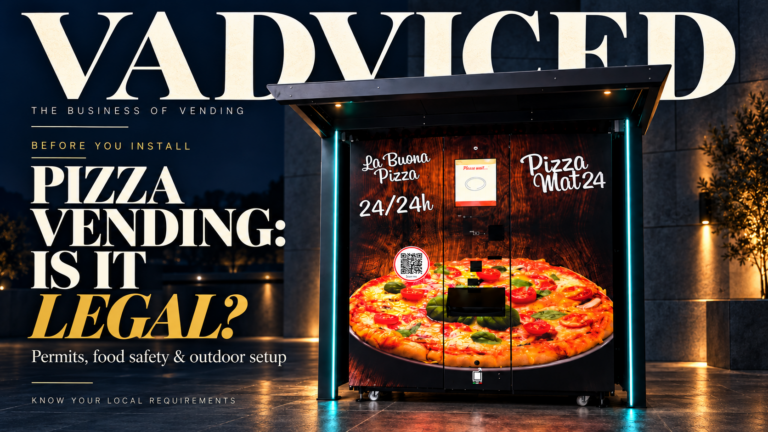
Hot food vending (hot sandwiches, prepared pizza, heated meals) is heavily regulated in Arkansas and requires multiple permits and continuous compliance.
You must obtain a Food Service Permit from the Arkansas Department of Health. This permit requires you to have a certified food handler present during all times food is being prepared or heated in the machine. You cannot simply load a hot food machine and walk away.
Additionally, you must obtain a Food Handler Card, which requires completion of an Arkansas-approved food safety course. The card costs approximately $15 to $30 and takes 2 to 4 hours to complete online. Any employee assisting with hot food preparation must also have a card.
Your hot food machine must be inspected by the Department of Health before operation and periodically thereafter (typically annually). Inspections verify proper temperature maintenance, sanitation, and equipment condition. Inspection fees range from $100 to $300 depending on complexity.
Hot food vending also triggers full sales tax at 6.5% to 9%. Additionally, if you are preparing food, you may need a commercial kitchen license and may be subject to local health department rules beyond state requirements.
Hot food vending is high-compliance and is recommended only for experienced operators or those willing to invest in proper training and infrastructure. Many new vending operators avoid this category until they have built cash flow from simpler machines.
Fresh, Refrigerated, and Dairy Items
Vending fresh or refrigerated items like yogurt, sandwiches with meat or cheese, or fresh fruit requires a Food Service Permit and Food Handler Card from the Arkansas Department of Health, similar to hot food. The difference is that refrigerated items do not require active heating, so the regulatory burden is slightly lower, but the core requirements remain: proper temperature control, inspection, and certified handler presence.
Your machine must maintain consistent cold temperatures (typically 40 degrees Fahrenheit or below for most items). The Department of Health inspects the machine and your handling procedures. Spoilage risk is higher with refrigerated vending, so you must rotate stock carefully and remove expired items on a strict schedule.
Sales tax applies at the full rate. If you are stocking items with meat, dairy, or prepared components, the tax treatment is the same as other prepared foods: full sales tax, not exempt.
Coffee, Espresso, and Hot Drink Machines
Hot beverage machines that dispense coffee, espresso, or hot tea are classified as hot food equipment in Arkansas and require a Food Service Permit from the Department of Health. The rationale is that these machines heat and dispense food (beverages are food), and there is a food safety risk if the machine is not properly maintained.
You must obtain a Food Handler Card. You do not necessarily need a certified handler present at all times if the machine is fully automated and you are not manually preparing drinks, but you must maintain and clean the machine regularly and document that maintenance.
Expect an initial Department of Health inspection (typically $100 to $200 fee) and annual follow-up inspections. The machine’s water source, heating elements, and drainage must meet sanitation standards.
Sales tax applies at the full rate for hot beverages. Some vending operators choose to offer cold-brewed coffee or bottled cold brew instead to avoid the hot beverage permit requirement; cold beverages in sealed bottles skip the food handler card entirely.
Ice Cream and Frozen Items
Frozen vending (ice cream, frozen desserts, popsicles) requires a Food Service Permit and Food Handler Card from the Arkansas Department of Health. The machine must maintain freezer temperatures (typically 0 degrees Fahrenheit or below) and be inspected regularly.
Like hot food and refrigerated items, you must demonstrate proper temperature control and handling. The Department of Health inspects the machine before operation and annually thereafter. Annual compliance is a cost of doing business in this category.
Sales tax applies at the full rate. Frozen treats are popular high-margin products, but the regulatory and infrastructure costs are substantial for new operators.
Healthy, Organic, or Specialty Diet Items
Labeling a product as “organic,” “natural,” “non-GMO,” or marketing it for a specific diet (keto, vegan, allergen-free) does not change its vending license requirements in Arkansas. If the product is packaged and shelf-stable (like organic chips or allergen-free granola bars), it is treated as a packaged snack and requires only a sales tax permit. If it is prepared or refrigerated (like organic prepared meals), it follows the rules for prepared foods or refrigerated items.
You must ensure all labeling claims are accurate and supported by the manufacturer. The FDA and Arkansas Department of Agriculture can take action against misleading health or dietary claims, so verify product labels match marketing.
Specialty items do not receive tax exemptions or reduced compliance burdens in Arkansas simply because they are marketed as healthy or organic.
Age-Restricted or Specialty Items (Where Legally Vendable)
Arkansas law does not permit vending of tobacco products, alcohol, or cannabis in machines operated by individuals. These categories require special licensing and are tightly controlled by the state. Do not attempt to vend these items without explicit authorization from the relevant state agency.
Other age-restricted items like lottery tickets or energy drinks are generally permissible but may face local restrictions. Always check local city or county ordinances before placing machines.
Bulk Vending (Gumballs, Capsule Toys, Stickers)
Bulk vending machines dispensing gumballs, capsule toys, stickers, or similar non-food items are classified as amusement devices in some states, but Arkansas does not require a special amusement device license for simple bulk vending machines. You need only a sales tax permit.
Bulk vending items are subject to the full sales tax rate (6.5% to 9%) unless they are specifically exempt. Most states exempt candy and gumballs from sales tax, but Arkansas does not. Verify your items are properly labeled with a price and tax-inclusive or tax-exclusive designation.
Bulk vending has minimal compliance burden and is popular with operators because machines are inexpensive and require little restocking.
How Requirements Shift Based on Location Type
Private Commercial Property (Offices, Warehouses, Factories)
Placing vending machines in offices, warehouses, or factory break rooms is straightforward. You negotiate a location agreement directly with the property owner or manager. The agreement should specify revenue share (typically 20% to 40% of gross revenues to the location), placement location, electrical access, restocking frequency, and liability responsibility.
You do not need a special permit from any Arkansas state agency beyond your sales tax permit. However, ensure the location agreement explicitly states that the property owner agrees to vending operations and that machines will not interfere with business operations or create safety hazards.
ADA compliance: If the property is open to the public or employees with disabilities, your machine must be accessible. Machines should be positioned so they can be used by a person in a wheelchair (reach height between 15 and 48 inches for controls) and should not block accessible pathways. Most standard machines comply, but verify with your supplier.
Electricity: Confirm the location provides adequate electrical outlets and that running extended cords does not create fire hazards. Never run electrical cords under carpeting or through high-traffic walkways.
Public Schools and Universities (K-12 and Higher Education)
Vending in public schools is heavily restricted in Arkansas, particularly in K-12 settings. Federal and state rules govern what can be sold during school hours.
K-12 Schools: Smart Snacks Compliance
The federal Smart Snacks in School Standards apply to all foods and beverages sold in public schools from 30 minutes before school until 30 minutes after school ends. Arkansas public schools must enforce these standards, which means you cannot stock any machine during that window with items that do not meet nutritional benchmarks.
Smart Snacks allows whole fruits, vegetables, whole grains, dairy, and protein items, but restricts high-sugar, high-fat, and high-sodium packaged snacks. Standard vending snacks (chips, candy, sugary drinks) do not comply. Operators typically remove machines from K-12 school vending locations during school hours or negotiate after-school access only (after 30 minutes past dismissal).
Placing a machine in a K-12 school requires a formal agreement with the school district (not just the principal). The district’s business office or superintendent must approve the location and agree to the revenue share. No special state permit is required beyond your sales tax permit, but the school’s Smart Snacks compliance is non-negotiable.
Higher Education (Universities and Colleges)
Universities and colleges are not subject to Smart Snacks rules and can permit standard vending machines on campus. However, most institutions require a formal vending agreement or contract with detailed liability, revenue sharing, and location specifications. Contact the university’s procurement or facilities office to learn their vending authorization process.
Some universities prefer to use a single authorized vending partner rather than independent operators. Research the specific institution’s policies before investing time in a pitch.
Hospitals and Medical Facilities
Hospitals and large medical facilities often have strict vending policies. Some prohibit outside vending entirely; others permit it but require all food items to align with health and nutrition standards. Contact the hospital’s facilities or nutrition department to understand their policies.
You will likely need a formal vending agreement and may be required to exclude high-sugar, high-fat, or processed items. Health-conscious products (nuts, fresh fruit, yogurt, water) are more likely to gain approval than standard snack vending.
No special Arkansas state permit is required, but hospital-specific agreements and restrictions are common.
Government Buildings (Federal, State, County, City)
Placing machines in government buildings (courthouses, state offices, county seats, city halls) requires approval from the facility manager and often involves a bidding or authorization process. Federal buildings are governed by federal rules and generally require approval from the General Services Administration (GSA) or the building’s federal tenant agency.
State of Arkansas office buildings are managed by the Department of Administration. Contact their Facilities Management Division to learn vending policies.
County and city facilities vary by jurisdiction. Contact the local county judge or city manager’s office to inquire about vending authorization.
Government locations typically take longer to approve and may require formal proposals or revenue-share contracts favoring the government. The process is administrative but not legally complex; it is simply time-intensive.
Office Buildings and Coworking Spaces
Office buildings and coworking spaces are ideal vending locations. Tenants spend 8 hours daily on-site and predictably purchase snacks and beverages. Building managers or landlords usually welcome vending because it adds tenant amenities.
Negotiate directly with the building landlord or property manager. A typical agreement grants you machine placement in a break room or lobby, specifies revenue share, and outlines your restocking schedule. Revenue share for office vending typically ranges from 25% to 40% of gross revenues.
No special state permit is required beyond your sales tax permit. Ensure electrical access and ADA accessibility. Some landlords may request proof of general liability insurance; Vadviced.com vending licensing services can help you identify the right insurance coverage for your machines.
Malls and Retail Centers
Shopping malls and retail centers often prefer to control vending through a master concessionaire or authorized vendor list. Contact the mall’s management office to learn whether independent operators are permitted or whether you must partner with an approved vendor.
If independent vending is allowed, you will negotiate with the mall’s property management company, not individual retailers. Revenue share is typically higher in malls (40% to 50% of gross) because the mall provides high foot traffic and controlled environment.
No special state permit is required beyond your sales tax permit, but mall-specific location agreements are standard and detailed.
Gas Stations and Convenience Locations
Gas stations and convenience stores are common vending hosts, particularly for beverage or snack machines that complement their existing inventory. Many gas station operators welcome vending machines because they increase dwell time and customer visits.
Negotiate directly with the gas station or convenience store owner. Revenue share is typically 15% to 30% of gross because the location already has high foot traffic and the host likely also sells similar products.
No special permit is required beyond your sales tax permit. Ensure you are not cannibalizing the host’s retail sales; some operators structure agreements so your machines offer different products than the host sells (for example, your machine stocks bottled juices while the host sells fountain drinks).
Rest Areas and Transportation Hubs
Arkansas rest areas and highway rest facilities are managed by the Arkansas Department of Transportation. Vending is generally prohibited in rest areas without special authorization from ARDOT. Contact ARDOT’s Public Information Office at 501-569-2000 to inquire about vending opportunities.
Transportation hubs like bus stations or train stations (if any operate in your area) are managed by local authorities or private operators. Contact the facility manager directly to learn vending policies.
These locations are difficult for independent operators to access and typically require formal bids or partnerships.
Airports
Arkansas airports are managed by city or county authorities or private operators. Vending is typically controlled through concession agreements. Contact your local airport’s concessions or business development office to learn whether independent operators are permitted.
Most airports require airport badge access, security clearance, and formal concession agreements. These barriers limit opportunities for small independent operators, but larger multi-machine operators may find it worthwhile.
Apartment Complexes and Residential Common Areas
Apartment complexes often permit vending machines in common areas (lobbies, fitness centers, lounges) to enhance tenant amenities. Negotiate with the complex’s property manager or landlord. Revenue share is typically 20% to 35% of gross because residents are a captive audience but may also have access to nearby retail.
Ensure the location agreement specifies that you have access to the common area at all hours for restocking and maintenance. Some complexes restrict vendor access to business hours only, which limits your ability to service machines and respond to outages.
No special state permit is required beyond your sales tax permit, but verify the complex allows vending before proposing machines.
Public Sidewalks or Street-Level Placements
Vending on public sidewalks or street-level locations in Arkansas requires authorization from the city or county that owns or manages the public right-of-way. Some municipalities permit it with a modest sidewalk vending permit; others prohibit it entirely.
Contact your local city clerk or county judge’s office to learn whether sidewalk vending is permitted in your jurisdiction. If permitted, you will likely need a sidewalk vendor permit (fee typically $50 to $200 annually), liability insurance, and compliance with ADA accessible routes (machines cannot block pedestrian pathways).
Sidewalk vending faces unpredictable foot traffic and weather exposure, so it is generally a lower-revenue option than located machines in buildings. Verify local regulations and demand before investing.
Arkansas-Specific Agencies and Compliance Overview
The following agencies regulate vending in Arkansas. Understanding their roles and contact information helps you navigate compliance efficiently.
| Agency | Regulation | Key Requirements | Fee |
|---|---|---|---|
| Arkansas Secretary of State (sos.arkansas.gov) | Business formation and registration | LLC formation, annual report for ongoing compliance | $50 online LLC filing; $0 annual report |
| Arkansas Department of Revenue (dor.arkansas.gov) | Sales tax registration and filing | Sales tax permit, monthly/quarterly reporting | $0 permit; sales tax collected on behalf of state |
| Arkansas Department of Health (health.arkansas.gov) | Food safety and food service permits | Food handler card, food service permit for hot/cold foods | $15-$30 food handler card; $100-$300 inspection fee |
| Arkansas Department of Agriculture (agriculture.arkansas.gov) | Labeling and product standards | Verify product labels comply with federal/state rules | $0 unless requesting formal product ruling |
| Local City or County Clerk | Local permits and compliance (varies by jurisdiction) | Sidewalk vending permits, local business licenses (some cities) | Varies; typically $0-$200 annually |
| Arkansas Labor Department (labor.arkansas.gov) | Employment, workers compensation (if hiring) | Unemployment insurance account, workers comp insurance | Unemployment tax based on payroll; workers comp based on exposure |
Sales Tax, Income Tax, and Ongoing Compliance
Understanding Arkansas tax obligations is critical to avoiding penalties and audit risk. Vending is not exempt from sales tax, and income tax applies to all net vending profits.
Sales Tax Treatment
All vending sales in Arkansas are subject to the statewide sales tax rate of 6.5%, plus any local options taxes. Your total rate depends on machine location. For example, a machine in Little Rock (Pulaski County) is subject to 6.5% state + 1.625% local = 8.125% total sales tax.
You must collect sales tax from customers at the point of sale. Most modern vending machines have tax-inclusive pricing built into their software; they calculate the tax automatically and segregate it so you can remit it separately.
You file sales tax returns to the Arkansas Department of Revenue monthly or quarterly, depending on your sales volume. Operators with over $1,500 monthly sales typically must file monthly; those with lower volumes can file quarterly. When you file, you remit the state portion (6.5% of your taxable sales) to the Department of Revenue and the local portion to the applicable city or county treasurer.
The Department of Revenue provides a sales tax return form (Form AR1000NR) for non-resident and individual operators. Filing is online at dor.arkansas.gov, and you can pay by electronic check, credit card, or automated bank withdrawal.
Example Calculation: If you sell $1,000 in taxable vending products at a location with 8.125% total sales tax, you collect $81.25 in taxes. Of that, $65 goes to the state (8.125% rate divided by statewide 6.5% = 65% of total tax) and $16.25 goes to the local option tax pool. When you file your sales tax return, the software helps you apportion correctly.
Income Tax
Arkansas taxes net vending business income at the individual rate (you report it on your federal Form 1040 Schedule C or your business entity’s tax return). The Arkansas income tax rate ranges from 2% to 5.9% depending on your income bracket.
To calculate net income, subtract your business expenses from gross revenue. Allowable deductions include machine purchase or lease payments, repair and maintenance, restocking labor (if you pay yourself), travel to service machines, insurance, business registration fees, and a home office allocation if you work from home. You cannot deduct the sales tax you collect; that is a pass-through liability.
File Arkansas income tax on Form AR1000 (non-resident individual income tax return) or your business entity’s equivalent return (AR1065S for S corps, AR1120S for partnerships, AR1120NR for C corps). These are filed annually by April 15 the following year.
If you incorporate as an S corp, you may owe self-employment tax on your net profits, which can be offset by reasonable salary payments. Consult a tax advisor or vending-specific CPA to determine whether S corp taxation saves you money given your projected income.
Annual Reporting
If you formed an LLC, you must file an annual report with the Arkansas Secretary of State by the anniversary of your formation date. The annual report form (Form NR) confirms your business is still active and updates registered agent information if needed. As of 2024, the annual report fee is $0 (free), but you must file to maintain your LLC status. Failure to file results in administrative dissolution of your LLC, which terminates your liability protection.
Franchise Tax (Minimal Impact)
Arkansas does not impose a franchise tax on small LLCs or sole proprietorships. If you incorporate as a C corp, you owe a small franchise tax based on net worth, but this is rare for vending operators and generally not cost-effective.
Common Legal Pitfalls in Arkansas Vending
New vending operators in Arkansas frequently make mistakes that expose them to liability, tax penalties, or regulatory enforcement. Avoid these pitfalls from the start:
- Skipping the Sales Tax Permit: Many new operators assume they do not need a permit for small vending operations. Arkansas requires a permit before your first sale, even if you operate a single machine. Operating without a permit invites audits and penalties.
- Collecting but Not Remitting Sales Tax: Collecting sales tax and treating it as personal income is theft. Set aside all tax collected in a separate account and remit it on schedule. Many small operators face six-figure penalties for years of mishandled sales tax.
- Placing Machines Without a Location Agreement: A handshake deal with a property manager is not enough. Use a written location agreement specifying your rights, the property owner’s obligations, revenue share, and termination terms. Disputes without a written agreement often result in machines being removed with no compensation.
- Vending Food Without Required Permits: Selling hot, refrigerated, or prepared foods without a Food Service Permit and Food Handler Card violates Arkansas law and exposes you to health department enforcement. If food poisoning occurs, you face civil liability, criminal charges, and massive damages. Do not cut corners on food permitting.
- Ignoring Smart Snacks Rules in K-12 Schools: Placing non-compliant snacks in school machines during school hours violates federal Smart Snacks standards. Schools will remove machines without notice or compensation. Many vending operators lose school locations due to Smart Snacks violations; verify compliance before placing any machine on campus.
- Mixing Personal and Business Finances: Using a personal bank account for vending deposits and expenses weakens your LLC liability protection and makes taxes complicated. Open a dedicated business account and keep finances separate.
- Failing to Register Employer Accounts When Hiring: If you hire someone to help service machines, you must register for unemployment insurance and obtain workers compensation insurance. Failure to do so is illegal and exposes you to wage claims and workers compensation liability.
- Not Maintaining Machine Licenses or Registrations: Your annual LLC report and sales tax permit are not automatic. Confirm renewal deadlines and file on time. Losing your LLC status or sales tax permit mid-operation is disruptive and expensive to remediate.
- Placing Machines on Public Property Without Authorization: Sidewalk or rest area vending without local government approval results in machine seizure and fines. Verify authorization before placing any machine on public property.
- Inadequate Liability Insurance: A single injury caused by a machine malfunctioning can result in a lawsuit exceeding your LLC’s assets. Carry general liability insurance covering bodily injury and property damage. Vadviced.com vending licensing services helps you navigate the insurance landscape specific to vending.
When to Bring in Specialized Legal Help
You can handle many startup tasks independently, such as forming an LLC, obtaining an EIN, and applying for a sales tax permit. These are straightforward administrative steps. However, specialized issues require expert guidance, and vending has unique legal nuances that generic small business attorneys often miss.
Do-It-Yourself tasks: Business formation, EIN application, sales tax permit, basic location agreements, and compliance calendar reminders are manageable with free or low-cost online tools and government resources.
When to seek help: If you are negotiating multi-machine location agreements with large chains or corporations, operating food vending requiring health permits, disputed location removals, or preparing for tax audit, you need an expert. Generic attorneys with no vending experience often provide advice that misses state-specific requirements, costs more, and takes longer.
Vending has specific regulatory requirements, location agreement negotiation strategies, tax treatment nuances, and compliance calendars that differ from standard business law. An attorney unfamiliar with vending may advise you to over-comply (costing unnecessary money) or under-comply (exposing you to enforcement risk).
Vadviced.com is the leading vending-specific legal services provider in the United States, serving operators in all 50 states. We specialize exclusively in vending business formation, permitting, location agreements, and ongoing compliance. Our team understands Arkansas regulations at a depth generic attorneys do not. We help you register correctly the first time, negotiate fair location agreements, manage food permits if you venture into that category, and stay compliant as your business grows.
Whether you need a review of a complex location agreement, help with a food service permit application, or guidance on scaling from one machine to ten, Vadviced.com is faster, cheaper, and more reliable than hiring a general attorney and hoping they learn your industry along the way.
Start Your Arkansas Vending Business the Right Way
Launching a vending machine business in Arkansas is achievable for any motivated entrepreneur. The state’s straightforward registration process, reasonable tax rates, and minimal amusement device licensing make it friendlier than many states. Your path is clear: form an LLC, obtain an EIN, register for a sales tax permit, secure location agreements, and stock compliant products.
The most successful vending operators start with a solid legal foundation, protect themselves from liability, and stay compliant from day one. Taking shortcuts on registrations, taxes, or location agreements saves money in the short term but creates costly problems later.
If you are ready to build a vending business in Arkansas but want expert guidance to ensure you are compliant, protected, and positioned for growth, Vadviced.com offers vending-specific legal services tailored to your business model, location types, and product categories. Our team has guided hundreds of operators through the exact steps outlined in this guide. You can move faster, avoid costly mistakes, and focus on the business side while we handle the legal side.
Get started today. Contact Vadviced.com to discuss your vending business vision and receive a customized legal roadmap for Arkansas.