Washington is a compelling market for vending entrepreneurs. With a population exceeding 7.7 million and rapid regional growth, the state hosts major tech and corporate hubs centered around Seattle, Redmond, Bellevue, and Renton, creating dense pockets of office workers and foot traffic. Companies like Microsoft, Amazon, Boeing, and Starbucks (headquartered in Seattle) employ hundreds of thousands of workers with steady incomes and reliable purchasing habits. Tourism thrives in urban centers, national parks, and mountain regions; three major airports (Seattle-Tacoma, Spokane, Bellingham) handle millions of passengers annually; and the temperate climate moderates year-round demand for both cold beverages and packaged snacks. Economic diversity is high: technology, aerospace, healthcare, agriculture, retail, hospitality, and defense all contribute to customer bases. Washington’s lack of state personal income tax is a significant financial advantage for business owners compared to neighboring states like California, Oregon, and Idaho, though you will contend with a Business and Occupation (B&O) tax (a gross receipts tax unique to Washington), a sales tax that reaches 10.35% in Seattle, and a Capital Gains Tax on certain long-term investment proceeds. Agricultural abundance (Washington leads the nation in apple production and also supports wine regions and dairy operations) and a thriving defense sector around the Tacoma-Seattle corridor (Joint Base Lewis-McChord) further diversify vending customer bases. This comprehensive guide walks you through every legal and tax step required to launch and operate a compliant vending machine business in Washington. You will learn how to form your business entity, navigate product licensing requirements that vary by item type, understand location-specific regulations, manage Washington’s unique tax obligations, and avoid common pitfalls that trap unprepared operators. Whether you plan to vend packaged snacks in office buildings, cold beverages in retail shops, or specialized products in niche locations, this guide provides the roadmap from idea to operational compliance.
Step by Step Business Registration for Your Washington Vending Operation
Launching a vending business in Washington requires you to move through a series of registration steps in the correct sequence. Skipping steps or completing them out of order can delay your launch, create tax problems, or leave you liable for disputes. The steps below walk you through forming your business entity, registering with state agencies, obtaining an EIN, opening a bank account, and securing the permits you need before your first sale. Most operators can complete these steps in two to four weeks with consistent effort. The investments are minimal (under $500 in total fees) compared to the protection and tax advantages you gain. Begin immediately if you are serious about launching.
Choose Your Business Entity
You have four main choices: sole proprietorship, limited liability company (LLC), S-corporation, or C-corporation. A sole proprietorship requires no filing and offers simplicity, but provides no liability shield; your personal assets are exposed if someone is injured or claims damages related to your vending machines. An LLC is a separate legal entity that protects your personal assets from business debts and lawsuits. LLCs are easy to operate, require minimal paperwork, and cost less than corporations. Most vending operators choose an LLC because the liability protection justifies the small filing cost. The Washington Secretary of State Corporations Division charges a filing fee of $200 (as of 2026) to form an LLC; processing takes 5 to 10 business days under standard service, with expedited processing (1 to 2 business days) available for an additional fee. An S-corporation or C-corporation offers similar liability protection but involves more complex tax filings, corporate governance requirements, and operational formalities. For a vending startup, an LLC is typically the best balance of liability protection, simplicity, and cost.
Reserve and Register Your Business Name in Washington
You can reserve a business name with the Washington Secretary of State before filing your articles of organization. A name reservation costs $30 (as of 2026) and is valid for 180 days. To check availability, visit the Washington Secretary of State business entity search. If you choose to operate under a name different from your LLC’s legal name, you will file a Assumed Business Name (Fictitious Name) document, which carries its own fee (typically under $30). Name renewals are required every five years and must be filed before expiration to maintain rights.
File Formation Documents with the Washington Secretary of State
Submit your Articles of Organization (for an LLC) to the Washington Secretary of State Corporations Division. The document includes your LLC name, principal address, registered agent, and purpose. Filing takes 5 to 10 business days at standard rates; expedited processing (1 to 2 business days) is available for higher fees. Keep a certified copy with your records; you will need it for your bank account, tax registration, and location agreements. After formation, the state issues a Certificate of Good Standing upon request for a small fee.
Obtain an EIN from the IRS
An Employer Identification Number (EIN) is a unique nine-digit identifier assigned by the IRS for business tax purposes. You need an EIN even if you have no employees; it separates your personal and business tax identities and is required to open a business bank account and hire staff. You can apply online for free at irs.gov in minutes; approval is immediate for most applications.
Open a Business Bank Account
Open a dedicated business checking account in your LLC’s name using your EIN. This keeps personal and business finances separate, simplifies accounting, and creates evidence that you have maintained corporate formalities (important if someone later tries to “pierce the corporate veil” and reach your personal assets). Bring your Certificate of Formation, EIN letter, and personal identification to your bank.
Register for a Washington Sales Tax Permit
Most vending sales are subject to Washington sales tax. The Washington Department of Revenue administers sales tax collection statewide. Statewide sales tax is 6.5% (as of 2026), but local counties and cities add surtaxes on top of the state rate. In Seattle and King County (where much of Washington’s commerce is concentrated), the combined rate reaches 10.25% to 10.35% (as of 2026), among the highest combined sales tax rates in the nation. This means that every beverage or candy bar you sell in Seattle comes with a 10+ percent tax obligation. Food and food ingredients (like raw produce or flour) are exempt from sales tax in Washington; however, hot prepared food, beverages (including water and coffee), candy, and non-food items (toys, electronics, gifts) are fully taxable. Understand which products are taxable before you launch; misclassification will haunt you in an audit. Register online or by mail with the Department of Revenue to obtain your Sales Tax Permit at no cost. You must collect and remit sales tax monthly (or quarterly if your sales fall below a threshold). File returns electronically through the Department of Revenue’s online portal. Failure to remit on time incurs interest charges and penalties that can escalate quickly.
Register for Washington Employer Accounts (If Hiring)
If you hire employees (drivers, service technicians, warehouse staff), you must register with multiple state and federal agencies before paying them. Register with the Washington Employment Security Department (ESD) for unemployment insurance; the ESD also administers paid family and medical leave (PFML) in Washington, which requires contributions from employers. Register with the Washington Department of Labor and Industries for workers’ compensation insurance (L&I) and state payroll withholding. Workers’ compensation premiums are mandatory and calculated as a percentage of payroll (typically 1-2 percent for vending operations). You must withhold federal income tax, state income tax (though Washington has no state income tax on wages, so this is federal only), Social Security (6.2 percent), and Medicare (1.45 percent) from every employee paycheck. Register before your first payroll date to avoid penalties and interest. Failure to register subjects you to back taxes, interest, and penalties from the IRS and state agencies. If you are unsure, consult a payroll service or accountant; the cost of outsourcing payroll ($30-100 per month) is far less than the cost of payroll compliance mistakes.
Product Type Requirements: How Licensing Changes for Different Vending Items
Choosing the right machine for each product category matters as much as the licensing track. You can browse new and refurbished vending machines at VMFS USA to compare snack machines, beverage coolers, hot food units, coffee and espresso equipment, ice cream freezers, healthy vending platforms, and bulk vending machines. Matching the machine to the product category from day one prevents costly equipment swaps later, especially for refrigerated, frozen, and hot food categories that have temperature compliance built into the hardware.
Your product choices drive licensing complexity more than any other factor. Different products trigger different regulations. A machine vending only sealed candy bars is minimally regulated; adding a refrigerated beverage section requires temperature monitoring; adding hot food requires a mobile food service license and daily inspections. Understanding your product scope upfront allows you to secure the correct permits before deployment and avoid costly surprises. This section breaks down the licensing and compliance requirements for each product category. If you are considering a mixed-product machine (snacks and beverages, for example), you need the most stringent license required by any single product in that machine. There is no exemption for “mostly safe” machines. Build your initial machine lineup around the simplest products (packaged snacks, cold beverages) and expand into licensed categories only after you have operational mastery and reliable service routes.
Packaged Snacks
Packaged snacks (potato chips, crackers, candy bars, granola bars, protein bars, nuts) are the simplest and lowest-risk products to vend. No special license or health permit is required beyond your standard sales tax permit. You do not need to contact the health department or register with any food agency. Ensure products are not expired (check packaging dates before stocking), properly stored (protected from heat, pests, moisture, and direct sunlight), and manufactured by licensed facilities with inspected facilities. The Washington State Department of Health does not regulate unopened, commercially manufactured snacks because the risk of contamination is managed by the manufacturer’s facilities inspection. Your only compliance obligations are collecting and remitting sales tax on snack sales, maintaining accurate inventory records, and ensuring products are genuine and not counterfeit. This simplicity makes packaged snack vending an attractive entry point for new operators.
Cold Beverages
Cold drinks (bottled water, soda, juice, energy drinks, sports drinks) are straightforward to vend and do not require a health permit if purchased from licensed distributors and kept in sealed, refrigerated machines. All beverages are subject to sales tax in Washington, even water, so ensure you collect and remit accordingly. Ensure machines have working thermostats and thermometers, and perform regular maintenance to prevent spoilage and protect your reputation. Cold drink vending is popular because the profit margins are solid and customers have reliable purchasing patterns. However, many location owners have specific requirements for machines (energy-efficient models, brand compatibility) and beverage types (sugar-free options, locally sourced brands), so confirm all expectations before placing a machine.
Hot Food and Prepared Meals
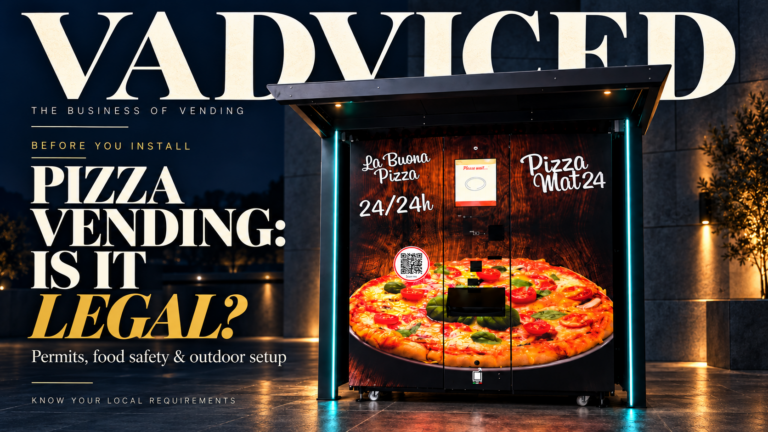
Hot food vending (pizza, sandwiches, soup, entrees, prepared meals) requires a Mobile Food Service License from your local health jurisdiction. You must obtain a license from the county or city health department in each jurisdiction where your machines operate. The licensing process includes an on-site food safety inspection of your food preparation and storage areas, verification of handwashing and refrigeration facilities, proof of approved ingredient sources from licensed suppliers, and documentation of your food safety protocols. Hot food vending involves Hazard Analysis and Critical Control Points (HACCP) planning to prevent foodborne illness and protect public health. Hot food vending machines require extensive compliance because temperatures must be monitored continuously, recorded daily, and maintained above 140 degrees Fahrenheit for safety. Health inspectors check machines regularly and log temperatures. Violations can result in machine closure, confiscation, and fines ranging from $500 to several thousand dollars, plus potential liability for any foodborne illness outbreak. Many successful hot food vending operators partner with licensed commercial kitchen facilities to source food safely and avoid the burden of operating their own food preparation area.
Fresh, Refrigerated, and Dairy Items
Fresh produce, yogurt, milk, cheese, deli items, and prepared salads require a Mobile Food Service License and may require additional refrigeration permits from the local health department. These items are highly perishable and present greater food safety risks than shelf-stable snacks. Your machines must maintain proper temperatures (typically 41 degrees Fahrenheit or below for refrigerated items) and display temperature gauges visible to health inspectors during inspections. Daily temperature checks, regular machine cleaning, ice management, and detailed temperature logs are required. Some items require time/temperature control for safety (TCS foods), meaning they cannot be left at room temperature for more than two hours without potential spoilage. If your route involves outdoor locations in warm weather, cooling and temperature management become mission-critical to prevent spoilage and foodborne illness. This category of vending is more complex and risky than packaged snacks; ensure you have the operational discipline to maintain compliance.
Coffee, Espresso, and Hot Drink Machines
Hot beverage machines (coffee, espresso, tea, cappuccino, hot chocolate) are often categorized as food service and may trigger licensing requirements. Regulatory treatment depends on whether you are dispensing pre-made drinks (lower risk, lower cost) or brewing fresh drinks on-site (higher risk, more compliance). Pre-made drinks from sealed containers (pre-brewed coffee in a sealed bottle, for example) are treated like cold beverages and may not require a health permit. Fresh-brewed machines that dispense hot coffee directly are often classified as food service equipment. If a machine brews fresh drinks on site, you will likely need a Mobile Food Service License, a handwashing station within the machine or adjacent, documented cleaning and descaling schedules, and water quality verification. Water quality is critical because poor water can introduce contaminants and affect taste; some jurisdictions require water treatment systems or testing. Consult your local health department before purchasing or placing a hot beverage machine to confirm requirements and avoid compliance surprises after purchase. The coffee and espresso market in Washington is mature and competitive (Starbucks originated here), but there is demand for convenient office vending if you can maintain quality and hygiene.
Ice Cream and Frozen Items
Ice cream, frozen yogurt, and frozen desserts require a Mobile Food Service License because they are potentially hazardous foods that require precise temperature control. Machines must maintain temperatures of 0 degrees Fahrenheit or below at all times. You must monitor and log temperatures daily (create a simple log sheet that rides in the machine), clean machines according to health department standards (weekly or as required), and ensure sourcing from licensed manufacturers with food safety certifications. Frozen items melt and spoil quickly, especially in warm environments or if machines malfunction, so regular servicing and monitoring are absolutely essential. A failed freezer unit can ruin inventory and lead to health violations. This category is suitable for operators with reliable service routes, strong mechanical aptitude, and attention to detail. Profitability can be high because frozen treats command premium pricing, but the operational burden is greater than packaged snacks or cold beverages.
Healthy, Organic, or Specialty Diet Items
Vending gluten-free, organic, vegan, keto, or allergen-controlled items does not exempt you from standard licensing or compliance requirements. The Washington State Department of Health treats these products under the same regulatory rules as conventional snacks or prepared foods. Marketing and health claims do not change the underlying food safety classification. If items are packaged in sealed containers by licensed manufacturers and shelf-stable (not requiring refrigeration or special handling), no health permit is needed, just like conventional snacks. If items are prepared fresh by you or a commercial partner, contain ingredients prone to spoilage, or require refrigeration, a Mobile Food Service License applies. Organic certification is a marketing claim and does not reduce regulatory requirements. Clearly label all allergen information (peanuts, tree nuts, dairy, gluten, soy, shellfish, sesame, sulfites) on machine labels or product packaging to protect consumers and reduce your liability. Some operators position “healthy vending” as a niche and secure premium placements in corporate wellness programs, health clubs, or medical facilities; these locations often pay higher commissions for curated healthy products. This is a valid market segment but requires expertise in nutrition, sourcing, and customer preferences.
Age-Restricted or Specialty Items
Tobacco and nicotine products (cigarettes, cigars, snuff, vape pens, e-cigarettes, and nicotine pouches) require extensive regulatory compliance in Washington. You must obtain a Tobacco Retailer License from the Washington Department of Revenue and comply with strict age verification requirements; the legal age for tobacco purchase in Washington is 21 years old. You cannot vend tobacco through unattended self-service machines; you must require direct transaction involvement or use an age-verification system (some newer machines have ID-scanning capabilities). Violations result in significant fines (hundreds of dollars per violation) and potential license suspension. Many vending operators avoid tobacco products altogether because the compliance burden, inspection risk, and potential liability exceed the profit margin. Cannabis products are legal in Washington (for adult use), but can only be sold through state-licensed retail locations with a Marijuana Retailer License issued by the Liquor and Cannabis Board; unattended vending machines are prohibited for cannabis. Alcohol sales through vending machines are prohibited entirely in Washington for safety and liability reasons. If you are considering age-restricted items, weigh the licensing complexity and compliance risk against projected revenue; most operators find it not worth the headache.
Bulk Vending (Gumballs, Capsule Toys)
Bulk vending machines (coin-operated gumball, toy, prize, or capsule machines) are the least regulated vending category because items are non-food and customers are aware they are buying novelty products. No health permit is required because items do not pose food safety risks. However, you must ensure machines are mechanically safe, financially transparent (customers should receive the product they pay for), and accessible (not blocking emergency exits or handicap access). Location agreements and property owner liability coverage are still essential; the property owner must consent to the placement and understand your liability responsibilities. Some municipalities require a local business license even for bulk vending, and cities may have rules about where machines can be placed (not in schools, for example), so confirm all requirements with your city or county clerk before deploying machines. Bulk vending can be profitable because startup costs are low, machines require minimal servicing, and you avoid the complexities of food licensing.
Location Type Requirements: How Rules Change by Where You Place Machines
Securing high-traffic locations is the hardest part of running a profitable vending route, and cold-calling property managers rarely scales. VPlaced location sourcing for vending operators connects Washington vending operators with property owners actively looking for vending services across offices, gyms, hospitals, schools, apartment complexes, and retail centers. Combining a structured location pipeline with the placement rules below speeds up route growth and protects you from spending weeks chasing locations that are already locked into long-term contracts with another operator.
Where you place machines matters as much as what you vend. Different location types have different regulatory requirements, liability exposures, and revenue potentials. A machine in a private office building faces far fewer regulations than one in a school or federal building. Public placements (streets, parks) involve permit requirements and local restrictions that private placements do not. This section details the rules and opportunities for each location category so you can strategically select placements that align with your product offerings and compliance capacity. Most successful operators start with 2 to 4 private commercial locations (offices, retail shops) to establish operational routines and cash flow, then expand to higher-regulation or higher-traffic venues after proving profitability.
Private Commercial Property
Placing a machine in a private office building, retail store, restaurant, or other commercial property requires a written location agreement. This is non-negotiable. Negotiate commission terms (typically 15 to 25% of gross sales, a fixed monthly rent, or a revenue-share hybrid), machine placement (lobby, break room, hallway, kitchen), servicing frequency (weekly, bi-weekly), liability responsibility (who pays if the machine is damaged or stolen), and any restrictions on product types. Get everything in writing on a signed document and keep a copy with your records. The property owner may require proof of insurance (liability coverage naming them as an additional insured) and may impose restrictions on product types (no high-sugar items, no alcohol, must be organic, etc.). Private locations are low-risk from a regulatory standpoint because they are not public facilities; health permits apply only if you vend hot food or highly perishable items. Relationship-building with property managers is key to long-term success; treat them professionally and pay commissions on time to earn renewals and referrals.
Public Schools and Universities
Vending in public schools (K-12) is heavily restricted. Under federal Smart Snacks standards, products must contain under 35% sugar by weight, under 10% saturated fat, and under 480 mg sodium per serving. Sugary sodas and high-calorie snacks are prohibited. Most school districts require a formal contract and insurance. Universities have their own policies and may give exclusive vending contracts to food service vendors, limiting independent operators. Contact the school or university food service director to inquire about opportunities.
Hospitals and Medical Facilities
Hospitals and medical facilities (clinics, surgery centers, physical therapy offices) are strategic vending locations because patients and staff have purchasing power and predictable presence. However, hospitals are highly regulated environments with strict product and operational requirements. Most hospitals restrict vending to healthy, low-calorie, low-sodium, and sugar-free options to align with medical and wellness messaging; high-sugar sodas, candy bars, and fried snacks are often prohibited. Nutritional labeling and ingredient transparency are typically required. Some hospitals reserve vending exclusively for contracted food services (Sodexo, Compass, etc.) and do not permit independent vendors. Contact the hospital’s food service director or facilities department to inquire about vending opportunities and product restrictions. Hospitals require proof of insurance (naming the hospital as an additional insured) and may audit your sales and compliance periodically. Pricing is often higher in hospitals because of captive customer bases, which can be profitable. Building relationships with hospital administrators can lead to placements across multiple facilities if you can meet their strict operational and product standards.
Government Buildings
Vending in federal buildings (owned or leased by the General Services Administration or managed by federal agencies) requires approval from the General Services Administration (GSA) or the specific agency managing the building. GSA guidelines restrict product types (typically healthy options only) and often require competitive bidding or formal vendor applications rather than direct placement requests. The application process can be lengthy and bureaucratic. State government buildings (Washington State offices, agencies, courts) have their own vending policies and are often managed by facility or procurement departments. Local government buildings (city and county offices) typically allow vending but may have specific vendor agreements or permit requirements. Contact the building manager or facilities/procurement administrator to request vending placement. Security clearances, background checks, and proof of insurance are sometimes required, especially for federal buildings. Profitability in government buildings can be strong because employees have regular work hours, purchasing patterns, and wages to spend. However, competitive bidding and lengthy approval processes may deter small operators. Consider government placements only after you have proof of operational success elsewhere.
Office Buildings and Coworking Spaces
Office buildings and corporate campuses are ideal vending locations, especially in Washington’s tech corridor (Seattle, Redmond, Bellevue). Tenants have consistent schedules, predictable traffic, high purchasing power, and regular work hours that align with vending service routes. Negotiate placement with the building management, lease administrator, or facilities director. Location agreements typically allow machines in common areas (lobbies, break rooms, hallways, kitchen areas) but prohibit placement in individual offices due to security and space concerns. Insurance and product restrictions vary by building; some require organic or low-calorie snacks as part of corporate wellness initiatives. Competition from existing food services and retail shops can be intense, but high traffic volumes often make the location worthwhile.
Malls and Retail Centers
Shopping malls and retail centers offer high foot traffic but come with challenges. Many malls reserve vending spaces exclusively for existing tenants (department stores, restaurants, anchor stores) under long-term contracts. Independent vending may be prohibited entirely or restricted to certain corridors (hallways, common areas) away from retail shops. Contact the mall management office and request a location agreement for any available space. Expect to negotiate commission (often 20-30 percent of gross sales) or fixed monthly rent. Even if you secure placement, foot traffic depends on the mall’s health; struggling malls with declining retail tenancy may not justify the commission expense. Competition from existing food courts, vending stations, and retail shops is intense, so pricing and product selection must be competitive.
Gas Stations and Convenience Locations
Gas stations and convenience stores present a mixed opportunity. They already sell packaged snacks and beverages as part of their core business, so they may not want competing vending machines cannibalizing sales from their shelves. However, some gas stations and travel stops accept machines in restrooms, parking areas, outdoor covered shelters, or locations visible from the pump islands. High-traffic stations on interstate highways (I-5, I-90) can be extremely profitable because travelers have steady purchasing patterns and limited alternatives. Approach the station manager first; if they are not interested, escalate to the corporate regional office for chains like Shell, Chevron, or Conoco. Locations near high-traffic highways are lucrative but require travel time for servicing, which may mean dedicating a full day per week to a single route. Calculate fuel costs and travel time against projected revenue before committing to remote highway locations.
Rest Areas and Transportation Hubs
Vending in Washington’s rest areas (located along interstate highways I-5, I-90, and U.S. Routes) is exclusively regulated by the Washington State Department of Transportation (WSDOT). WSDOT contracts directly with approved vendors and does not allow independent machine placement; you cannot simply place a machine in a rest area without authorization. To participate, contact WSDOT’s Vending Program office and inquire about contract opportunities. WSDOT typically awards vending contracts competitively and may require experience, insurance, background checks, and compliance with specific product and service standards. Rest areas offer extremely high traffic (thousands of travelers daily) but come with strict compliance requirements and competitive bidding. Vending in bus terminals and train stations (King Street Station in Seattle, Pierce Transit centers in Tacoma, etc.) requires approval from the station operator or local transit authority. These locations have high traffic but limited available space; contact the facility directly or visit their website for vendor requirements. Airports are covered separately below.
Airports
The Seattle-Tacoma International Airport (SEA) is Washington’s busiest airport. Vending at SEA and other major airports (Spokane International, Sea-Tac) is managed by the Port of Seattle and Spokane airport authority. These facilities typically have concessions agreements with vendors and may not allow independent machine placement. Contact the airport’s concessions or vendor relations department to inquire about inclusion in their vending programs.
Apartment Complexes and Residential Common Areas
Vending in apartment complex common areas (lobbies, laundry rooms, fitness centers, community rooms, mail areas) is a viable strategy, especially for mid-sized and larger complexes with hundreds of resident households. Residents are a captive customer base with predictable routines; they may prefer convenient vending over leaving the property for snacks. Contact the property management company (typically a professional management firm, not the building owner) with a location proposal and sample products. Expect to share revenue (often 20-25 percent of gross sales) or pay fixed monthly rent. Property management may restrict products to healthy options, prohibit alcohol, or require organic/locally sourced items to align with community values. Machines must not obstruct emergency exits, disabled access, or fire safety routes; placement in hallways, common kitchens, or designated areas only. Complex managers appreciate vendors who maintain machines clean, respond quickly to complaints, and pay rent on time. Starting with one apartment complex can lead to placements across multiple properties owned by the same management company, creating network effect and economies of scale. Residential vending requires excellent customer service and reliability because residents will report problems directly to property management.
Public Sidewalks and Street-Level Placements
Vending on public sidewalks, streets, parks, or other public property requires a municipal Street Vending Permit from your city or county and compliance with numerous local rules. Seattle, Tacoma, Spokane, Bellevue, and other Washington cities have specific ordinances governing machine size, location, signage, hours, and noise levels. Permits typically cost $100 to $500 annually plus background checks and liability insurance. Some cities limit the number of permits or restrict locations near competing businesses.
Washington Agencies, Roles, and Fees
The following table summarizes Washington state and local agencies that touch a vending operation, their role in your day-to-day compliance, and the current fees or filings you should plan around (as of 2026).
| Agency | Role in Vending | Current Fee or Requirement (as of 2026) |
|---|---|---|
| Washington Secretary of State | LLC and corporation formation, annual report filings, registered agent records. | $200 LLC Articles of Organization filing fee; $60 annual report. |
| Washington Department of Revenue | Sales tax permit, B&O tax registration and filings. | No fee to register; B&O tax rate varies by classification (typically 0.471 percent for retailing). |
| Washington State Department of Health | Statewide food safety standards and oversight of food vending operations. | Food worker card $10; valid two years. |
| Local Health Jurisdiction (Seattle-King County, Tacoma-Pierce County, Spokane Regional, Snohomish, etc.) | Food service permits and inspections for hot food, prepared food, and refrigerated vending placements. | Food service permits commonly $100 to $500 annually depending on jurisdiction and machine type. |
| Washington State Department of Agriculture (Weights and Measures) | Inspection and registration of vending machines. | Annual machine registration fees vary by device. |
| Washington Employment Security Department | Unemployment insurance and wage law administration. | New employer UI rate around 1.45 percent on the first $72,800 of wages per employee. |
| Washington State DOT (WSDOT) | Rest area concessions on interstate highways. | Concession opportunities awarded through competitive bid. |
| City or County Clerk (Seattle, Spokane, Tacoma, Vancouver, Bellevue) | Local business licenses, sidewalk vending permits, fictitious business name (DBA) filings. | Local business license fees typically $50 to $200; Seattle Business License Tax certificate required. |
Sales Tax, Income Tax, and Ongoing Compliance in Washington
Sales Tax on Vending Sales. Washington imposes a 6.5 percent statewide sales tax (as of 2026) on most vending machine sales, plus local taxes that bring combined rates to as high as 10.35 percent in Seattle, 10.1 percent in Tacoma, and 9.0 percent in Spokane. Food and food ingredients sold for home consumption are exempt at the state level, but Washington Department of Revenue rules treat most vending machine food and beverage sales as taxable when items are dispensed for immediate consumption. Confirm specific product treatment with the Department of Revenue before assuming an exemption. Register for a sales tax reseller permit before your first sale.
Business and Occupation (B&O) Tax. Washington has no personal income tax, but it does levy a Business and Occupation Tax on gross receipts. Vending operators classify under retailing (0.471 percent of gross income) and may also owe service and other tax classifications depending on activities. The B&O tax is owed regardless of profit, and operators frequently underestimate this obligation. File quarterly or monthly through the Department of Revenue.
Income Tax and Business Deductions. Washington does not impose state personal income tax, a meaningful advantage for high-earning operators. However, you still file federal income tax on your vending profits using Schedule C (sole proprietor), Form 1065 (multi-member LLC), or Form 1120/1120-S (corporation). Washington also levies a Capital Gains Tax (7 percent on long-term capital gains over a threshold), confirm 2026 details with the Department of Revenue. Across all entity types, you can deduct ordinary and necessary business expenses including machine purchases, inventory, mileage, insurance, location commissions, and accounting.
Annual Compliance and Reporting. Washington LLCs must file an annual report each year with the Secretary of State, paying a $60 fee. Failure to file results in administrative dissolution within 60 days. Sales tax and B&O tax returns are due monthly, quarterly, or annually based on assigned frequency. Federal payroll tax deposits follow the IRS schedule once you hire employees.
Weights and Measures Registration in Washington
The Washington State Department of Agriculture Weights and Measures Program regulates the accuracy of any vending machine that displays a price and dispenses a product. Operators must register each commercial weighing or measuring device, and annual registration fees vary by device type. Inspectors test machines on a periodic schedule, verify that posted prices match charged prices, and place an inspection sticker on each compliant unit. Machines that fail inspection are tagged out of service until repairs are made. Document maintenance, calibration, and software updates for each machine.
Common Legal Pitfalls in Washington Vending
- Underestimating B&O tax. Many new operators overlook B&O tax until they get a Department of Revenue notice. Plan for B&O on every dollar of gross revenue, not just net profit.
- Skipping the Seattle Business License Tax. If you operate in Seattle, you owe Seattle’s specific business and occupation tax in addition to state B&O. Operating without a Seattle Business License Tax certificate results in fines.
- Confusing sales tax exemptions for food. Most vending food sold for immediate consumption is taxable; operators frequently misclassify and face audit findings.
- Missing the annual report deadline. Failing to file with the Secretary of State by the deadline triggers administrative dissolution.
- Ignoring local health jurisdiction permits. Each Washington county or regional health jurisdiction runs its own inspections; a state food worker card does not replace local permits.
- Operating without a food worker card. Washington requires food workers to hold a valid food worker card; operating without one for any food vending is a violation.
- Mishandling weights and measures registration. Failing to register machines or operating without inspection stickers exposes you to per-device fines.
- Ignoring Smart Snacks rules in schools. School vending must meet federal nutrition standards.
- Mixing personal and business funds. Operators who commingle funds lose limited liability protection.
- Hiring without registering for unemployment insurance. Hiring requires Washington Employment Security Department registration.
- Operating without general liability insurance. Carry at least $1 million in general liability coverage.
When to Bring in Specialized Legal Help
Most Washington vending operators can handle the basic registration tracks without legal help. Once you scale into multi-machine contracts, hot food, age restricted products, or multi-state operations, professional advice pays for itself.
A vending specific attorney understands the interplay between the Washington Department of Revenue, Secretary of State, Department of Health, Department of Agriculture, and local health jurisdictions. Vadviced.com is a vending specific legal services provider that helps operators across all 50 states draft location agreements, navigate health department disputes, structure tax efficient entities, and respond to audits. The team at Vadviced.com can guide you through every Washington track and stay with you as you expand into Oregon, Idaho, or California.
- Negotiating multi-machine agreements with hospital systems, universities, or large tech employers. Master service agreements covering 20 or more machines deserve attorney review.
- Defending health department citations. A Seattle-King County Public Health citation can spiral into license suspension.
- Adding hot food, alcohol, or tobacco product lines. Each opens a new licensing track.
- Handling a Department of Revenue B&O or sales tax audit. Auditors compare bank deposits and supplier records.
- Pursuing federal vending opportunities at military installations. Joint Base Lewis-McChord and other federal facilities have specific bid processes.
- Structuring multi-state operations. Operators expanding into Oregon or Idaho need foreign LLC registrations.
- Hiring your first employees. Washington wage and hour law and paid family leave rules require attention.
Your Next Steps to Launch Your Washington Vending Business
Once your Washington operation is live, growing the route depends on visibility and reputation as much as compliance. VMarketed vending marketing services can help you with local SEO, Google Business Profile optimization, content strategy, and lead generation campaigns aimed at decision makers at your target locations. Operators who treat marketing as a launch-day priority typically reach their first 10 machines several months ahead of operators who rely solely on cold outreach.
You now have the regulatory map for Washington vending. The path forward is concrete: form your entity, get tax accounts in place, secure locations, and deploy machines. Most operators move from concept to first revenue in four to eight weeks.
- Form your Washington LLC. File a Certificate of Formation with the Washington Secretary of State for $200 (as of 2026). Use the online portal at sos.wa.gov.
- Obtain your federal EIN. Apply free at IRS.gov immediately after your LLC is approved.
- Open a dedicated business bank account. Bring your Certificate of Formation and EIN letter to a Washington bank or credit union.
- Register for a Washington Business License (UBI number). Apply through the Department of Revenue’s Business Licensing Service at $90 plus any city endorsements (Seattle adds its own).
- Register for B&O tax and sales tax. Note your assigned filing frequency for each.
- Register for unemployment insurance and workers compensation (if hiring). File with the Employment Security Department and the Department of Labor and Industries.
- Obtain a food worker card. Take the online Washington food worker training ($10, valid two years) before vending any food product.
- Apply for local food service permits. Contact your local health jurisdiction (Seattle-King County, Tacoma-Pierce County, Spokane Regional, etc.) for vending permits.
- Register your machines with the Department of Agriculture Weights and Measures Program and negotiate location agreements. Pay any per-machine fees and draft written agreements with each property owner.
- Buy general liability insurance, deploy your first machines, and file your first sales tax and B&O return. Purchase a policy with at least $1 million in coverage, deploy machines, restock on a regular cadence, and file your first returns on schedule. Calendar your annual report deadline so you do not lose your entity.
Washington Vending Compliance FAQ
A Limited Liability Company (LLC) is typically the best balance of asset protection, simplicity, and cost. It shields your personal assets from business liabilities and lawsuits for a filing fee of $200 with the Washington Secretary of State.
Yes. You need an EIN to separate your personal and business identities, open a dedicated business bank account, and register for state tax permits, even if you function as a sole operator without staff.
While the state base rate is 6.5%, local city and county surtaxes push the total rate higher. For instance, the combined sales tax rate ranges from 10.25% to 10.35% in Seattle and King County.
Hot prepared food, beverages (including water and coffee), candy, and non-food items are fully taxable. Unprepared food and raw food ingredients are generally exempt from sales tax under Washington rules.
Washington does not have a state personal income tax on wages. However, business owners must pay the Business and Occupation (B&O) tax, which is a unique tax levied on gross receipts, along with standard sales taxes and a Capital Gains Tax on specific long-term investment proceeds.
No. Unopened, commercially manufactured packaged snacks and cold drinks purchased from licensed distributors do not require a health permit, provided they are stored securely in clean, properly functioning machines.
These items carry high safety risks and require a Mobile Food Service License from the local health jurisdiction. Operators must submit to health inspections, maintain temperature safety logs (above 140°F for hot foods; 41°F or below for cold dairy), and source from licensed facilities.
Tobacco products require a specialized Tobacco Retailer License and strict age-verification systems; they cannot be sold through unattended, standard machines. Cannabis vending machines are completely prohibited, and alcohol sales via vending machines are illegal under state law.
Public schools (K-12) are bound by federal Smart Snacks standards. Vending items must meet strict nutritional guardrails, including containing under 35% sugar by weight, under 10% saturated fat, and under 480 mg of sodium per serving. High-calorie snacks and sugary sodas are prohibited.
No. Vending setups in Washington rest areas are strictly regulated and contracted through the Washington State Department of Transportation (WSDOT) Vending Program. Independent placement without formal, competitive state authorization is illegal.