Texas presents an exceptional opportunity for aspiring vending machine operators. With a population exceeding 30 million, the state combines rapid urbanization, robust tourism, and strong commercial activity across its largest metros: Houston, Dallas, Austin, San Antonio, and Fort Worth. The state’s diverse economy spans oil and gas, technology (particularly Austin’s growing tech corridor), aerospace (Fort Worth and Houston), healthcare (the Texas Medical Center is the world’s largest medical complex), and agriculture, all of which create steady demand for convenient snacking and beverage options. Texas also benefits from no state personal income tax, reducing your individual tax burden as the business owner.
Launching a vending machine operation in Texas requires navigating multiple federal, state, and local requirements. Unlike some states, Texas separates coin-operated machine licensing (handled by the Texas Comptroller) from food vending permits (handled by the Texas Department of State Health Services and local health departments). You’ll encounter sales tax compliance, occupancy agreements with property owners, health inspections for food items, and ongoing machine registration. The good news: Texas does not require annual LLC reports at the state level, simplifying ongoing compliance compared to many other states.
This guide walks you through every step from forming your business entity through deploying your first machine and maintaining ongoing compliance. We cover business registration, product-type-specific licensing, location requirements, agency roles, and the legal pitfalls most operators encounter in Texas. Whether you are planning a single snack machine or a multi-unit operation, you’ll find the concrete steps and contacts you need to launch confidently.
Step by Step Business Registration for Your Texas Vending Operation
Choose Your Business Entity
The structure you select affects your personal liability, tax burden, and compliance overhead. Most vending operators in Texas choose an LLC because it provides liability protection (your personal assets are separate from the business) while offering simplicity and favorable tax treatment.
A sole proprietorship requires no formal filing; you operate under your personal name or a registered fictitious name. Income flows directly to your personal tax return, and you pay self-employment tax. You have unlimited personal liability for business debts and claims.
An LLC (Limited Liability Company) is formed by filing articles of organization with the Texas Secretary of State. The LLC fee is $300 (as of 2026), with standard processing taking 12 to 15 business days. Expedited same-day processing costs $25 extra. The LLC shields your personal assets from business claims and provides pass-through taxation (you report profits on your personal return), though you may owe Texas Franchise Tax if your revenue exceeds the no-tax-due threshold of $2.65 million (as of 2026). There is no annual LLC report filing fee in Texas, making it highly cost-effective long-term. Learn more about forming an LLC for a vending machine business.
An S-Corporation or C-Corporation involves additional complexity and costs. Both require articles of incorporation with the Secretary of State, ongoing franchise tax reporting, and more detailed accounting. Corporations are rarely chosen for small vending operations because the liability protection they offer overlaps with LLC protection, yet they demand more administrative work and potentially higher taxes.
For most first-time vending operators in Texas, an LLC is the recommended structure. It combines liability protection with minimal state-level reporting obligations.
Reserve and Register Your Business Name in Texas
You can reserve a business name with the Texas Secretary of State before filing your LLC. The reservation fee is $40 and protects your name for 120 days. You can renew the reservation for another 120 days for the same fee if needed.
If you operate under a name different from your LLC’s official name (for example, your LLC is “ABC Vending LLC” but you trade as “Texas Snack Co”), you must file a fictitious name (DBA) with your county clerk. Most Texas counties charge a modest filing fee (typically $20 to $50) and require publication in a local newspaper, which adds another $50 to $200. Some counties allow online filing and digital publication, reducing both cost and time.

Use the Texas Secretary of State business entity search to check if your desired name is available. Once reserved or your LLC is formed, that name is protected statewide at the state level.
File Formation Documents with the Texas Secretary of State
To form an LLC in Texas, you file Articles of Organization with the Secretary of State. The document is straightforward: it includes your LLC’s name, principal place of business, the name and address of your registered agent (can be yourself), and the county where your principal office is located. You may also specify whether your LLC will be manager-managed or member-managed (manager-managed is typical for single-member LLCs).
You can file online, by mail, or through an authorized formation service. Filing directly costs $300 (as of 2026). The standard processing time is 12 to 15 business days; expedited same-day processing is available for an additional $25.
The Secretary of State will issue a Certificate of Formation once filed and accepted. Keep a certified copy for your records; you will need it when opening a business bank account and registering for tax permits.
Obtain an EIN from the IRS
An Employer Identification Number (EIN) is a unique identifier for your business and is required even if you have no employees. The IRS issues EINs for free. You can apply online in real time at irs.gov/businesses/small-businesses-self-employed/apply-for-an-employer-identification-number-ein-online. The process takes minutes, and you receive your EIN immediately. You will need your Employer Identification Number for a Texas sales tax permit, a Texas business bank account, and all IRS correspondence.
Open a Business Bank Account
Once your LLC is formed and you have an EIN, open a dedicated business bank account. This step is critical: commingling personal and business funds undermines the liability protection of your LLC and can result in “piercing the corporate veil,” meaning a court might hold you personally responsible for business debts. Bring your Certificate of Formation, EIN letter, and photo ID to the bank. Many Texas banks waive monthly fees for small business accounts with a modest minimum balance. Keeping separate books also simplifies tax filing and accounting.
Register for a Texas Sales Tax Permit
If your vending machines dispense any taxable items (snacks, beverages, candy), you must register for a Sales Tax Permit with the Texas Comptroller of Public Accounts. You apply online via the Texas Online Services (TOS) system or by mail. There is no permit fee to register for sales tax in Texas.
Texas has no state personal income tax but does impose sales tax at a base rate of 6.25% (as of 2026). Local jurisdictions can add up to 2% more, meaning the combined rate reaches 8.25% in high-tax areas like Houston and Dallas. For example, in Houston, the combined rate is 8.25% (6.25% state plus 2% local, including the Houston Metropolitan Transit Authority tax). In Dallas, it is also 8.25% (6.25% state plus 2% local, including the Dallas Area Rapid Transit tax).
Important vending-specific rule: food and beverages sold from vending machines are generally taxable. However, there is a notable exception: if you operate a bulk vending machine (a machine that dispenses items at random without customer selection, such as gumball or capsule toy machines), items priced at $0.50 or less are exempt from sales tax in Texas.
You must file sales tax returns with the Comptroller monthly, quarterly, or annually depending on your sales volume. Most small operators file monthly. Payments are due by the 20th of the following month (or the next business day if the 20th falls on a weekend).
Register for Texas Employer Accounts (If Hiring)
If you hire employees, you must register with the Texas Workforce Commission (TWC) for unemployment insurance, carry workers compensation insurance (required in Texas if you have employees), and register for federal payroll tax withholding with the IRS. The TWC registration is free but mandatory. Workers compensation insurance varies by payroll and risk but typically costs $500 to $2,000 annually for a small vending operation. Federal payroll taxes are withheld from employee paychecks and paid quarterly to the IRS. Most small vending operators start as solo proprietors or teams of family members (not employees), delaying these expenses until the business grows.
Product Type Requirements: How Licensing Changes for Different Vending Items
Choosing the right machine for each product category matters as much as the licensing track. You can browse vending machines and equipment from VMFS USA to compare snack machines, beverage coolers, hot food units, coffee and espresso equipment, ice cream freezers, healthy vending platforms, and bulk vending machines. Matching the machine to the product category from day one prevents costly equipment swaps later, especially for refrigerated, frozen, and hot food categories that have temperature compliance built into the hardware.
Packaged Snacks
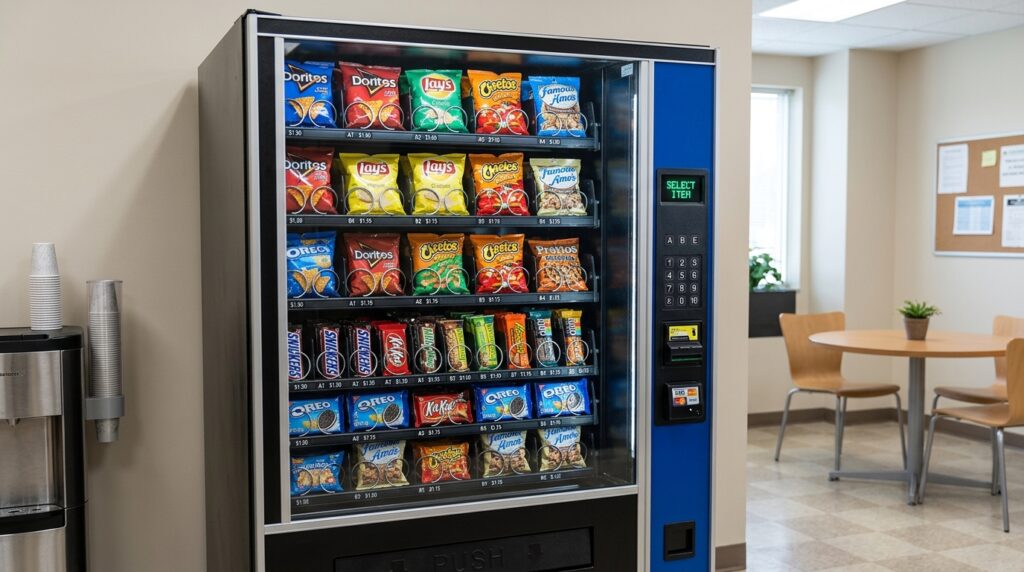
Pre-packaged, shelf-stable snacks (chips, crackers, cookies, granola bars) are the lowest-barrier vending category in Texas. You need a valid sales tax permit (registered with the Texas Comptroller) and must be compliant with federal Food and Drug Administration labeling and ingredient rules. No state food permit is required for packaged snacks because they are considered non-potentially-hazardous foods. You should still verify with your machine’s location owner that they permit vending. Local ordinances in some cities may restrict outdoor machines or require property owner consent forms.
Cold Beverages
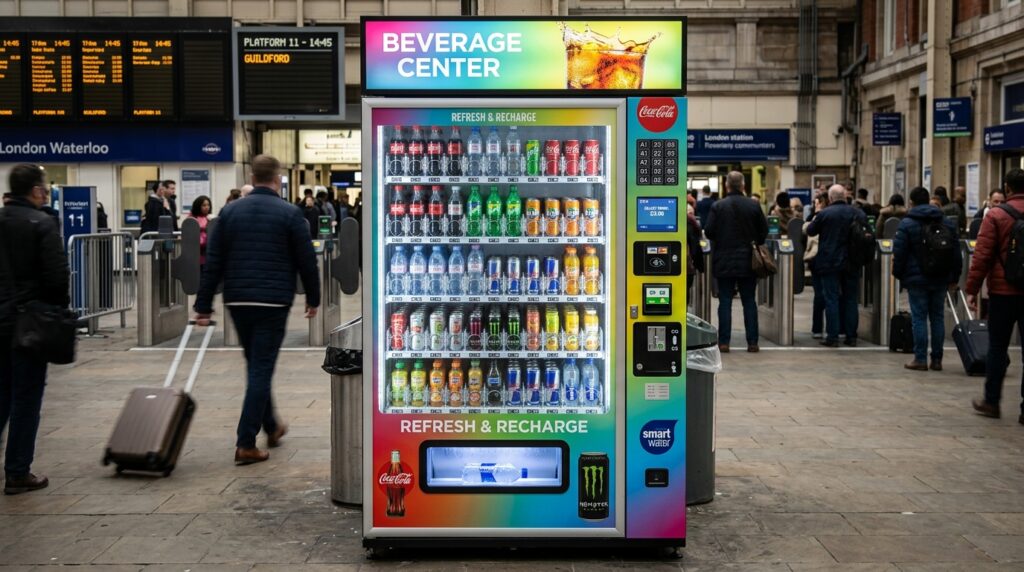
Cold drinks (bottled water, soft drinks, juice in sealed containers) are treated like packaged snacks for licensing purposes in Texas: no state food permit is required if the beverages are commercially bottled and sealed. You do need your sales tax permit. Some bottled water is exempt from sales tax in Texas if it meets specific criteria (not flavored, not carbonated, sold in bulk), but this applies more to grocery stores than vending operators. For vending, assume all cold beverages are taxable at your local rate.
Hot Food and Prepared Meals
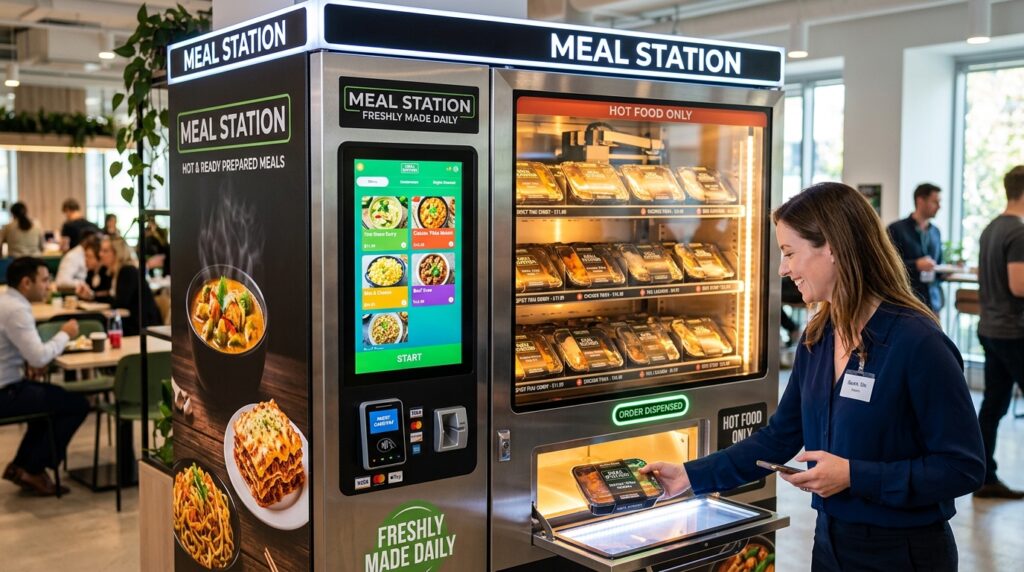
Hot foods and ready-to-eat prepared meals from a vending machine trigger full food licensing. You must obtain a Food Establishment Permit from either the Texas Department of State Health Services (DSHS) (if you operate across multiple counties) or your local health department (single county). At least one person on your team must hold a Food Handler Certificate, which involves passing a short exam. Some counties require the machine operator themselves to be certified; others allow a designated manager to hold the certification. The DSHS website has details on becoming a registered food handler and the permit process: dshs.texas.gov/retail-food-establishments/permitting-information-retail-food-establishments. Permits typically cost $100 to $500 and require annual renewal. Food machines are subject to unannounced health inspections, and the machine itself must meet specific design standards (stainless steel, removable parts, drainage).
Fresh, Refrigerated, and Dairy Items
Vending fresh, refrigerated foods (sandwiches, salads, milk, cheese) is heavily regulated. You need a Food Establishment Permit as for hot foods, plus your machine must maintain documented time/temperature control. The machine must have a certified temperature monitoring device, and you must keep daily logs showing the internal temperature. Many Texas health departments require such machines to use a temperature data logger (an electronic device that records temperature continuously) to prove compliance. The permit cost and renewal fees are comparable to hot food machines ($100 to $500 annually). Some counties have additional requirements for dairy vending, so contact your local health department before investing in a refrigerated machine.
Coffee, Espresso, and Hot Drink Machines
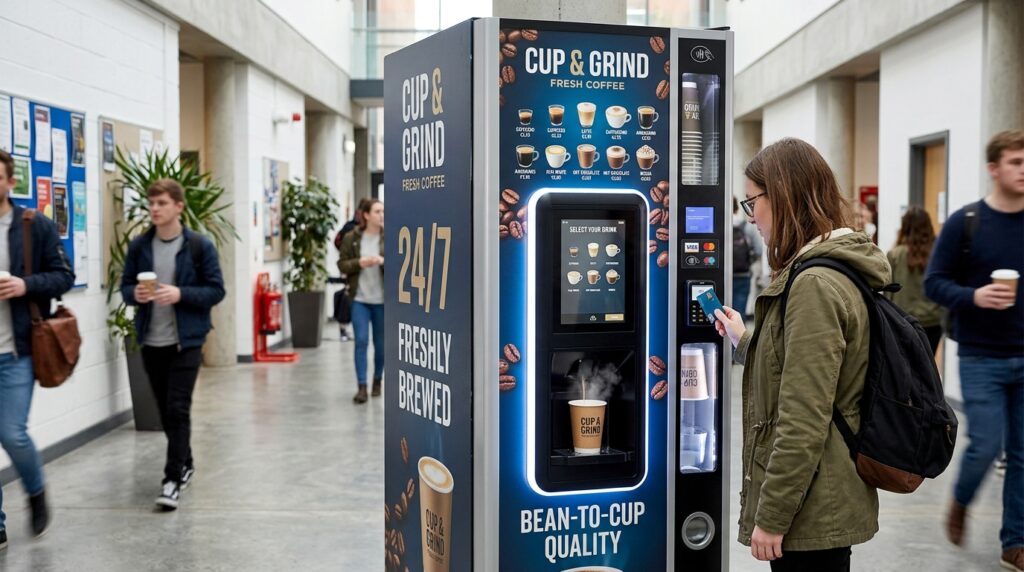
Automated hot beverage machines (serving coffee, tea, hot chocolate) without human preparation are treated differently depending on whether the machine or a person dispenses the drink. If the machine dispenses directly into a cup (fully automated), the Texas DSHS generally classifies it as a potentially-hazardous food operation, requiring a Food Establishment Permit and food handler certification. Verify this with your local health department because some counties treat fully automated machines more leniently than traditional food service. Permit costs, renewal fees, and inspection requirements mirror those for hot food machines. See vadviced.com’s hot food vending permit guide for state-neutral guidance.
Ice Cream and Frozen Items
Vending frozen items (ice cream, frozen yogurt, popsicles) requires a Food Establishment Permit from your local health department. The machine must maintain a temperature of 0 degrees Fahrenheit or below, with continuous temperature monitoring. You need a food handler certificate and must log temperatures daily. Annual inspections are mandatory. Because frozen vending machines are power-intensive, you also need reliable electrical service at your location. Permit fees are typically $100 to $400 annually.
Healthy, Organic, or Specialty Diet Items
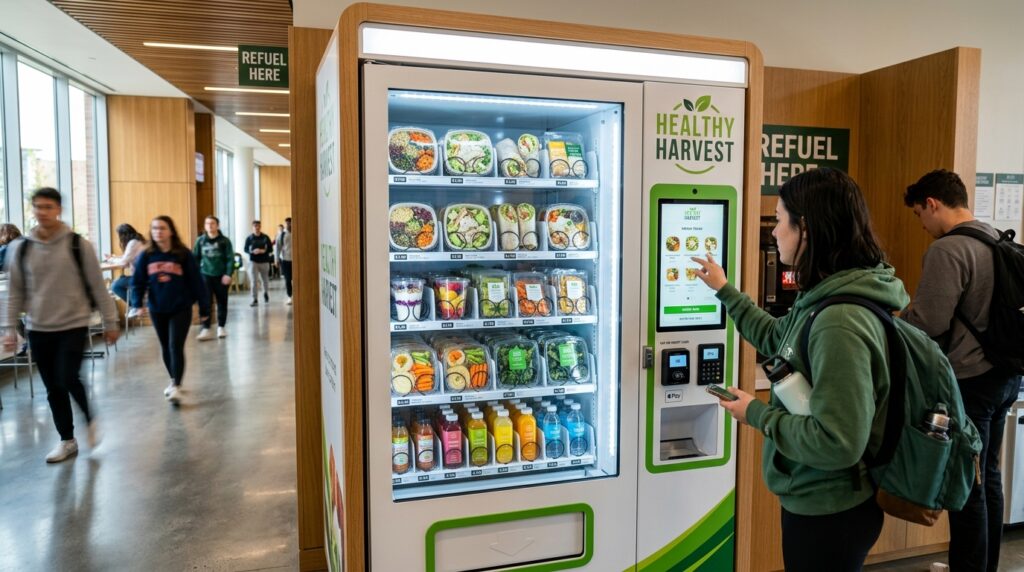
There is no separate “healthy” or “organic” vending category in Texas law. Licensing depends on the item type, not its nutritional profile or certification. Organic packaged snacks follow packaged snack rules (no permit needed). Organic prepared meals or organic dairy follow the same Food Establishment Permit requirements as their conventional counterparts. However, if you place machines in schools, you must comply with federal Smart Snacks in School standards, which require snacks to have no more than 35% sugar by weight, no more than 10% calories from saturated fat, and no more than 480 mg of sodium per serving. This applies regardless of whether the items are organic or conventional.
Age-Restricted or Specialty Items
Vending tobacco products (cigarettes, chewing tobacco) from machines is illegal in Texas except in age-verified kiosks (which require an ID scanner and operator compliance checks). Most vending operators avoid tobacco entirely. CBD and cannabis products are not federally legal for interstate commerce, and Texas law is evolving; do not vend these without explicit legal counsel from an attorney licensed in Texas. Alcohol (beer, wine, spirits) cannot be vended from machines in any Texas location; it requires a licensed premises, trained staff, and age verification that machines cannot reliably provide. Scratch-off lottery tickets and other gambling items are restricted to licensed retailers and cannot be vended.
Bulk Vending (Gumballs, Capsule Toys)
Bulk vending machines (dispensing gumballs, bouncy balls, capsule toys, or similar items) are lightly regulated in Texas. You need a sales tax permit, but you do not need a food permit because the items are not food. If items cost $0.50 or less and are dispensed from a true bulk machine (items dispensed at random without customer selection), they are exempt from sales tax in Texas. Machines that allow the customer to choose which item to purchase do not qualify for the bulk exemption. Bulk machines must still be registered with your local city or county for coin-operated machine licensing (see the Coin-Operated section below). Most bulk operators face no other state permits.
Location Type Requirements: How Rules Change by Where You Place Machines
Securing high-traffic locations is the hardest part of running a profitable vending route, and cold-calling property managers rarely scales. VPlaced (location matching for vending operators) connects Texas vending operators with property owners actively looking for vending services across offices, gyms, hospitals, schools, apartment complexes, and retail centers. Combining a structured location pipeline with the placement rules below speeds up route growth and protects you from spending weeks chasing locations that are already locked into long-term contracts with another operator.
Private Commercial Property
Placing a machine in a private office building, retail store, or commercial business is the most straightforward path. You negotiate a location agreement directly with the property owner or manager. Texas law does not mandate a government permit or approval for machines on private property (other than the sales tax permit and coin-operated machine registration). The property owner may require liability insurance, typically a $1 million general liability policy. Keep a signed location agreement on file showing permission to operate. Some property owners request a monthly commission (typically 15 to 30% of sales) in exchange for space.
Public Schools and Universities
Placing machines in K-12 public schools requires approval from the school district, and you must comply with federal Smart Snacks in School standards (no more than 35% sugar by weight, no more than 10% calories from saturated fat, and no more than 480 mg sodium per serving, per item). Machines cannot be placed in food service areas during meal times. University vending is less regulated than K-12; many universities operate their own machines or partner with national operators. You would need a vendor agreement with the university and must follow the university’s food and beverage policies.
Hospitals and Medical Facilities
Hospitals and clinics often have strict vendor agreements governing what can be vended (many prefer organic or low-sugar items). You may need a hospital vendor badge and background check. The facility may require higher insurance limits (sometimes $2 million). No state permit is specific to hospitals, but the facility’s internal policies determine placement and product restrictions.
Government Buildings
Placing machines in Texas state office buildings, courthouses, or city halls requires a procurement or vendor agreement. Some facilities use a competitive bid process. Federal buildings (post offices, Social Security offices, etc.) fall under GSA (General Services Administration) rules and typically require a formal GSA contract. No specific state vending permit is needed, but you must navigate each government entity’s procurement process, which can be lengthy.
Office Buildings and Coworking Spaces
Office buildings and coworking spaces are favorable locations. Building management negotiates directly with you. Most require a commission-sharing agreement (15 to 30% of sales) and liability insurance. No specific government permit is required beyond your sales tax permit and coin-operated registration.
Malls and Retail Centers
Shopping malls typically have strict vendor agreements and often demand high commissions (25 to 40% of sales) and exclusive product categories (e.g., no competing snack vendors). Some regional malls own and operate their own machines. Verify with mall management whether independent operators are permitted.
Gas Stations and Convenience Locations
Gas stations and convenience stores frequently partner with vending operators. Agreements typically involve commission-sharing (10 to 25%) and may include exclusive placement rights. No additional permits are required beyond your base business licenses.
Rest Areas and Transportation Hubs
Texas has rest areas along major highways operated by TxDOT (Texas Department of Transportation). Rest area placement requires a contract with TxDOT. The process is competitive, and contracts often go to larger multi-unit operators. Contact TxDOT’s rest area vendor program to inquire about current opportunities. Airport vending is covered separately below.
Airports
Texas’s largest airport is George Bush Intercontinental (IAH) in Houston. Other major airports include Austin-Bergstrom (AUS), San Antonio International, Dallas/Fort Worth (DFW), Houston Hobby (HOU), and El Paso International. Airport vending requires a contract with the airport’s concessions department and typically involves higher commissions (30 to 50% of sales) and compliance with airport security and operational rules. Most airports have existing concession agreements that dominate vending; obtaining a new contract is competitive and lengthy.
Apartment Complexes and Residential Common Areas
Placing a machine in an apartment complex common area (hallway, fitness center, pool area) requires permission from the property management. Agreements typically involve a commission or flat fee. Some complexes prohibit outside vendors entirely. Always get written approval from management before placing a machine.
Public Sidewalks and Street-Level Placements
Vending from a machine on public sidewalks or street-level locations requires a permit from your city or county. Most Texas cities regulate sidewalk vending through their business licensing or parks department. Some municipalities have adopted “street vending” ordinances that set rules for cart and machine placement, spacing, and product types. Contact your city’s business licensing office before placing a sidewalk machine. You may also need approval from the property owner of the building adjacent to the sidewalk.
Texas Agencies, Roles, and Fees
| Agency | Role in Vending | Current Fee or Requirement (as of 2026) |
|---|---|---|
| Texas Secretary of State | LLC formation, business name registration, Secretary of State search | LLC filing $300; expedited $25 extra; name reservation $40 |
| Texas Comptroller of Public Accounts | Sales tax permit, franchise tax reporting, coin-operated machine license | Sales tax permit free; coin-op license $60/machine annually (due by Nov 30); franchise tax if revenue >$2.65M |
| Texas DSHS (Department of State Health Services) | Food establishment permits, food vending compliance, hot/prepared food machines | Food permit typically $100-$500 annually; food handler certificate varies by county |
| Local County Health Department | Food permits (if single-county operation), inspections for food machines | Food permit $100-$500 annually; varies by county |
| Texas Department of Agriculture | Weights and measures registration for commercial scales and dispensing devices | Registration and inspection fees vary; inspection frequency once every 4 years |
| Texas Workforce Commission (TWC) | Unemployment insurance registration (if hiring employees) | Free registration; insurance costs depend on payroll and risk classification |
| Texas Department of Transportation (TxDOT) | Rest area vending contracts | Vendor contracts negotiated case-by-case; typically require commission sharing |
| City/County Business Licensing Office | General business license, sidewalk/public placement permits | General business license $200-$500 depending on machine count; varies by jurisdiction |
Sales Tax, Income Tax, and Ongoing Compliance in Texas
Sales Tax on Vending Sales. As a vending operator in Texas, you collect sales tax on every transaction and remit it to the Texas Comptroller. The tax rate depends on your machine’s location (base 6.25% plus local add-ons, up to 8.25% combined). You register once but must file returns monthly if your sales exceed certain thresholds, or quarterly/annually if lower. Bulk vending items under $0.50 are exempt. Keep detailed records of your sales and tax collected because the Comptroller can audit you at any time. Failure to remit collected taxes exposes you to penalties, interest, and potential criminal liability. Most operators use point-of-sale (POS) or mechanical counters on machines to track sales and calculate taxes owed.
Income Tax and Business Deductions. Texas has no state personal income tax, which is a substantial advantage over most states. You report your vending business profit on your federal tax return (Form 1040, Schedule C if a sole proprietor, or the LLC’s corresponding form). You can deduct ordinary business expenses: machine lease or purchase depreciation, maintenance and repairs, fuel and travel to service machines, commission fees paid to location owners, food and product costs, insurance premiums, and a portion of your office rent if you work from home. Keep receipts for all expenses. If you operate as an LLC, you do not owe state income tax on your profits, but you may owe Texas Franchise Tax if your total revenue exceeds $2.65 million (as of 2026). Most small operators fall well below this threshold.
Annual Compliance and Reporting. Texas LLCs do not file an annual report with the Secretary of State, which significantly reduces paperwork. However, you must file your sales tax returns with the Comptroller on schedule (monthly, quarterly, or annually depending on volume) and renew your coin-operated machine license by November 30 each year for $60 per machine. If you hold a food permit, you must renew it annually with your county or state health department ($100 to $500). Keep your sales tax permit current; a lapsed permit can result in closure of operations. If you have employees, you must file quarterly payroll tax returns with the IRS and annual W-2 forms with the Social Security Administration. Set aside time quarterly to organize receipts, reconcile sales, and prepare tax filings or work with an accountant familiar with vending businesses.
Weights and Measures Registration in Texas
The Texas Department of Agriculture Weights and Measures Section oversees compliance with state and federal weights and measures standards. For most vending operations, this matters only if your machine has an integrated scale or weight-based dispensing system (e.g., a machine that dispenses a specific weight of bulk candy or coffee beans). If your machine simply dispenses pre-counted or pre-measured items (gumballs, packaged snacks), you likely fall outside weights and measures jurisdiction. However, if you operate machines with commercial scales or devices that measure product by weight, they must be registered and inspected. Registration and inspection fees vary by device type and quantity. The Texas Department of Agriculture conducts inspections at least once every four years to verify that devices meet federal accuracy standards. Non-compliance can result in removal of the device from service and civil penalties. Consult the Department of Agriculture website or your local county agricultural extension office to determine whether your specific machines require registration.
Common Legal Pitfalls in Texas Vending
- Forgetting the $60 annual coin-operated machine license renewal. The Texas Comptroller requires each machine to have a current license decal displayed. If you fail to renew by November 30, you face a $50 late fee and potential machine seizure. Set a calendar reminder in October.
- Placing machines without written location agreements. A handshake deal with a property manager leaves you with no proof of permission. If the manager is replaced or the business disputes your presence, you lose your investment. Always get a signed agreement specifying placement terms, commission splits, duration, and termination conditions.
- Not collecting or remitting sales tax. If you forget to register for a sales tax permit or fail to collect tax on taxable items, the Comptroller can audit you and demand back taxes plus penalties and interest. This is especially risky if you have multiple machines in different tax jurisdictions. Use machine counters or POS systems to track sales accurately.
- Operating food machines without a permit. Health departments inspect food machines unannounced. Operating without a Food Establishment Permit or a current Food Handler Certificate can result in immediate shutdown, fines, and liability if someone becomes ill from your products.
- Failing to maintain temperature records on refrigerated or frozen machines. Health inspectors expect to see daily temperature logs for refrigerated/frozen machines. Lack of documentation is prima facie evidence of non-compliance and can result in permit revocation.
- Ignoring federal Smart Snacks requirements in schools. If you place machines in K-12 public schools with products that exceed the 35% sugar threshold (or sodium/fat limits), the school district can remove your machine and ban you from future placements. Verify every product against federal standards before loading school machines.
- Commingling personal and business funds. If you pay machine repair costs from your personal account or use business revenue to pay personal expenses without proper accounting, a creditor suing your LLC can argue the LLC is a sham and pierce the veil to reach your personal assets. Maintain a separate business bank account and never co-mingle funds.
- Operating without liability insurance. Most property owners require a $1 million general liability policy. If someone is injured by your machine or a product malfunction causes harm, liability insurance protects both you and the property owner. Going uninsured exposes your personal assets to lawsuit.
- Neglecting local sidewalk vending permits. If you place a machine on a public sidewalk without a city or county permit, you risk fines and removal. Some jurisdictions have specific ordinances regulating sidewalk vending; check with your city’s business licensing office before deploying outdoor machines.
- Assuming all packaged snacks are tax-exempt. Some pre-packaged items sold from vending machines are taxable; the rule depends on serving size, packaging, and whether the item is considered “candy” or “food.” When in doubt, contact the Texas Comptroller’s office for clarification on specific products.
- Not registering for Franchise Tax reporting even below the threshold. If your revenue exceeds the no-tax-due threshold of $2.65 million, you must file a Public Information Report (PIR) with the Comptroller. Missing this filing can result in penalties and loss of liability protection for the LLC.
When to Bring in Specialized Legal Help
Most vending operators handle routine business registration and tax filings independently. However, certain situations warrant professional legal and tax advice. A vending-specific attorney or accountant can save you money by clarifying ambiguous regulations, helping you structure your business optimally, and defending you if an agency questions your compliance.
Consider consulting a Texas-licensed vending attorney (or a general business attorney with vending experience) in these scenarios:
- Negotiating multi-location or multi-year agreements with large property owners or franchisors. Complex location agreements, especially with malls or hotels, may include exclusivity clauses, commission structures, or termination penalties that require careful review to protect your interests.
- Responding to a health department inspection notice or violation. If your food machine fails an inspection or you receive a notice of non-compliance, a health law attorney can help you respond, request a hearing, or negotiate corrective action without losing your permit.
- Addressing a tax audit or franchise tax dispute with the Comptroller. If the Comptroller audits your sales tax records or disputes your franchise tax filing, an attorney or CPA can represent you in appeals and help negotiate a settlement.
- Forming a multi-member LLC or partnership to share vending operations with partners. Operating agreements, profit-sharing terms, and liability among partners are complex and best documented by an attorney to prevent disputes later.
- Planning to scale to 50+ machines across multiple counties, involving food vending. Scaling requires understanding multi-jurisdictional tax and health compliance, potential need for a state-level food permit, and franchise tax implications. Vadviced.com provides resources on vending-specific legal services that can guide this growth.
- Handling a product liability claim or injury allegation tied to your vending machine. If a customer claims illness from a product or injury from the machine, you need immediate legal counsel and coordination with your liability insurer. Do not communicate with the claimant without your attorney.
- Navigating cannabis, CBD, or other emerging product categories. Texas law on hemp-derived and cannabis products is evolving. Before vending these items, consult a Texas attorney licensed to practice in this specialized area. Vadviced.com can connect you with attorneys experienced in emerging product vending compliance.
Your Next Steps to Launch Your Texas Vending Business
Once your Texas operation is live, growing the route depends on visibility and reputation as much as compliance. VMarketed vending marketing services can help you with local SEO, Google Business Profile optimization, content strategy, and lead generation campaigns aimed at decision makers at your target locations. Operators who treat marketing as a launch-day priority typically reach their first 10 machines several months ahead of operators who rely solely on cold outreach.
Now that you understand the legal landscape in Texas, put your plan into action. The steps below are sequential; completing each one moves you closer to your first deployed machine and a fully compliant operation.
- Form your LLC by filing Articles of Organization with the Texas Secretary of State ($300 filing fee, standard processing 12 to 15 days). Keep your Certificate of Formation on file.
- Obtain your EIN from the IRS using the free online application at irs.gov (takes minutes, EIN issued immediately).
- Open a dedicated business bank account with your Certificate of Formation, EIN letter, and photo ID.
- Register for a Texas Sales Tax Permit with the Texas Comptroller via the Texas Online Services system (no fee; registration typically takes 1 to 2 days).
- Identify your initial machine locations (e.g., three to five offices or retail sites) and negotiate written location agreements with property managers specifying placement, commission, duration, and termination terms.
- If vending food or beverages, obtain a Food Establishment Permit from your county health department ($100 to $500) and enroll in a food handler certification course (typically $10 to $50 online).
- Purchase or lease your vending machines and stock them with products compliant with your chosen category (packaged snacks, beverages, bulk items, or food). Ensure any food products meet nutritional standards if placing in schools.
- Register each machine with the Texas Comptroller for the $60 annual coin-operated machine license (due by November 30; apply in September or October to avoid late fees).
- Arrange general liability insurance ($1 million minimum) through a commercial broker; most policies cost $300 to $800 annually for small operators and satisfy property owner requirements.
- Deploy your machines to agreed locations, maintain daily sales records and temperature logs (for refrigerated/frozen machines), file monthly or quarterly sales tax returns with the Comptroller, and renew all licenses and permits on schedule (sales tax, coin-op, food permits, insurance) to stay in compliance and grow your operation profitably.
Texas Vending Machine FAQ
Get clear, compliant answers on navigating the specific legal and tax frameworks of the Lone Star State.
Do I need a license to operate vending machines in Texas?
Yes. If your machines accept coins, bills, or plastic/digital payments, the Texas Comptroller requires a General Business License (or a Registration Certificate if you only place machines in your own physical business). Additionally, you must secure a Texas Sales and Use Tax Permit.
What is the Texas Occupation Tax for vending machines?
Texas imposes an annual Occupation Tax of $60.00 on every coin-operated vending machine exhibited for public play/use. A physical tax permit decal must be securely attached and clearly visible on every single machine.
How much does a Texas General Business License cost?
The annual fee for a General Business License is structured on a tiered scale depending on your fleet size: $200 for 50 or fewer machines, $400 for 51 to 200 machines, and $500 for more than 200 machines. All license renewals are due by November 30th each year.
How much does it cost to register a vending LLC in Texas?
Filing a Certificate of Formation to create an LLC with the Texas Secretary of State costs a flat $300 state filing fee. Texas does not charge an annual report filing fee, but LLCs must file a No Tax Due Information Report (and a Public Information Report) annually to maintain franchise tax compliance.
What is the sales tax rate for vending machines in Texas?
Texas charges a base state sales tax of 6.25%. Local jurisdictions (cities, counties, and transit authorities) can add up to an additional 2%, making the maximum total sales tax rate 8.25% depending on the machine’s exact location.
Do snacks and sodas require health permits in Texas?
No. Standard shelf-stable, pre-packaged foods (like chips and candy bars) and factory-sealed bottled/canned drinks do not require local health department permits or food handler cards. Your General Business License and Sales Tax Permit are all that’s required.
When is a Retail Food Permit required for Texas vending?
If your machines sell temperature-controlled, perishable items (such as milk, fresh sandwiches, hot meals, or ice cream), you must obtain a Retail Food Permit from the Texas Department of State Health Services (DSHS) or your local county health authority, and at least one key employee must have a Texas Food Handler Card.
Can I sell tobacco or vape products in Texas vending machines?
Texas strictly regulates tobacco sales. Vending machines dispensing cigarettes or e-cigarettes are prohibited except in age-restricted venues (like bars or private clubs) where individuals under 21 are not permitted entry, and the machine must be positioned at least 25 feet away from any entrance.
How are commission payouts to property hosts regulated in Texas?
Under Texas Comptroller rules, no more than 50% of the gross receipts from a coin-operated machine can be contracted to, or shared with, a bailee or lessee (the property host) by the license holder. Keep this in mind when negotiating Host Location Agreements.
How do I file and pay sales taxes for my Texas vending business?
You must report and remit all collected sales taxes online through the Texas Comptroller’s Webfile system. Filing frequencies (monthly, quarterly, or yearly) are determined by the Comptroller’s office based on your anticipated monthly sales volume upon registration.