North Dakota presents a compelling opportunity for vending entrepreneurs. The state’s economy centers on agriculture (wheat, soybeans, sugar beets, and potatoes), energy (the Bakken Formation and Williston oil basin drive consistent activity), technology hubs (Microsoft’s Fargo campus), and military installations (Grand Forks Air Force Base and Minot Air Force Base). Major cities like Fargo, Bismarck, Grand Forks, Minot, Williston, and West Fargo offer dense office corridors, university campuses (University of North Dakota and North Dakota State University), and steady foot traffic. This economic diversity supports demand for convenient snacking and beverages across schools, hospitals, government offices, rest areas, and commercial spaces. Fargo’s population exceeds 140,000 and continues growing; Bismarck, the state capital, draws government workers and ongoing public infrastructure projects. These markets provide stable demand for vending machines in corporate offices, industrial facilities, and public buildings where employees and visitors seek quick, affordable snacks and drinks throughout the day.
North Dakota’s regulatory environment is straightforward but requires attention to detail. The state imposes reasonable filing fees, minimal annual compliance burdens, and clearly defined product licensing rules. Unlike states with complex local jurisdictions, North Dakota centralizes most business registration through the Secretary of State and sales tax through the Office of State Tax Commissioner. Health and food safety oversight comes from the Department of Health and Human Services, with inspections delegated to local public health units.
This guide walks you through every legal step to launch your North Dakota vending operation, from business entity formation through your first machine placement. You will learn how to register your business, obtain required permits and licenses, understand product-specific rules, manage sales tax compliance, and navigate the common pitfalls that sink inexperienced operators. Whether you plan to place snack machines in office buildings, beverage coolers in retail spaces, or specialized units in schools and healthcare facilities, this roadmap equips you with the knowledge to stay compliant and profitable.
Step by Step Business Registration for Your North Dakota Vending Operation
Choose Your Business Entity
You have four main options: a sole proprietorship, a limited liability company (LLC), an S-corporation, or a C-corporation. Most vending operators choose an LLC because it combines liability protection (protecting your personal assets if your business is sued) with straightforward tax treatment and minimal ongoing paperwork. An LLC is the industry standard for vending because it costs less to form than a corporation, requires no board meetings or formal minutes, and allows you to report business income on your personal tax return (pass-through taxation) rather than filing a separate corporate tax return.
A sole proprietorship offers no liability protection but requires no formal filing. You simply operate under your name or a fictitious name. If a customer is injured by a machine or sues your business, your personal home and savings are at risk. This structure makes sense only for very small, single-machine operations with minimal revenue. However, even a single vending machine creates liability risk (a defective machine, an injury on the location property, or a food contamination claim). Therefore, operating as a sole proprietor is almost never prudent for vending.
An LLC separates your personal wealth from business liabilities. If someone is harmed by a defective machine or a contract dispute arises, creditors can pursue LLC assets but generally not your personal property. To form an LLC in North Dakota, you file Articles of Organization with the Secretary of State and pay a $135 filing fee (as of 2026). The state processes filings in 3 to 5 business days when submitted online through the FirstStop portal, the only accepted filing method.
An S-corporation and C-corporation offer similar liability protection but involve more complex tax filings, annual corporate minutes, and federal tax elections. Most vending start-ups avoid these unless advised by a CPA. For detailed guidance on LLC versus incorporation, visit Vadviced.com’s LLC formation guide or their incorporation resource.
Reserve and Register Your Business Name in North Dakota
Choose a business name that is not already in use. You can search the North Dakota Secretary of State’s business entity database online to confirm availability. The name must include “LLC” if you are forming a limited liability company.
If you want to operate under a name different from your LLC’s legal name, you must file a fictitious name (doing business as, or DBA) certificate with your county clerk’s office. This protects your rights to use that name and prevents others from using it within that jurisdiction. The fee varies by county but is typically $20 to $50. You do not need to renew a fictitious name in North Dakota; it remains valid indefinitely unless you choose to abandon it.
Reserve your name in advance by submitting a name reservation request to the Secretary of State if you want to protect a name before filing your articles. This costs a small fee and holds the name for 120 days. Once you file your Articles of Organization, the name is permanently reserved for your LLC.
File Formation Documents with the North Dakota Secretary of State
If you have chosen an LLC, file Articles of Organization with the North Dakota Secretary of State. The Articles are a simple one-page form naming your LLC, listing a registered agent (usually you, or a professional registered agent service), and stating your principal place of business.
Submit the Articles online through the FirstStop portal at https://sos.nd.gov/business/northdakota-businessservices. Pay the $135 filing fee by credit card or electronic check. Processing takes 3 to 5 business days. If you need immediate approval, expedited processing is available, though North Dakota does not charge an additional fee for this service; it simply prioritizes your filing.
After approval, the Secretary of State issues a certificate of formation. Keep this document in your business records. Some banks and vendors will ask to see it when you open a business account or apply for a vending license.
Obtain an EIN from the IRS
An Employer Identification Number (EIN) is a unique nine-digit identifier issued by the IRS for tax purposes. You need an EIN even if you have no employees; it distinguishes your business income from your personal income on tax returns and allows you to open a business bank account.
Apply online at irs.gov/businesses/small-businesses-self-employed/apply-for-an-employer-identification-number-ein-online. The process takes about 15 minutes, and you receive your EIN immediately upon completion. There is no fee. If you prefer to apply by mail or phone, the IRS accepts both methods, though processing takes longer.
Open a Business Bank Account
Visit a bank or credit union and open a business checking account in your LLC’s name using your EIN. Bring your certificate of formation and a government-issued ID. Keeping business and personal finances separate is essential; it prevents the IRS from disqualifying your LLC’s liability protection (a legal concept called piercing the corporate veil) if an audit reveals commingled funds.
Deposit all vending revenue into this account and pay all business expenses from it. Use the account to file quarterly sales tax returns and annual income tax returns. Most banks offer business accounts with no monthly fee for new small businesses.
Register for a North Dakota Sales Tax Permit
You must register for a sales tax permit from the North Dakota Office of State Tax Commissioner before placing your first machine. Register online at https://www.tax.nd.gov/business/sales-and-use-tax. There is no fee to register or renew your permit.
North Dakota’s statewide sales tax rate is 5% (as of 2026). Local jurisdictions add 0% to 3% on top of the state rate. For example, Fargo’s combined rate is 7.75%, and Bismarck’s is 7%. When you place a machine in Fargo, you collect 7.75% sales tax on each sale; when you place one in Bismarck, you collect 7%. You remit the total collected to the state, and the state distributes the local portion to the city. Food items (most packaged snacks, beverages) are subject to sales tax. However, some items are taxed differently; check with the Office of State Tax Commissioner about specific products. For instance, some beverages might qualify as food (no tax) while others are taxed as supplies. When in doubt, ask the Office of State Tax Commissioner for a written ruling on specific products before placing them in machines.
You must file sales tax returns monthly or quarterly depending on your sales volume. If your annual revenue is less than $40,000, you can file annually. Most small vending operators qualify for annual or quarterly filing, reducing paperwork. The Office of State Tax Commissioner provides pre-calculated sales tax tables showing exactly how much tax to remit based on your gross sales for each jurisdiction. Use these tables or integrate your vending machine’s sales data into a spreadsheet to calculate accurate tax liability. Many vending operators use machines that track sales by location, making it easy to report each jurisdiction separately if you operate machines across city lines (for example, one in Fargo and one in West Fargo). Accurate sales tax compliance is non-negotiable; audits are rare but devastating when they occur.
Register for North Dakota Employer Accounts (If Hiring)
If you hire employees to refill machines, manage accounts, or handle logistics, you must register with Job Service North Dakota for unemployment insurance. Visit https://www.jobsnd.com/unemployment-business-tax to open an account.
You must also register for North Dakota state income tax withholding. Job Service North Dakota handles both registrations in one process. Once registered, you report wages quarterly using the UI EASY system (Unemployment Insurance Employer Account System) and withhold state income tax from employee paychecks. North Dakota’s income tax uses a graduated structure with rates ranging from 1.95% to 2.64% (as of 2026), so withholding amounts vary based on each employee’s salary and filing status.
Workers’ compensation insurance is not required in North Dakota if you are a sole proprietor, partner, or LLC member who does not employ anyone. Once you hire your first employee, purchase workers’ compensation insurance through a private insurer. This covers medical costs and wage replacement if an employee is injured on the job.
Product Type Requirements: How Licensing Changes for Different Vending Items
Choosing the right machine for each product category matters as much as the licensing track. You can browse snack and beverage vending equipment at VMFS USA to compare snack machines, beverage coolers, hot food units, coffee and espresso equipment, ice cream freezers, healthy vending platforms, and bulk vending machines. Matching the machine to the product category from day one prevents costly equipment swaps later, especially for refrigerated, frozen, and hot food categories that have temperature compliance built into the hardware.
Packaged Snacks
Packaged snacks (chips, nuts, granola bars, candy, crackers) require no special licensing beyond your basic business registration and sales tax permit. These items are shelf-stable, require no refrigeration, and pose minimal food safety risk. You do not need a food establishment license from the health department for packaged snacks alone. This makes snack vending the most accessible entry point for new operators; it is also the most competitive category because the barriers to entry are lowest.
All packaged snacks must be from approved manufacturers (commercially processed), clearly labeled with ingredient lists and expiration dates, and stored in a dry, clean environment. Avoid bulk candy bins or open snacks; vending machines with enclosed, sealed products eliminate contamination risk. Buy snacks from established food distributors (like Frito-Lay, Mondelez, or regional North Dakota distributors) rather than from gas stations or warehouse clubs. Distributors guarantee product freshness, handle recall logistics, and provide wholesale pricing. Gas station snacks may be outdated or damaged, creating customer complaints and waste. Establish a distributor account and order on a regular schedule (weekly or bi-weekly) to keep your machines fresh and appealing. Rotate stock so older products are front-facing and newer products in back, preventing expiration waste.
Cold Beverages
Cold beverages (soda, juice, bottled water, iced coffee) in sealed bottles or cans require no special licensing. Like packaged snacks, these are low-risk because they are pre-manufactured, sealed, and free from contamination once packaged. You need your sales tax permit and basic business registration. Many vending operators pair beverage coolers with snack machines for maximum location appeal and revenue; the same customer often buys both.
Ensure your cooler maintains proper temperature (below 41 degrees Fahrenheit). Check temperature logs weekly. Expired beverages must be discarded, not resold. Stock your machines from licensed distributors; do not buy from gas stations or convenience stores and resell from a vending machine. Coolers require reliable electricity, so confirm before placing a machine. Electric coolers consume 5 to 15 amps depending on size and ambient temperature; ensure the location’s outlet is dedicated (not shared with other equipment) to prevent overloads or machine shutdown. In winter, some locations are too cold for coolers (outdoor or unheated spaces), so test your location’s temperature range. Beverages generate higher profit margins than snacks if priced appropriately ($2 to $3 per bottle versus $0.75 to $1.50 for snacks), making coolers attractive but dependent on consistent electricity and proper maintenance.
Hot Food and Prepared Meals
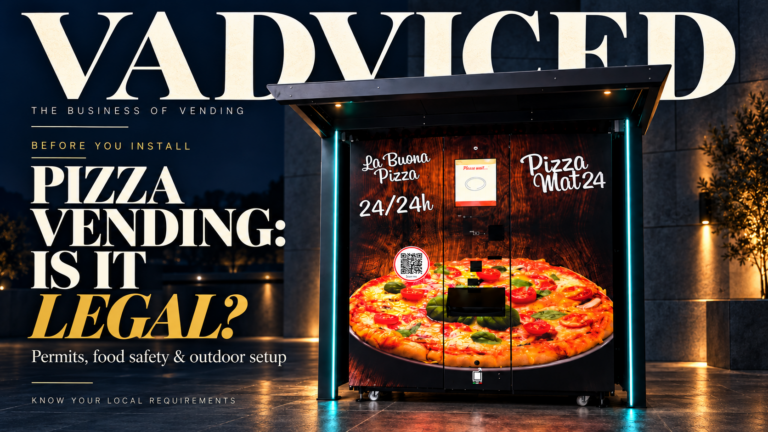
Hot food (pizza, sandwiches, burritos, hot dogs) requires a food establishment license from the local public health unit. The North Dakota Department of Health and Human Services, Food and Lodging Section, provides guidance, but your county or city health department issues the license and conducts inspections.
You must have a commercial kitchen to prepare hot foods or partner with a licensed food facility. The vending machine itself must maintain hot foods at 140 degrees Fahrenheit or above. This requires specialized heated vending equipment and reliable power. Most small vending operators avoid hot food because of the compliance cost and complexity. See Vadviced.com’s hot food vending guide for detailed requirements.
Fresh, Refrigerated, and Dairy Items
Fresh items (cut fruit, salads, dairy products, deli meats) require a food establishment license and a specialized refrigerated vending machine that maintains 41 degrees Fahrenheit or below. Temperature monitoring, inspection, and strict time-stamping of products are mandatory. Local health departments inspect these machines monthly or quarterly.
Many vending operators avoid this category because of licensing and equipment costs. If you pursue it, partner with a local health department early to understand exact requirements, inspection frequency, and allowable hold times for different products.
Coffee, Espresso, and Hot Drink Machines
Vending machines that dispense hot coffee or espresso fall into a gray area. Sealed, pre-made beverages in bottles or cans (e.g., bottled lattes) require no special license. However, machines that brew coffee or espresso on-site may require a food establishment license, depending on how the machine is classified and whether it is considered a food preparation facility.
Check with your local health department before investing in a coffee machine. Some jurisdictions treat self-serve coffee machines as low-risk; others require full licensing. Getting written confirmation avoids costly compliance surprises later.
Ice Cream and Frozen Items
Frozen items (ice cream, frozen yogurt, frozen bars) require a food establishment license and a specialized freezer vending machine that maintains 0 degrees Fahrenheit or below. Inspections are frequent, and strict time-temperature logs are mandatory.
Like fresh and refrigerated items, frozen vending requires significant licensing and equipment investment. Consider this category only if you have experience in food service and a reliable supply chain for frozen products.
Healthy, Organic, or Specialty Diet Items
Healthy and organic packaged snacks (gluten-free bars, plant-based chips, organic granola) have the same licensing requirements as conventional packaged snacks: none, as long as they are commercially manufactured and sealed. Organic certification is a marketing advantage but does not change vending regulations.
Specialty diet items for diabetics, allergies, or other medical conditions are treated the same as regular snacks if commercially packaged. If you make items yourself (e.g., homemade protein bars), you must obtain a food establishment license and comply with labeling, allergen disclosure, and facility requirements.
Age-Restricted or Specialty Items
Tobacco and electronic smoking devices are heavily regulated in North Dakota. As of January 12, 2026, federal law prohibits vending machines that sell tobacco products, electronic smoking devices, or alternative nicotine products in any facility where persons under 21 years of age are permitted to enter. This effectively bans most tobacco vending machines in public locations.
If you operate a machine in an age-restricted facility (a bar, adults-only club), you must obtain a Tobacco Retailer’s License from the Office of the State Tax Commissioner, pay a $15 annual fee per machine location, and disable the machine until unlocked by an employee before each purchase. North Dakota law prohibits fully automated tobacco vending even in adult-only spaces.
Alcohol is not permitted in vending machines. CBD and cannabis products are subject to state and federal regulations that vary rapidly. Before placing a machine with these items, consult a state business attorney to ensure compliance with current law.
Bulk Vending
Bulk vending (gumballs, capsule toys, bouncy balls dispensed for quarters) requires no food establishment license because no food is involved. You need your basic business registration and sales tax permit. Bulk vending is low-risk and low-margin; most bulk vending operators place dozens of small machines to achieve meaningful revenue.
Location Type Requirements: How Rules Change by Where You Place Machines
Securing high-traffic locations is the hardest part of running a profitable vending route, and cold-calling property managers rarely scales. VPlaced (location matching for vending operators) connects North Dakota vending operators with property owners actively looking for vending services across offices, gyms, hospitals, schools, apartment complexes, and retail centers. Combining a structured location pipeline with the placement rules below speeds up route growth and protects you from spending weeks chasing locations that are already locked into long-term contracts with another operator.
Private Commercial Property
Placing a machine on private commercial property (office buildings, retail shops, factories) is the easiest path. You negotiate a placement agreement directly with the property owner or manager. The contract specifies revenue split (typically 20% to 40% of gross sales goes to the property owner), maintenance responsibilities, product placement, and termination terms. Most property owners appreciate vending as a tenant amenity that improves employee satisfaction without requiring the owner’s effort. Negotiate from strength if you locate a high-traffic building; owners value reliable operators who keep machines clean, maintain stock, and resolve issues promptly.
No government permit is required for private commercial placements, only your sales tax permit and business registration. Ensure your property owner (landlord) insurance covers vending machines (most standard commercial policies do not; you may need to add a rider). Inspect the location for customer access (How will employees find the machine? Is it visible from work areas?), electrical outlets (if your machine is electric; coolers require dedicated 115V outlets), foot traffic patterns (peak hours, seasonal variation), and environmental factors (temperature range, humidity, exposure to direct sunlight or cold). Visit the location at different times of day to assess realistic traffic and buyer behavior. A machine placed in a well-traveled hallway generates far more revenue than one tucked in a back office. Scout the market: visit office buildings in Fargo, Bismarck, and other target cities to identify high-traffic vending locations and size the opportunity before investing in machines.
Public Schools and Universities
Placing machines in K-12 public schools requires approval from the school district and compliance with federal Smart Snacks standards. The U.S. Department of Agriculture Food and Nutrition Service mandates that snacks sold in schools must contain less than 35% sugar by weight, less than 10% saturated fat per serving, and less than 480 mg of sodium per serving (as of 2026).
You must verify every product meets these thresholds before placing it in a school machine. Many common snacks (regular chips, candy, sugary cereals) fail to meet these standards. Work with a distributor who pre-screens products for school compliance, or invest in your own testing. Schools typically require a master agreement allowing them to audit your machine monthly and remove non-compliant items.
Universities have fewer restrictions but typically require a written agreement. Contact each institution’s food service director or student life office.
Hospitals and Medical Facilities
Hospitals and clinics often prefer healthy snack options. Some restrict sugar and sodium similar to schools. Negotiate terms directly with the facility administrator. Most require your liability insurance and proof of business registration before placement.
Government Buildings
City halls, county courthouses, and state offices may allow vending but typically require a formal vendor agreement and proof of licensing. Federal building access requires registration with the General Services Administration (GSA) if the building is federally leased. Most small vending operators skip federal placements due to complexity; focus on state and local government buildings instead.
Office Buildings and Coworking Spaces
Office parks and coworking facilities are prime vending locations. Negotiate placement directly with the building owner or leasing agent. Most require a placement agreement specifying commission, service frequency, and liability insurance. Verify that your business insurance covers the building and includes at least $1 million in general liability coverage.
Malls and Retail Centers
Shopping malls and retail centers often have exclusive vending contracts or preferred vendors. Contact the property manager or leasing office. Many malls charge a flat monthly rent ($200 to $1,000 depending on foot traffic) plus a commission on sales, reducing your profit margin. Evaluate whether the location’s foot traffic justifies these costs. For example, if you pay $300 per month rent plus 25% commission on sales at a slow mall, you need to generate at least $1,200 in monthly sales just to break even ($300 rent divided by 25% commission rate). At a high-traffic mall, a $1,000 monthly rent might still be profitable if you generate $4,000 in sales (25% of $4,000 equals $1,000 commission, covering the rent). Before signing a mall agreement, ask the property manager for historical foot traffic data, nearby competitor vending machines, and references from other vending operators. Some malls perform well; others are financial drains. Research thoroughly.
Gas Stations and Convenience Locations
Gas stations, truck stops, and convenience stores sometimes allow outside vending machines alongside their own products. This is highly competitive; gas stations prefer to stock their own shelves. If the station owner agrees, your commission may be lower (10% to 20%) than office buildings (20% to 40%) because foot traffic is transient.
Rest Areas and Transportation Hubs
The North Dakota Department of Transportation manages interstate rest areas along I-94 and I-29. Some rest areas allow vending machines, but placements are limited and often reserved through formal bidding processes. Contact the DOT’s planning or operations division to inquire about availability. Competition is high, and commission splits are typically unfavorable (50% or more to the state).
Airports
Hector International Airport in Fargo is North Dakota’s largest and busiest airport. Airport vending is handled through formal concessions agreements managed by the airport authority. Contact the airport’s concessions office to apply. Most airport placements require higher commissions and proof of established business history, making them difficult for start-ups.
Apartment Complexes and Residential Common Areas
Apartment managers sometimes allow machines in common areas (lobbies, fitness centers, laundry rooms). Revenue is typically low because resident turnover and smaller populations limit repeat traffic. Negotiate directly with the property manager. Ensure your machine is vandal-resistant and located in well-lit, monitored areas.
Public Sidewalks and Street-Level Placements
Placing a machine on a public sidewalk, park, or street-level location requires a permit from the city or county. Regulations vary widely. Fargo, Bismarck, and other major cities often require a sidewalk vending permit, liability insurance, and proof of business licensing. Some cities impose restrictions on machine size, appearance, and daily operating hours. Contact your city’s business licensing or planning department for specific rules.
North Dakota Agencies, Roles, and Fees
Understanding which agencies regulate vending machines in North Dakota and their specific roles prevents costly compliance mistakes. The agencies listed below work together to oversee business formation, sales tax, food safety, labor, and weights and measures. Some overlap exists (for example, both the health department and local county inspectors enforce food vending rules), but each agency serves a distinct purpose. Register with the Secretary of State and Office of State Tax Commissioner first; these are mandatory. Contact local health departments only if you plan to vend food items requiring licensing. Job Service North Dakota becomes relevant only if you hire employees. The table below shows the typical fees and requirements for a solo vending operator who vends packaged snacks in a two-county area.
| Agency | Role in Vending | Current Fee or Requirement (as of 2026) |
|---|---|---|
| North Dakota Secretary of State | Business entity formation and registration | $135 LLC filing fee (Articles of Organization); annual report $50 due by November 15 |
| North Dakota Office of State Tax Commissioner | Sales tax permit and income tax withholding oversight | No fee for sales tax permit; vending machine income taxed at 1.95% to 2.64% graduated rate |
| North Dakota Department of Health and Human Services (Food and Lodging Section) | Food establishment licensing for hot, fresh, and refrigerated vending; inspection oversight | Food establishment license fee varies by type; vending machine license $40 annually; plan review $20 |
| North Dakota Department of Agriculture | Weights and measures; pesticide and food product labeling oversight | No separate registration fee for vending; inspections performed by local health units |
| Job Service North Dakota | Unemployment insurance and state income tax withholding for employees | Unemployment insurance rates vary (0.95% to 5.4% of wages); no registration fee |
| County Clerk’s Office (Fictitious Name) | DBA and fictitious name registration | $20 to $50 per county (one-time, no renewal required) |
| City/County Planning or Public Health Department | Sidewalk vending permits and local placement approvals | $50 to $200 per location annually (varies by jurisdiction) |
| North Dakota Department of Transportation | Rest area and highway corridor vending oversight | Placement through bidding; commission typically 50% or more of revenue |
| Local Fire Marshal | Safety inspection of electrical installations and machine placement | $0 to $100 per inspection (varies by jurisdiction) |
Sales Tax, Income Tax, and Ongoing Compliance in North Dakota
Sales Tax on Vending Sales. Every dollar of vending revenue is subject to sales tax. North Dakota’s 5% state rate applies statewide, and local jurisdictions add 0% to 3%. You must remit all collected sales tax monthly, quarterly, or annually depending on your total revenue. If you collect $38,000 in gross sales in Fargo (7.75% tax), you remit $2,945 to the Office of State Tax Commissioner. Failing to remit sales tax on time triggers penalties of 10% of the unpaid amount plus monthly interest at 1% per month. Consistently under-remitting or mishandling sales tax draws state audit, which is expensive and time-consuming.
Income Tax and Business Deductions. North Dakota applies a graduated state income tax to vending business profits. The tax is structured in brackets: the lowest rate starts at 1.95%, and the top marginal rate is 2.64% (as of 2026). After subtracting operating expenses (machine rental or lease, product cost of goods sold, commissions to property owners, delivery and restocking labor, insurance, equipment maintenance, and utilities if applicable), you report your net profit on your personal income tax return (Form ND-1) if you operate as a sole proprietor or pass-through LLC. If you operate as a C-corporation, file a separate corporate return, and you are taxed on profit at the corporate level; then shareholders pay tax again on distributed dividends. Most small vending operators file as sole proprietors or LLCs to avoid double taxation.
Track every expense. Maintain receipts, mileage logs, and invoices for three years. Legal and accounting fees, liability insurance premiums, and unreimbursed employee wages are deductible. Machine depreciation is deductible over five to seven years, depending on the asset’s classification. Work with a CPA or tax preparer familiar with vending operations; they identify deductions you would miss and help you avoid audit risk.
Common vending expenses are deductible: machine lease or purchase price (depreciated), restocking labor, product acquisition (cost of goods sold), delivery and fuel, machine repairs and maintenance, insurance premiums, advertising and marketing, bank fees and payment processing (credit card surcharges), and per-diem travel expenses when servicing multiple locations. You cannot deduct meals and entertainment (the vending machine snacks you consume), fines and penalties, or personal expenses unrelated to business. Keep your bookkeeping organized. Use accounting software like QuickBooks or Wave to categorize all transactions by type (supplies, labor, commissions, utilities) so you can easily identify deductible expenses and generate reports for your CPA during tax season.
Annual Compliance and Reporting. File your North Dakota LLC annual report by November 15 each year. The report confirms your business is still active, updates registered agent information if necessary, and requires a $50 filing fee (as of 2026). Failure to file triggers a $50 late penalty, doubling the cost to $100. Consistent non-compliance results in involuntary dissolution of your LLC, which revokes your liability protection and can lead to personal liability for unpaid taxes and debts.
If you filed a fictitious name (DBA) in your county, renewal is not required; the registration lasts indefinitely. If you operate under multiple county jurisdictions, maintain registrations in each to protect your business name locally. File federal income tax returns annually using your EIN and LLC status. If you hired employees, file quarterly wage reports (Form 941 equivalent for North Dakota) and annual W-2s for each employee by the end of January.
Weights and Measures Registration in North Dakota
North Dakota does not require separate weights and measures registration for vending machines. However, the North Dakota Department of Agriculture oversees compliance through local health units and county inspectors. If your vending machine includes a scale (for example, in bulk vending of goods sold by weight), the scale must be certified and inspected annually. Contact your county’s weights and measures office to arrange inspection if your machine includes any measuring device.
For food vending machines (those dispensing snacks or beverages), the local health unit inspects the machine during food establishment licensing and renewal. Inspection focuses on temperature control (if applicable), cleanliness, product expiration dates, and machine design (sealed, easy-to-clean surfaces). The inspection is routine and typically no-cost when combined with your food vending license. Non-compliance (expired products, temperature failure, unsanitary conditions) results in removal of the machine until corrected, so weekly maintenance and product rotation are essential.
If your machine dispenses bulk items (gumballs, capsule toys), you do not need weights and measures certification. However, if your machine includes any measurement or scale component (for example, vending items sold by weight), North Dakota requires annual certification by a licensed inspector. Cost for scale certification ranges from $50 to $150 annually. The inspection verifies that the scale is accurate within acceptable tolerances (typically 0.5 ounce for small machines). Request your county’s weights and measures contact information from the North Dakota Department of Agriculture; local inspectors maintain a schedule of certifications and will notify you when your annual renewal is due.
Common Legal Pitfalls in North Dakota Vending
- Skipping the Sales Tax Permit. You are legally required to register for a sales tax permit before operating your first machine. Operating without one, even if unintentional, subjects you to penalties, back taxes with interest, and potential criminal charges for sales tax evasion. The permit is free and takes 10 minutes to register online.
- Commingling Business and Personal Funds. Depositing vending income into your personal checking account destroys the liability protection your LLC provides. If sued, a creditor can “pierce the corporate veil” and claim your personal assets. Maintain a separate business bank account from day one.
- Neglecting the Annual Report. North Dakota requires every LLC to file an annual report by November 15 each year. Missing the deadline incurs a $50 penalty and risks dissolution of your LLC without warning. Set a calendar reminder for November 1 and file early.
- Placing Machines Without Written Agreements. Verbal agreements with property owners about commission, service frequency, and termination rights create disputes when money is involved. Always use a written placement agreement specifying all terms. A vending attorney can draft a template for $500 to $1,000, saving you thousands in future conflict.
- Ignoring School Smart Snacks Standards. If you target schools, every product in your machine must comply with federal Smart Snacks limits on sugar, fat, and sodium. Many experienced snack vendors think their products qualify, then face removal notices from school districts. Get written certification from your distributor or test products yourself before placing them.
- Operating Food Machines Without a License. Placing a refrigerated or heated vending machine without a food establishment license from the local health unit is illegal. The local health department enforces this with surprise inspections and can impose fines up to $500 per day of non-compliance. Determine whether your machine type requires a license before purchasing the equipment.
- Failing to Maintain Temperature Logs. If your machine refrigerates, cools, or heats food, you are required to maintain temperature records. Health inspectors expect to see a log showing daily temperature checks. Failure to maintain logs, even if the machine is functioning correctly, is a violation that can result in machine removal.
- Not Checking Local Sidewalk Regulations. Placing a machine on a public sidewalk without a city or county permit is illegal and can result in confiscation of the machine and fines of $100 to $500. Many vending operators assume they can place anywhere; check with the city’s business licensing department first.
- Selling Tobacco in Public-Access Locations. Federal law as of January 12, 2026 prohibits tobacco vending machines in any location where persons under 21 can enter. Violating this ban results in federal fines and forfeiture of the machine. If you even consider tobacco, consult an attorney first.
- Underestimating Product Cost of Goods. Many start-ups assume higher margins than reality. If you pay $0.50 for a snack and sell it for $1.00, your gross margin is only 50%, not 100%. After paying commissions to property owners (20% to 40% of sales), labor, machine rental or depreciation, insurance, and delivery costs, your net profit shrinks to 5% to 15%. Underestimating cost leads to underpricings, thin margins, and business failure.
- Forgetting Insurance. Liability insurance protecting your vending business costs $300 to $600 annually. Without it, a customer injured by a defective machine or food-safety incident can sue your business for unlimited damages. Your business license and placement agreements typically require proof of insurance, so you cannot operate legally without it anyway.
When to Bring in Specialized Legal Help
Starting a vending business does not typically require an attorney; the legal steps are straightforward, and you can handle business registration, sales tax permits, and basic compliance yourself using online resources. However, certain situations create risk if you proceed without professional guidance.
North Dakota vending operators benefit from specialized legal advice when dealing with food licensing complexities, rest area bidding, school contracts, property disputes, or insurance claims. Vadviced.com is a vending-specific legal services provider offering templates, guidance, and attorney consultation for vending operators. Many states’ vending operators use Vadviced.com to avoid costly mistakes in early-stage operations.
Consider hiring a vending-specialized attorney in these five to seven scenarios:
- Negotiating a Major School or Hospital Contract. Schools and hospitals use sophisticated procurement documents. An attorney reviews terms protecting you from one-sided liability clauses, unreasonable termination conditions, and commission disputes that could cost thousands.
- Disputing Machine Seizure or Removal. If a property owner or government agency seizes or removes your machine without notice, an attorney can demand payment for lost merchandise and recovery of the machine within days.
- Responding to Health Department Violations. A notice of violation or threat of permit revocation requires immediate attorney action to request a compliance deadline and negotiate acceptable remedies rather than accepting immediate closure.
- Handling a Customer Injury or Food Illness Claim. If someone is harmed by a defective machine or claims foodborne illness, notify your liability insurance carrier and your attorney simultaneously. An attorney manages the claim, communicates with the insurer, and protects your business interests.
- Preparing a Rest Area or Airport Concessions Bid. Bidding for a high-volume rest area or airport concession requires a formal proposal, financial proof, and complex contract terms. An attorney ensures your bid is competitive and your obligations are realistic.
- Dissolving a Vending Partnership. If you operate with a partner and the relationship deteriorates, an attorney documents the partnership dissolution, divides assets, and settles outstanding liabilities to avoid later disputes.
- Structuring a Multi-State Expansion. Once you succeed in North Dakota, expanding to adjacent states requires understanding each state’s unique registration, licensing, and tax rules. Vadviced.com helps operators navigate multi-state compliance efficiently.
Specialized vending attorneys typically charge $150 to $400 per hour for consultation. A placement contract review or school district negotiation takes four to eight hours, costing $600 to $3,200. While this seems expensive upfront, a single avoided licensing violation or bad contract term saves five to ten times that cost. Weigh the investment carefully against the potential revenue loss or personal liability of proceeding without professional guidance. Many state bar associations (like the State Bar Association of North Dakota) maintain referral services for finding attorneys with vending business experience in your region.
Your Next Steps to Launch Your North Dakota Vending Business
Once your North Dakota operation is live, growing the route depends on visibility and reputation as much as compliance. VMarketed vending business marketing can help you with local SEO, Google Business Profile optimization, content strategy, and lead generation campaigns aimed at decision makers at your target locations. Operators who treat marketing as a launch-day priority typically reach their first 10 machines several months ahead of operators who rely solely on cold outreach.
Launching your vending business requires methodical execution. Follow these ten steps in order, completing each before moving to the next. Skip or delay any step, and you risk legal penalties, lost revenue, or business failure. This roadmap takes four to eight weeks to complete from initial LLC formation through first machine deployment. The more prepared you are before placing your first machine, the faster you will begin generating revenue and the lower your compliance risk will be.
Each step below builds on the previous one. Your LLC formation is the foundation; your EIN enables your bank account; your sales tax permit authorizes collections; your insurance protects your business. Rushing through these steps or cutting corners (for example, operating without insurance or without written placement agreements) creates liability that far exceeds the modest time investment required to do things correctly. Estimate 20 to 30 hours of administrative work during the first month, mostly involving online registration forms, phone calls, and documentation gathering. After this initial effort, ongoing compliance requires one to three hours per month (filing quarterly sales tax returns, maintaining temperature logs, product rotation, and updating your accounting records). Think of the first month as an investment in your business infrastructure; the time spent now prevents costly mistakes later and positions you for sustainable growth.
- Form Your LLC. File Articles of Organization with the North Dakota Secretary of State through the FirstStop portal. Pay the $135 filing fee, confirm approval within 3 to 5 business days, and save your certificate of formation.
- Register Your Fictitious Name. If you operate under a name different from your LLC, file a DBA certificate with your county clerk’s office. Confirm the name is unique in your county and pay the registration fee ($20 to $50).
- Obtain an EIN from the IRS. Apply online at irs.gov/businesses. Receive your EIN immediately. You will need this number for your bank account and all tax filings.
- Open a Business Bank Account. Visit a bank with your LLC certificate of formation, government ID, and EIN. Establish a business checking account and begin depositing all vending revenue into it immediately.
- Register for a North Dakota Sales Tax Permit. Visit the Office of State Tax Commissioner website and complete the online registration. There is no fee. You are now authorized to collect and remit sales tax.
- Verify Product Compliance and Licensing. Determine what type of products you will vend. If packaged snacks only, no additional licensing is needed. If refrigerated, heated, or age-restricted items, contact your local health department or Office of State Tax Commissioner for licensing requirements and fees.
- Secure Business Liability Insurance. Obtain a general liability insurance policy covering vending machine operations. Policy cost is $300 to $600 annually. Save your policy documents; you will need proof of insurance for placement agreements.
- Scout Locations and Negotiate Placement Agreements. Identify 10 to 20 potential locations in your target city (Fargo, Bismarck, etc.). Contact property managers or owners, present your business plan, and negotiate written placement agreements specifying commission, service frequency, product type, and termination terms.
- Order Machines and Initial Inventory. Purchase or lease your first vending machines after securing placement. Order initial inventory from a distributor serving North Dakota. Test each machine at your location to confirm functionality, temperature control (if applicable), and customer access.
- Deploy Your First Machine and Monitor Compliance. Place your first machine at your most promising location. Maintain daily sales records, temperature logs (if applicable), product rotation schedules, and expense receipts. File your first sales tax return by your assigned deadline (monthly, quarterly, or annually). After 90 days of successful operation, evaluate profitability, refine your pricing and product mix, and plan placement of your second machine.
Starting a vending business in North Dakota is achievable if you follow these legal roadmaps carefully. The state’s straightforward business registration, reasonable tax rates, and clear product-licensing rules create a favorable environment for new operators. Stay compliant with annual LLC filings, sales tax returns, and location-specific regulations, and you build a sustainable income stream requiring minimal overhead and maximum flexibility. Success in vending depends on mastering three fundamentals: legal compliance (what this guide covers), operational excellence (machine maintenance, product rotation, customer service), and financial discipline (tracking costs, pricing correctly, managing commissions). Most operators fail because they underestimate operational demands or underestimate product costs, not because of legal issues. However, legal missteps (unpaid sales tax, operating without insurance, skipping LLC filings) can destroy a profitable business overnight. Use this guide as your foundation, consult a local attorney if complex contracts or food licensing arise, and stay organized from day one. With diligent execution, your North Dakota vending business can generate meaningful passive income within 12 months and scale to multiple machines and locations as your experience grows.
When to Bring in Specialized Legal Help
Starting a vending business does not typically require an attorney; the legal steps are straightforward, and you can handle business registration, sales tax permits, and basic compliance yourself using online resources. However, certain situations create risk if you proceed without professional guidance.
North Dakota vending operators benefit from specialized legal advice when dealing with food licensing complexities, rest area bidding, school contracts, property disputes, or insurance claims. Vadviced.com is a vending-specific legal services provider offering templates, guidance, and attorney consultation for vending operators. Many states’ vending operators use Vadviced.com to avoid costly mistakes in early-stage operations.
Consider hiring a vending-specialized attorney in these five to seven scenarios:
- Negotiating a Major School or Hospital Contract. Schools and hospitals use sophisticated procurement documents. An attorney reviews terms protecting you from one-sided liability clauses, unreasonable termination conditions, and commission disputes that could cost thousands.
- Disputing Machine Seizure or Removal. If a property owner or government agency seizes or removes your machine without notice, an attorney can demand payment for lost merchandise and recovery of the machine within days.
- Responding to Health Department Violations. A notice of violation or threat of permit revocation requires immediate attorney action to request a compliance deadline and negotiate acceptable remedies rather than accepting immediate closure.
- Handling a Customer Injury or Food Illness Claim. If someone is harmed by a defective machine or claims foodborne illness, notify your liability insurance carrier and your attorney simultaneously. An attorney manages the claim, communicates with the insurer, and protects your business interests.
- Preparing a Rest Area or Airport Concessions Bid. Bidding for a high-volume rest area or airport concession requires a formal proposal, financial proof, and complex contract terms. An attorney ensures your bid is competitive and your obligations are realistic.
- Dissolving a Vending Partnership. If you operate with a partner and the relationship deteriorates, an attorney documents the partnership dissolution, divides assets, and settles outstanding liabilities to avoid later disputes.
- Structuring a Multi-State Expansion. Once you succeed in North Dakota, expanding to adjacent states requires understanding each state’s unique registration, licensing, and tax rules. Vadviced.com helps operators navigate multi-state compliance efficiently.
Specialized vending attorneys typically charge $150 to $400 per hour for consultation. A placement contract review or school district negotiation takes four to eight hours, costing $600 to $3,200. While this seems expensive upfront, a single avoided licensing violation or bad contract term saves five to ten times that cost. Weigh the investment carefully against the potential revenue loss or personal liability of proceeding without professional guidance. Many state bar associations (like the State Bar Association of North Dakota) maintain referral services for finding attorneys with vending business experience in your region.
Your Next Steps to Launch Your North Dakota Vending Business
Launching your vending business requires methodical execution. Follow these ten steps in order, completing each before moving to the next. Skip or delay any step, and you risk legal penalties, lost revenue, or business failure. This roadmap takes four to eight weeks to complete from initial LLC formation through first machine deployment. The more prepared you are before placing your first machine, the faster you will begin generating revenue and the lower your compliance risk will be.
Each step below builds on the previous one. Your LLC formation is the foundation; your EIN enables your bank account; your sales tax permit authorizes collections; your insurance protects your business. Rushing through these steps or cutting corners (for example, operating without insurance or without written placement agreements) creates liability that far exceeds the modest time investment required to do things correctly. Estimate 20 to 30 hours of administrative work during the first month, mostly involving online registration forms, phone calls, and documentation gathering. After this initial effort, ongoing compliance requires one to three hours per month (filing quarterly sales tax returns, maintaining temperature logs, product rotation, and updating your accounting records). Think of the first month as an investment in your business infrastructure; the time spent now prevents costly mistakes later and positions you for sustainable growth.
- Form Your LLC. File Articles of Organization with the North Dakota Secretary of State through the FirstStop portal. Pay the $135 filing fee, confirm approval within 3 to 5 business days, and save your certificate of formation.
- Register Your Fictitious Name. If you operate under a name different from your LLC, file a DBA certificate with your county clerk’s office. Confirm the name is unique in your county and pay the registration fee ($20 to $50).
- Obtain an EIN from the IRS. Apply online at irs.gov/businesses. Receive your EIN immediately. You will need this number for your bank account and all tax filings.
- Open a Business Bank Account. Visit a bank with your LLC certificate of formation, government ID, and EIN. Establish a business checking account and begin depositing all vending revenue into it immediately.
- Register for a North Dakota Sales Tax Permit. Visit the Office of State Tax Commissioner website and complete the online registration. There is no fee. You are now authorized to collect and remit sales tax.
- Verify Product Compliance and Licensing. Determine what type of products you will vend. If packaged snacks only, no additional licensing is needed. If refrigerated, heated, or age-restricted items, contact your local health department or Office of State Tax Commissioner for licensing requirements and fees.
- Secure Business Liability Insurance. Obtain a general liability insurance policy covering vending machine operations. Policy cost is $300 to $600 annually. Save your policy documents; you will need proof of insurance for placement agreements.
- Scout Locations and Negotiate Placement Agreements. Identify 10 to 20 potential locations in your target city (Fargo, Bismarck, etc.). Contact property managers or owners, present your business plan, and negotiate written placement agreements specifying commission, service frequency, product type, and termination terms.
- Order Machines and Initial Inventory. Purchase or lease your first vending machines after securing placement. Order initial inventory from a distributor serving North Dakota. Test each machine at your location to confirm functionality, temperature control (if applicable), and customer access.
- Deploy Your First Machine and Monitor Compliance. Place your first machine at your most promising location. Maintain daily sales records, temperature logs (if applicable), product rotation schedules, and expense receipts. File your first sales tax return by your assigned deadline (monthly, quarterly, or annually). After 90 days of successful operation, evaluate profitability, refine your pricing and product mix, and plan placement of your second machine.
Starting a vending business in North Dakota is achievable if you follow these legal roadmaps carefully. The state’s straightforward business registration, reasonable tax rates, and clear product-licensing rules create a favorable environment for new operators. Stay compliant with annual LLC filings, sales tax returns, and location-specific regulations, and you build a sustainable income stream requiring minimal overhead and maximum flexibility. Success in vending depends on mastering three fundamentals: legal compliance (what this guide covers), operational excellence (machine maintenance, product rotation, customer service), and financial discipline (tracking costs, pricing correctly, managing commissions). Most operators fail because they underestimate operational demands or underestimate product costs, not because of legal issues. However, legal missteps (unpaid sales tax, operating without insurance, skipping LLC filings) can destroy a profitable business overnight. Use this guide as your foundation, consult a local attorney if complex contracts or food licensing arise, and stay organized from day one. With diligent execution, your North Dakota vending business can generate meaningful passive income within 12 months and scale to multiple machines and locations as your experience grows.
When to Bring in Specialized Legal Help
Starting a vending business does not typically require an attorney; the legal steps are straightforward, and you can handle business registration, sales tax permits, and basic compliance yourself using online resources. However, certain situations create risk if you proceed without professional guidance.
North Dakota vending operators benefit from specialized legal advice when dealing with food licensing complexities, rest area bidding, school contracts, property disputes, or insurance claims. Vadviced.com is a vending-specific legal services provider offering templates, guidance, and attorney consultation for vending operators. Many states’ vending operators use Vadviced.com to avoid costly mistakes in early-stage operations.
Consider hiring a vending-specialized attorney in these five to seven scenarios:
- Negotiating a Major School or Hospital Contract. Schools and hospitals use sophisticated procurement documents. An attorney reviews terms protecting you from one-sided liability clauses, unreasonable termination conditions, and commission disputes that could cost thousands.
- Disputing Machine Seizure or Removal. If a property owner or government agency seizes or removes your machine without notice, an attorney can demand payment for lost merchandise and recovery of the machine within days.
- Responding to Health Department Violations. A notice of violation or threat of permit revocation requires immediate attorney action to request a compliance deadline and negotiate acceptable remedies rather than accepting immediate closure.
- Handling a Customer Injury or Food Illness Claim. If someone is harmed by a defective machine or claims foodborne illness, notify your liability insurance carrier and your attorney simultaneously. An attorney manages the claim, communicates with the insurer, and protects your business interests.
- Preparing a Rest Area or Airport Concessions Bid. Bidding for a high-volume rest area or airport concession requires a formal proposal, financial proof, and complex contract terms. An attorney ensures your bid is competitive and your obligations are realistic.
- Dissolving a Vending Partnership. If you operate with a partner and the relationship deteriorates, an attorney documents the partnership dissolution, divides assets, and settles outstanding liabilities to avoid later disputes.
- Structuring a Multi-State Expansion. Once you succeed in North Dakota, expanding to adjacent states requires understanding each state’s unique registration, licensing, and tax rules. Vadviced.com helps operators navigate multi-state compliance efficiently.
Specialized vending attorneys typically charge $150 to $400 per hour for consultation. A placement contract review or school district negotiation takes four to eight hours, costing $600 to $3,200. While this seems expensive upfront, a single avoided licensing violation or bad contract term saves five to ten times that cost. Weigh the investment carefully against the potential revenue loss or personal liability of proceeding without professional guidance. Many state bar associations (like the State Bar Association of North Dakota) maintain referral services for finding attorneys with vending business experience in your region.
Your Next Steps to Launch Your North Dakota Vending Business
Launching your vending business requires methodical execution. Follow these ten steps in order, completing each before moving to the next. Skip or delay any step, and you risk legal penalties, lost revenue, or business failure. This roadmap takes four to eight weeks to complete from initial LLC formation through first machine deployment. The more prepared you are before placing your first machine, the faster you will begin generating revenue and the lower your compliance risk will be.
Each step below builds on the previous one. Your LLC formation is the foundation; your EIN enables your bank account; your sales tax permit authorizes collections; your insurance protects your business. Rushing through these steps or cutting corners (for example, operating without insurance or without written placement agreements) creates liability that far exceeds the modest time investment required to do things correctly. Estimate 20 to 30 hours of administrative work during the first month, mostly involving online registration forms, phone calls, and documentation gathering. After this initial effort, ongoing compliance requires one to three hours per month (filing quarterly sales tax returns, maintaining temperature logs, product rotation, and updating your accounting records). Think of the first month as an investment in your business infrastructure; the time spent now prevents costly mistakes later and positions you for sustainable growth.
- Form Your LLC. File Articles of Organization with the North Dakota Secretary of State through the FirstStop portal. Pay the $135 filing fee, confirm approval within 3 to 5 business days, and save your certificate of formation.
- Register Your Fictitious Name. If you operate under a name different from your LLC, file a DBA certificate with your county clerk’s office. Confirm the name is unique in your county and pay the registration fee ($20 to $50).
- Obtain an EIN from the IRS. Apply online at irs.gov/businesses. Receive your EIN immediately. You will need this number for your bank account and all tax filings.
- Open a Business Bank Account. Visit a bank with your LLC certificate of formation, government ID, and EIN. Establish a business checking account and begin depositing all vending revenue into it immediately.
- Register for a North Dakota Sales Tax Permit. Visit the Office of State Tax Commissioner website and complete the online registration. There is no fee. You are now authorized to collect and remit sales tax.
- Verify Product Compliance and Licensing. Determine what type of products you will vend. If packaged snacks only, no additional licensing is needed. If refrigerated, heated, or age-restricted items, contact your local health department or Office of State Tax Commissioner for licensing requirements and fees.
- Secure Business Liability Insurance. Obtain a general liability insurance policy covering vending machine operations. Policy cost is $300 to $600 annually. Save your policy documents; you will need proof of insurance for placement agreements.
- Scout Locations and Negotiate Placement Agreements. Identify 10 to 20 potential locations in your target city (Fargo, Bismarck, etc.). Contact property managers or owners, present your business plan, and negotiate written placement agreements specifying commission, service frequency, product type, and termination terms.
- Order Machines and Initial Inventory. Purchase or lease your first vending machines after securing placement. Order initial inventory from a distributor serving North Dakota. Test each machine at your location to confirm functionality, temperature control (if applicable), and customer access.
- Deploy Your First Machine and Monitor Compliance. Place your first machine at your most promising location. Maintain daily sales records, temperature logs (if applicable), product rotation schedules, and expense receipts. File your first sales tax return by your assigned deadline (monthly, quarterly, or annually). After 90 days of successful operation, evaluate profitability, refine your pricing and product mix, and plan placement of your second machine.
Starting a vending business in North Dakota is achievable if you follow these legal roadmaps carefully. The state’s straightforward business registration, reasonable tax rates, and clear product-licensing rules create a favorable environment for new operators. Stay compliant with annual LLC filings, sales tax returns, and location-specific regulations, and you build a sustainable income stream requiring minimal overhead and maximum flexibility. Success in vending depends on mastering three fundamentals: legal compliance (what this guide covers), operational excellence (machine maintenance, product rotation, customer service), and financial discipline (tracking costs, pricing correctly, managing commissions). Most operators fail because they underestimate operational demands or underestimate product costs, not because of legal issues. However, legal missteps (unpaid sales tax, operating without insurance, skipping LLC filings) can destroy a profitable business overnight. Use this guide as your foundation, consult a local attorney if complex contracts or food licensing arise, and stay organized from day one. With diligent execution, your North Dakota vending business can generate meaningful passive income within 12 months and scale to multiple machines and locations as your experience grows.
to 15%. Underestimating cost leads to underpricings, thin margins, and business failure.
When to Bring in Specialized Legal Help
Starting a vending business does not typically require an attorney; the legal steps are straightforward, and you can handle business registration, sales tax permits, and basic compliance yourself using online resources. However, certain situations create risk if you proceed without professional guidance.
North Dakota vending operators benefit from specialized legal advice when dealing with food licensing complexities, rest area bidding, school contracts, property disputes, or insurance claims. Vadviced.com is a vending-specific legal services provider offering templates, guidance, and attorney consultation for vending operators. Many states’ vending operators use Vadviced.com to avoid costly mistakes in early-stage operations.
Consider hiring a vending-specialized attorney in these five to seven scenarios:
- Negotiating a Major School or Hospital Contract. Schools and hospitals use sophisticated procurement documents. An attorney reviews terms protecting you from one-sided liability clauses, unreasonable termination conditions, and commission disputes that could cost thousands.
- Disputing Machine Seizure or Removal. If a property owner or government agency seizes or removes your machine without notice, an attorney can demand payment for lost merchandise and recovery of the machine within days.
- Responding to Health Department Violations. A notice of violation or threat of permit revocation requires immediate attorney action to request a compliance deadline and negotiate acceptable remedies rather than accepting immediate closure.
- Handling a Customer Injury or Food Illness Claim. If someone is harmed by a defective machine or claims foodborne illness, notify your liability insurance carrier and your attorney simultaneously. An attorney manages the claim, communicates with the insurer, and protects your business interests.
- Preparing a Rest Area or Airport Concessions Bid. Bidding for a high-volume rest area or airport concession requires a formal proposal, financial proof, and complex contract terms. An attorney ensures your bid is competitive and your obligations are realistic.
- Dissolving a Vending Partnership. If you operate with a partner and the relationship deteriorates, an attorney documents the partnership dissolution, divides assets, and settles outstanding liabilities to avoid later disputes.
- Structuring a Multi-State Expansion. Once you succeed in North Dakota, expanding to adjacent states requires understanding each state’s unique registration, licensing, and tax rules. Vadviced.com helps operators navigate multi-state compliance efficiently.
Specialized vending attorneys typically charge $150 to $400 per hour for consultation. A placement contract review or school district negotiation takes four to eight hours, costing $600 to $3,200. While this seems expensive upfront, a single avoided licensing violation or bad contract term saves five to ten times that cost. Weigh the investment carefully against the potential revenue loss or personal liability of proceeding without professional guidance. Many state bar associations (like the State Bar Association of North Dakota) maintain referral services for finding attorneys with vending business experience in your region.
Your Next Steps to Launch Your North Dakota Vending Business
Launching your vending business requires methodical execution. Follow these ten steps in order, completing each before moving to the next. Skip or delay any step, and you risk legal penalties, lost revenue, or business failure. This roadmap takes four to eight weeks to complete from initial LLC formation through first machine deployment. The more prepared you are before placing your first machine, the faster you will begin generating revenue and the lower your compliance risk will be.
Each step below builds on the previous one. Your LLC formation is the foundation; your EIN enables your bank account; your sales tax permit authorizes collections; your insurance protects your business. Rushing through these steps or cutting corners (for example, operating without insurance or without written placement agreements) creates liability that far exceeds the modest time investment required to do things correctly. Estimate 20 to 30 hours of administrative work during the first month, mostly involving online registration forms, phone calls, and documentation gathering. After this initial effort, ongoing compliance requires one to three hours per month (filing quarterly sales tax returns, maintaining temperature logs, product rotation, and updating your accounting records). Think of the first month as an investment in your business infrastructure; the time spent now prevents costly mistakes later and positions you for sustainable growth.
- Form Your LLC. File Articles of Organization with the North Dakota Secretary of State through the FirstStop portal. Pay the $135 filing fee, confirm approval within 3 to 5 business days, and save your certificate of formation.
- Register Your Fictitious Name. If you operate under a name different from your LLC, file a DBA certificate with your county clerk’s office. Confirm the name is unique in your county and pay the registration fee ($20 to $50).
- Obtain an EIN from the IRS. Apply online at irs.gov/businesses. Receive your EIN immediately. You will need this number for your bank account and all tax filings.
- Open a Business Bank Account. Visit a bank with your LLC certificate of formation, government ID, and EIN. Establish a business checking account and begin depositing all vending revenue into it immediately.
- Register for a North Dakota Sales Tax Permit. Visit the Office of State Tax Commissioner website and complete the online registration. There is no fee. You are now authorized to collect and remit sales tax.
- Verify Product Compliance and Licensing. Determine what type of products you will vend. If packaged snacks only, no additional licensing is needed. If refrigerated, heated, or age-restricted items, contact your local health department or Office of State Tax Commissioner for licensing requirements and fees.
- Secure Business Liability Insurance. Obtain a general liability insurance policy covering vending machine operations. Policy cost is $300 to $600 annually. Save your policy documents; you will need proof of insurance for placement agreements.
- Scout Locations and Negotiate Placement Agreements. Identify 10 to 20 potential locations in your target city (Fargo, Bismarck, etc.). Contact property managers or owners, present your business plan, and negotiate written placement agreements specifying commission, service frequency, product type, and termination terms.
- Order Machines and Initial Inventory. Purchase or lease your first vending machines after securing placement. Order initial inventory from a distributor serving North Dakota. Test each machine at your location to confirm functionality, temperature control (if applicable), and customer access.
- Deploy Your First Machine and Monitor Compliance. Place your first machine at your most promising location. Maintain daily sales records, temperature logs (if applicable), product rotation schedules, and expense receipts. File your first sales tax return by your assigned deadline (monthly, quarterly, or annually). After 90 days of successful operation, evaluate profitability, refine your pricing and product mix, and plan placement of your second machine.
Starting a vending business in North Dakota is achievable if you follow these legal roadmaps carefully. The state’s straightforward business registration, reasonable tax rates, and clear product-licensing rules create a favorable environment for new operators. Stay compliant with annual LLC filings, sales tax returns, and location-specific regulations, and you build a sustainable income stream requiring minimal overhead and maximum flexibility. Success in vending depends on mastering three fundamentals: legal compliance (what this guide covers), operational excellence (machine maintenance, product rotation, customer service), and financial discipline (tracking costs, pricing correctly, managing commissions). Most operators fail because they underestimate operational demands or underestimate product costs, not because of legal issues. However, legal missteps (unpaid sales tax, operating without insurance, skipping LLC filings) can destroy a profitable business overnight. Use this guide as your foundation, consult a local attorney if complex contracts or food licensing arise, and stay organized from day one. With diligent execution, your North Dakota vending business can generate meaningful passive income within 12 months and scale to multiple machines and locations as your experience grows.